

196
J.-P. Brison
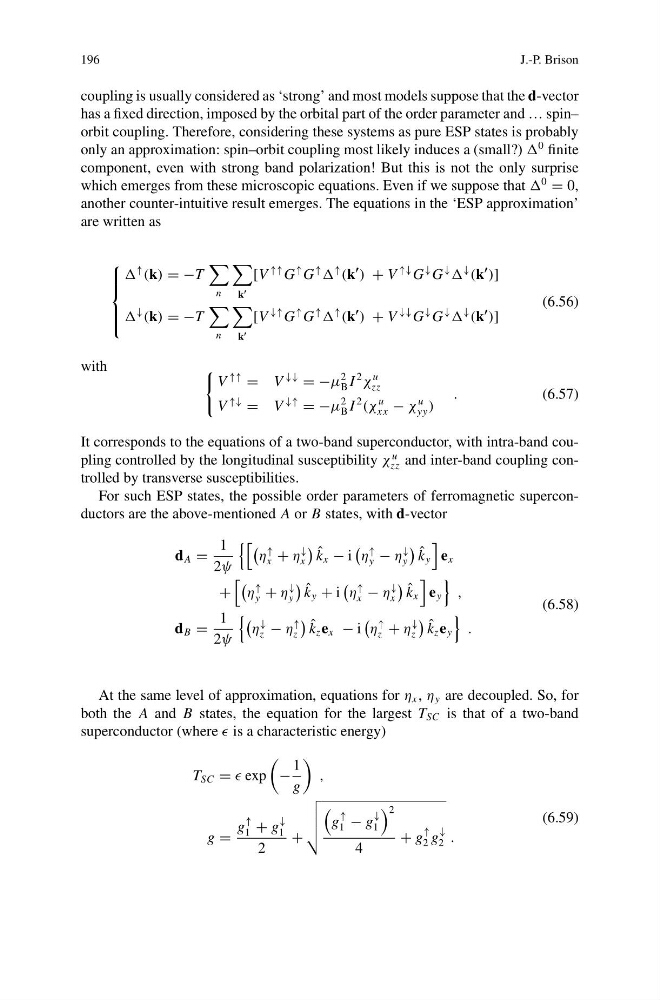
coupling is usually considered as ‘strong’ and most models suppose that the d-vector
has a fixed direction, imposed by the orbital part of the order parameter and … spin–
orbit coupling. Therefore, considering these systems as pure ESP states is probably
only an approximation: spin–orbit coupling most likely induces a (small?)
0 finite
component, even with strong band polarization! But this is not the only surprise
which emerges from these microscopic equations. Even if we suppose that
0
= 0,
another counter-intuitive result emerges. The equations in the ‘ESP approximation’
are written as
⎧
⎪ ⎪ ⎨
⎪ ⎪ ⎩
↑
(k) = −T
n
k
[V
↑↑ G
↑ G
↑
↑
(k
) + V
↑↓ G
↓ G
↓
↓
(k
)]
↓
(k) = −T
n
k
[V
↓↑ G
↑ G
↑
↑
(k
) + V
↓↓ G
↓ G
↓
↓
(k
)]
(6.56)
with
V
↑↑
= V
↓↓
= −μ
2
B I
2
χ
u
zz
V
↑↓
= V
↓↑
= −μ
2
B I
2
(χ
u
xx − χ
u
yy )
.
(6.57)
It corresponds to the equations of a two-band superconductor, with intra-band coupling controlled by the longitudinal susceptibility χ
u
zz and inter-band coupling controlled by transverse susceptibilities.
For such ESP states, the possible order parameters of ferromagnetic superconductors are the above-mentioned A or B states, with d-vector
d A =
1
2ψ
η
↑
x + η
↓
x
ˆ
k x − i
η
↑
y − η
↓
y
ˆ
k y
e x
+
η
↑
y + η
↓
y
ˆ
k y + i
η
↑
x − η
↓
x
ˆ
k x
e y
,
d B =
1
2ψ
η
↓
z − η
↑
z
ˆ
k z e x − i
η
↑
z + η
↓
z
ˆ
k z e y
.
(6.58)
At the same level of approximation, equations for η x , η y are decoupled. So, for
both the A and B states, the equation for the largest T SC is that of a two-band
superconductor (where is a characteristic energy)
T SC = exp
−
1
g
,
g =
g
↑
1 + g
↓
1
2
+
g
↑
1 − g
↓
1
2
4
+ g
↑
2 g
↓
2 .
(6.59)
J.-P. Brison
coupling is usually considered as ‘strong’ and most models suppose that the d-vector
has a fixed direction, imposed by the orbital part of the order parameter and … spin–
orbit coupling. Therefore, considering these systems as pure ESP states is probably
only an approximation: spin–orbit coupling most likely induces a (small?)
0 finite
component, even with strong band polarization! But this is not the only surprise
which emerges from these microscopic equations. Even if we suppose that
0
= 0,
another counter-intuitive result emerges. The equations in the ‘ESP approximation’
are written as
⎧
⎪ ⎪ ⎨
⎪ ⎪ ⎩
↑
(k) = −T
n
k
[V
↑↑ G
↑ G
↑
↑
(k
) + V
↑↓ G
↓ G
↓
↓
(k
)]
↓
(k) = −T
n
k
[V
↓↑ G
↑ G
↑
↑
(k
) + V
↓↓ G
↓ G
↓
↓
(k
)]
(6.56)
with
V
↑↑
= V
↓↓
= −μ
2
B I
2
χ
u
zz
V
↑↓
= V
↓↑
= −μ
2
B I
2
(χ
u
xx − χ
u
yy )
.
(6.57)
It corresponds to the equations of a two-band superconductor, with intra-band coupling controlled by the longitudinal susceptibility χ
u
zz and inter-band coupling controlled by transverse susceptibilities.
For such ESP states, the possible order parameters of ferromagnetic superconductors are the above-mentioned A or B states, with d-vector
d A =
1
2ψ
η
↑
x + η
↓
x
ˆ
k x − i
η
↑
y − η
↓
y
ˆ
k y
e x
+
η
↑
y + η
↓
y
ˆ
k y + i
η
↑
x − η
↓
x
ˆ
k x
e y
,
d B =
1
2ψ
η
↓
z − η
↑
z
ˆ
k z e x − i
η
↑
z + η
↓
z
ˆ
k z e y
.
(6.58)
At the same level of approximation, equations for η x , η y are decoupled. So, for
both the A and B states, the equation for the largest T SC is that of a two-band
superconductor (where is a characteristic energy)
T SC = exp
−
1
g
,
g =
g
↑
1 + g
↓
1
2
+
g
↑
1 − g
↓
1
2
4
+ g
↑
2 g
↓
2 .
(6.59)