

6 p-Wave Superconductivity and d-Vector Representation
191
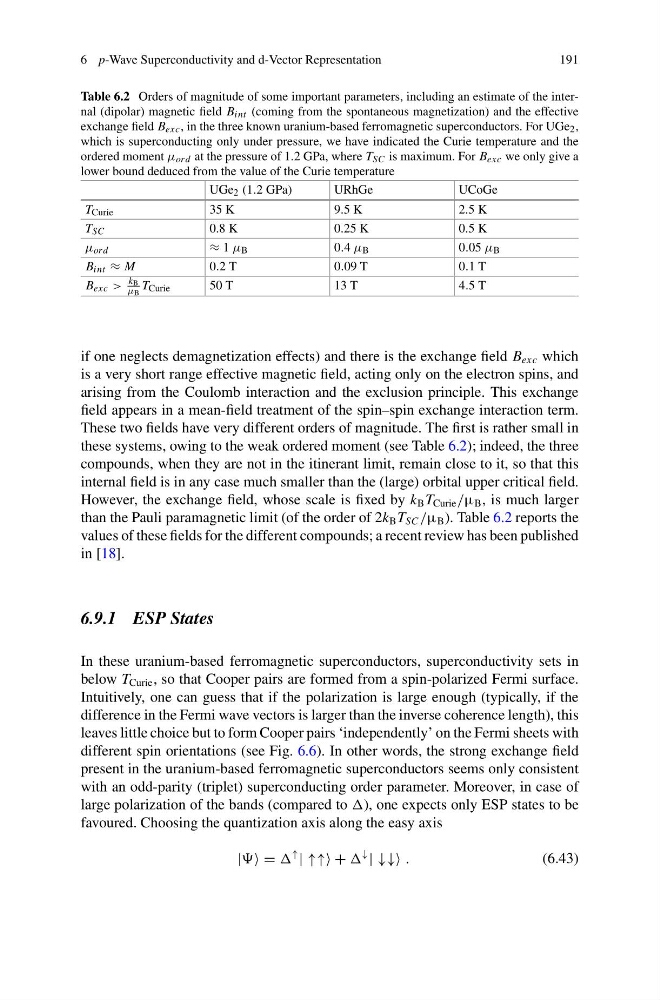
Table 6.2 Orders of magnitude of some important parameters, including an estimate of the internal (dipolar) magnetic field B int (coming from the spontaneous magnetization) and the effective
exchange field B exc , in the three known uranium-based ferromagnetic superconductors. For UGe 2 ,
which is superconducting only under pressure, we have indicated the Curie temperature and the
ordered moment μ or d at the pressure of 1.2 GPa, where T SC is maximum. For B exc we only give a
lower bound deduced from the value of the Curie temperature
UGe 2 (1.2 GPa)
URhGe
UCoGe
T Curie
35 K
9.5 K
2.5 K
T SC
0.8 K
0.25 K
0.5 K
μ or d
≈ 1 μ B
0.4 μ B
0.05 μ B
B int ≈ M
0.2 T
0.09 T
0.1 T
B exc >
kB
μB T Curie
50 T
13 T
4.5 T
if one neglects demagnetization effects) and there is the exchange field B exc which
is a very short range effective magnetic field, acting only on the electron spins, and
arising from the Coulomb interaction and the exclusion principle. This exchange
field appears in a mean-field treatment of the spin–spin exchange interaction term.
These two fields have very different orders of magnitude. The first is rather small in
these systems, owing to the weak ordered moment (see Table 6.2); indeed, the three
compounds, when they are not in the itinerant limit, remain close to it, so that this
internal field is in any case much smaller than the (large) orbital upper critical field.
However, the exchange field, whose scale is fixed by k B T Curie /µ B , is much larger
than the Pauli paramagnetic limit (of the order of 2k B T SC /µ B ). Table 6.2 reports the
values of these fields for the different compounds; a recent review has been published
in [18].
6.9.1 ESP States
In these uranium-based ferromagnetic superconductors, superconductivity sets in
below T Curie , so that Cooper pairs are formed from a spin-polarized Fermi surface.
Intuitively, one can guess that if the polarization is large enough (typically, if the
difference in the Fermi wave vectors is larger than the inverse coherence length), this
leaves little choice but to form Cooper pairs ‘independently’ on the Fermi sheets with
different spin orientations (see Fig. 6.6). In other words, the strong exchange field
present in the uranium-based ferromagnetic superconductors seems only consistent
with an odd-parity (triplet) superconducting order parameter. Moreover, in case of
large polarization of the bands (compared to ), one expects only ESP states to be
favoured. Choosing the quantization axis along the easy axis
| =
↑
| ↑↑↑ +
↓
| ↓↓↓ .
(6.43)
191
Table 6.2 Orders of magnitude of some important parameters, including an estimate of the internal (dipolar) magnetic field B int (coming from the spontaneous magnetization) and the effective
exchange field B exc , in the three known uranium-based ferromagnetic superconductors. For UGe 2 ,
which is superconducting only under pressure, we have indicated the Curie temperature and the
ordered moment μ or d at the pressure of 1.2 GPa, where T SC is maximum. For B exc we only give a
lower bound deduced from the value of the Curie temperature
UGe 2 (1.2 GPa)
URhGe
UCoGe
T Curie
35 K
9.5 K
2.5 K
T SC
0.8 K
0.25 K
0.5 K
μ or d
≈ 1 μ B
0.4 μ B
0.05 μ B
B int ≈ M
0.2 T
0.09 T
0.1 T
B exc >
kB
μB T Curie
50 T
13 T
4.5 T
if one neglects demagnetization effects) and there is the exchange field B exc which
is a very short range effective magnetic field, acting only on the electron spins, and
arising from the Coulomb interaction and the exclusion principle. This exchange
field appears in a mean-field treatment of the spin–spin exchange interaction term.
These two fields have very different orders of magnitude. The first is rather small in
these systems, owing to the weak ordered moment (see Table 6.2); indeed, the three
compounds, when they are not in the itinerant limit, remain close to it, so that this
internal field is in any case much smaller than the (large) orbital upper critical field.
However, the exchange field, whose scale is fixed by k B T Curie /µ B , is much larger
than the Pauli paramagnetic limit (of the order of 2k B T SC /µ B ). Table 6.2 reports the
values of these fields for the different compounds; a recent review has been published
in [18].
6.9.1 ESP States
In these uranium-based ferromagnetic superconductors, superconductivity sets in
below T Curie , so that Cooper pairs are formed from a spin-polarized Fermi surface.
Intuitively, one can guess that if the polarization is large enough (typically, if the
difference in the Fermi wave vectors is larger than the inverse coherence length), this
leaves little choice but to form Cooper pairs ‘independently’ on the Fermi sheets with
different spin orientations (see Fig. 6.6). In other words, the strong exchange field
present in the uranium-based ferromagnetic superconductors seems only consistent
with an odd-parity (triplet) superconducting order parameter. Moreover, in case of
large polarization of the bands (compared to ), one expects only ESP states to be
favoured. Choosing the quantization axis along the easy axis
| =
↑
| ↑↑↑ +
↓
| ↓↓↓ .
(6.43)