

190
J.-P. Brison
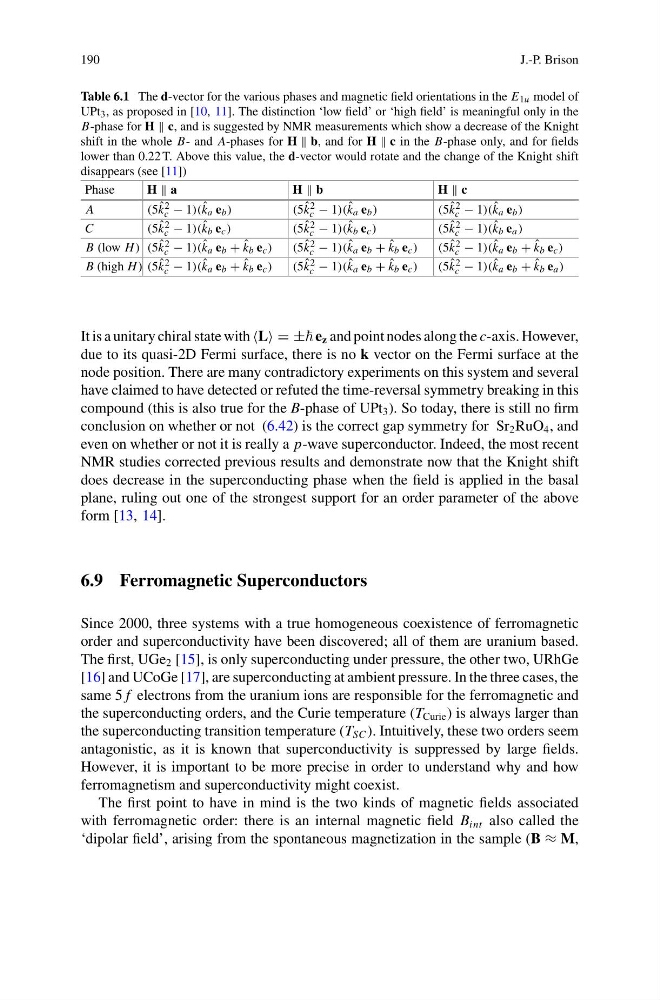
Table 6.1 The d-vector for the various phases and magnetic field orientations in the E 1u model of
UPt 3 , as proposed in [10, 11]. The distinction ‘low field’ or ‘high field’ is meaningful only in the
B-phase for H c, and is suggested by NMR measurements which show a decrease of the Knight
shift in the whole B- and A-phases for H b, and for H c in the B-phase only, and for fields
lower than 0.22 T. Above this value, the d-vector would rotate and the change of the Knight shift
disappears (see [11])
Phase
H a
H b
H c
A
(5 ˆ
k 2
c − 1)( ˆ
k a e b )
(5 ˆ
k 2
c − 1)( ˆ
k a e b )
(5 ˆ
k 2
c − 1)( ˆ
k a e b )
C
(5 ˆ
k 2
c − 1)( ˆ
k b e c )
(5 ˆ
k 2
c − 1)( ˆ
k b e c )
(5 ˆ
k 2
c − 1)( ˆ
k b e a )
B (low H ) (5 ˆ
k 2
c − 1)( ˆ
k a e b + ˆ
k b e c )
(5 ˆ
k 2
c − 1)( ˆ
k a e b + ˆ
k b e c )
(5 ˆ
k 2
c − 1)( ˆ
k a e b + ˆ
k b e c )
B (high H ) (5 ˆ
k 2
c − 1)( ˆ
k a e b + ˆ
k b e c )
(5 ˆ
k 2
c − 1)( ˆ
k a e b + ˆ
k b e c )
(5 ˆ
k 2
c − 1)( ˆ
k a e b + ˆ
k b e a )
It is a unitary chiral state with L = ± e z and point nodes along the c-axis. However,
due to its quasi-2D Fermi surface, there is no k vector on the Fermi surface at the
node position. There are many contradictory experiments on this system and several
have claimed to have detected or refuted the time-reversal symmetry breaking in this
compound (this is also true for the B-phase of UPt 3 ). So today, there is still no firm
conclusion on whether or not (6.42) is the correct gap symmetry for Sr 2 RuO 4 , and
even on whether or not it is really a p-wave superconductor. Indeed, the most recent
NMR studies corrected previous results and demonstrate now that the Knight shift
does decrease in the superconducting phase when the field is applied in the basal
plane, ruling out one of the strongest support for an order parameter of the above
form [13, 14].
6.9 Ferromagnetic Superconductors
Since 2000, three systems with a true homogeneous coexistence of ferromagnetic
order and superconductivity have been discovered; all of them are uranium based.
The first, UGe 2 [15], is only superconducting under pressure, the other two, URhGe
[16] and UCoGe [17], are superconducting at ambient pressure. In the three cases, the
same 5 f electrons from the uranium ions are responsible for the ferromagnetic and
the superconducting orders, and the Curie temperature (T Curie ) is always larger than
the superconducting transition temperature (T SC ). Intuitively, these two orders seem
antagonistic, as it is known that superconductivity is suppressed by large fields.
However, it is important to be more precise in order to understand why and how
ferromagnetism and superconductivity might coexist.
The first point to have in mind is the two kinds of magnetic fields associated
with ferromagnetic order: there is an internal magnetic field B int also called the
‘dipolar field’, arising from the spontaneous magnetization in the sample (B ≈ M,
J.-P. Brison
Table 6.1 The d-vector for the various phases and magnetic field orientations in the E 1u model of
UPt 3 , as proposed in [10, 11]. The distinction ‘low field’ or ‘high field’ is meaningful only in the
B-phase for H c, and is suggested by NMR measurements which show a decrease of the Knight
shift in the whole B- and A-phases for H b, and for H c in the B-phase only, and for fields
lower than 0.22 T. Above this value, the d-vector would rotate and the change of the Knight shift
disappears (see [11])
Phase
H a
H b
H c
A
(5 ˆ
k 2
c − 1)( ˆ
k a e b )
(5 ˆ
k 2
c − 1)( ˆ
k a e b )
(5 ˆ
k 2
c − 1)( ˆ
k a e b )
C
(5 ˆ
k 2
c − 1)( ˆ
k b e c )
(5 ˆ
k 2
c − 1)( ˆ
k b e c )
(5 ˆ
k 2
c − 1)( ˆ
k b e a )
B (low H ) (5 ˆ
k 2
c − 1)( ˆ
k a e b + ˆ
k b e c )
(5 ˆ
k 2
c − 1)( ˆ
k a e b + ˆ
k b e c )
(5 ˆ
k 2
c − 1)( ˆ
k a e b + ˆ
k b e c )
B (high H ) (5 ˆ
k 2
c − 1)( ˆ
k a e b + ˆ
k b e c )
(5 ˆ
k 2
c − 1)( ˆ
k a e b + ˆ
k b e c )
(5 ˆ
k 2
c − 1)( ˆ
k a e b + ˆ
k b e a )
It is a unitary chiral state with L = ± e z and point nodes along the c-axis. However,
due to its quasi-2D Fermi surface, there is no k vector on the Fermi surface at the
node position. There are many contradictory experiments on this system and several
have claimed to have detected or refuted the time-reversal symmetry breaking in this
compound (this is also true for the B-phase of UPt 3 ). So today, there is still no firm
conclusion on whether or not (6.42) is the correct gap symmetry for Sr 2 RuO 4 , and
even on whether or not it is really a p-wave superconductor. Indeed, the most recent
NMR studies corrected previous results and demonstrate now that the Knight shift
does decrease in the superconducting phase when the field is applied in the basal
plane, ruling out one of the strongest support for an order parameter of the above
form [13, 14].
6.9 Ferromagnetic Superconductors
Since 2000, three systems with a true homogeneous coexistence of ferromagnetic
order and superconductivity have been discovered; all of them are uranium based.
The first, UGe 2 [15], is only superconducting under pressure, the other two, URhGe
[16] and UCoGe [17], are superconducting at ambient pressure. In the three cases, the
same 5 f electrons from the uranium ions are responsible for the ferromagnetic and
the superconducting orders, and the Curie temperature (T Curie ) is always larger than
the superconducting transition temperature (T SC ). Intuitively, these two orders seem
antagonistic, as it is known that superconductivity is suppressed by large fields.
However, it is important to be more precise in order to understand why and how
ferromagnetism and superconductivity might coexist.
The first point to have in mind is the two kinds of magnetic fields associated
with ferromagnetic order: there is an internal magnetic field B int also called the
‘dipolar field’, arising from the spontaneous magnetization in the sample (B ≈ M,