

192
J.-P. Brison
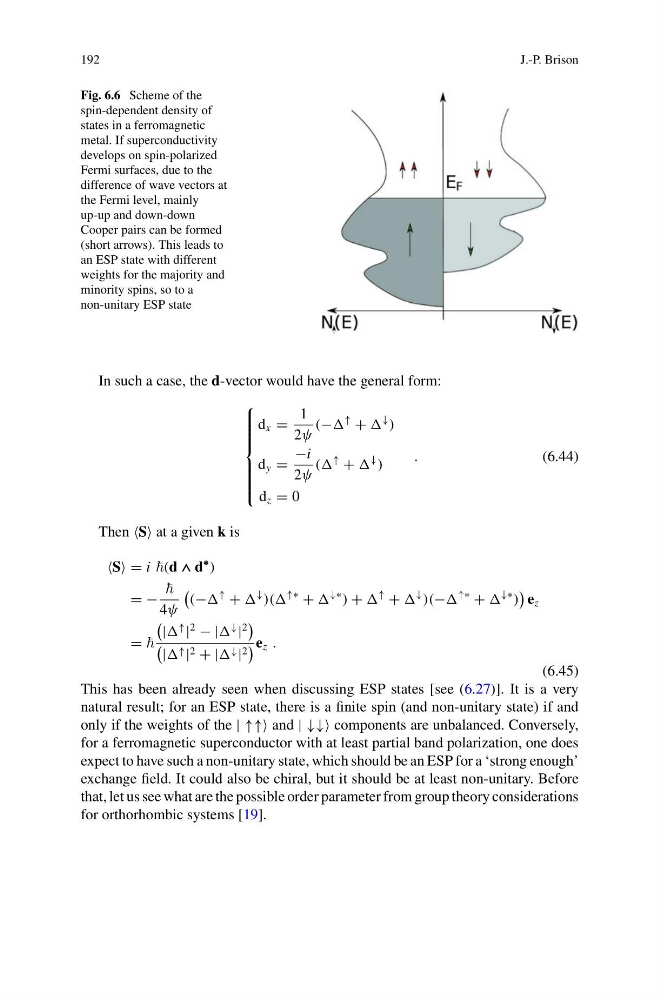
Fig. 6.6 Scheme of the
spin-dependent density of
states in a ferromagnetic
metal. If superconductivity
develops on spin-polarized
Fermi surfaces, due to the
difference of wave vectors at
the Fermi level, mainly
up-up and down-down
Cooper pairs can be formed
(short arrows). This leads to
an ESP state with different
weights for the majority and
minority spins, so to a
non-unitary ESP state
In such a case, the d-vector would have the general form:
⎧
⎪ ⎪ ⎪ ⎪ ⎪ ⎨
⎪ ⎪ ⎪ ⎪ ⎪ ⎩
d x =
1
2ψ
(−
↑
+
↓
)
d y =
−i
2ψ
((
↑
+
↓
)
d z = 0
.
(6.44)
Then S at a given k is
S = i (d ∧ d
∗
)
= −
4ψ
(−
↑
+
↓
)((
↑∗
+
↓∗
) +
↑
+
↓
)(−
↑∗
+
↓∗
)
e z
=
|
↑
|
2
− |
↓
|
2
| ↑ | 2 + | ↓ | 2
e z .
(6.45)
This has been already seen when discussing ESP states [see (6.27)]. It is a very
natural result; for an ESP state, there is a finite spin (and non-unitary state) if and
only if the weights of the | ↑↑↑ and | ↓↓↓ components are unbalanced. Conversely,
for a ferromagnetic superconductor with at least partial band polarization, one does
expect to have such a non-unitary state, which should be an ESP for a ‘strong enough’
exchange field. It could also be chiral, but it should be at least non-unitary. Before
that, let us see what are the possible order parameter from group theory considerations
for orthorhombic systems [19].
J.-P. Brison
Fig. 6.6 Scheme of the
spin-dependent density of
states in a ferromagnetic
metal. If superconductivity
develops on spin-polarized
Fermi surfaces, due to the
difference of wave vectors at
the Fermi level, mainly
up-up and down-down
Cooper pairs can be formed
(short arrows). This leads to
an ESP state with different
weights for the majority and
minority spins, so to a
non-unitary ESP state
In such a case, the d-vector would have the general form:
⎧
⎪ ⎪ ⎪ ⎪ ⎪ ⎨
⎪ ⎪ ⎪ ⎪ ⎪ ⎩
d x =
1
2ψ
(−
↑
+
↓
)
d y =
−i
2ψ
((
↑
+
↓
)
d z = 0
.
(6.44)
Then S at a given k is
S = i (d ∧ d
∗
)
= −
4ψ
(−
↑
+
↓
)((
↑∗
+
↓∗
) +
↑
+
↓
)(−
↑∗
+
↓∗
)
e z
=
|
↑
|
2
− |
↓
|
2
| ↑ | 2 + | ↓ | 2
e z .
(6.45)
This has been already seen when discussing ESP states [see (6.27)]. It is a very
natural result; for an ESP state, there is a finite spin (and non-unitary state) if and
only if the weights of the | ↑↑↑ and | ↓↓↓ components are unbalanced. Conversely,
for a ferromagnetic superconductor with at least partial band polarization, one does
expect to have such a non-unitary state, which should be an ESP for a ‘strong enough’
exchange field. It could also be chiral, but it should be at least non-unitary. Before
that, let us see what are the possible order parameter from group theory considerations
for orthorhombic systems [19].