

184
J.-P. Brison
6.8.1.2 A-Phase
The A-phase of superfluid
3 He is simply characterized by
d(k) =
3
2
( ˆ
k y + i ˆ
k z , 0, 0) ,
| ˆ
k) = −ψ
3
2
( ˆ
k y + i ˆ
k z )(| ↑↑↑ − | ↓↓↓) .
(6.35)
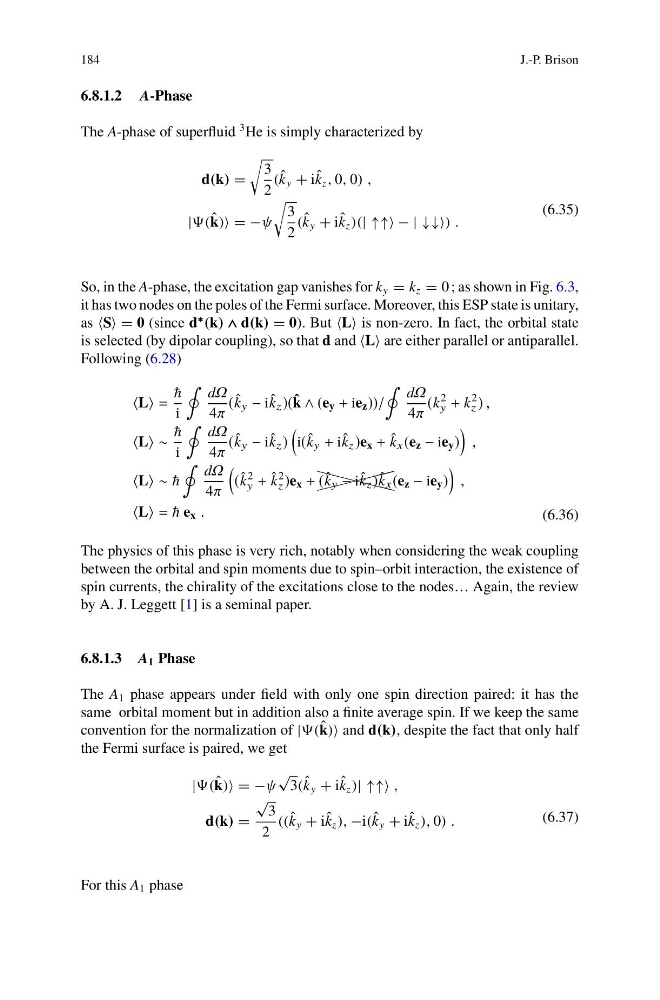
So, in the A-phase, the excitation gap vanishes for k y = k z = 0 ; as shown in Fig. 6.3,
it has two nodes on the poles of the Fermi surface. Moreover, this ESP state is unitary,
as = 0 (since d
∗
(k) ∧ d(k) = 0). But is non-zero. In fact, the orbital state
is selected (by dipolar coupling), so that d and are either parallel or antiparallel.
Following (6.28)
(6.36)
The physics of this phase is very rich, notably when considering the weak coupling
between the orbital and spin moments due to spin–orbit interaction, the existence of
spin currents, the chirality of the excitations close to the nodes… Again, the review
by A. J. Leggett [1] is a seminal paper.
6.8.1.3 A 1 Phase
The A 1 phase appears under field with only one spin direction paired: it has the
same orbital moment but in addition also a finite average spin. If we keep the same
convention for the normalization of | ˆ
k) and d(k), despite the fact that only half
the Fermi surface is paired, we get
| ˆ
k) = −ψ
√
3( ˆ
k y + i ˆ
k z )| ↑↑↑ ,
d(k) =
√
3
2
(( ˆ
k y + i ˆ
k z ), −i( ˆ
k y + i ˆ
k z ), 0) .
(6.37)
For this A 1 phase
J.-P. Brison
6.8.1.2 A-Phase
The A-phase of superfluid
3 He is simply characterized by
d(k) =
3
2
( ˆ
k y + i ˆ
k z , 0, 0) ,
| ˆ
k) = −ψ
3
2
( ˆ
k y + i ˆ
k z )(| ↑↑↑ − | ↓↓↓) .
(6.35)
So, in the A-phase, the excitation gap vanishes for k y = k z = 0 ; as shown in Fig. 6.3,
it has two nodes on the poles of the Fermi surface. Moreover, this ESP state is unitary,
as = 0 (since d
∗
(k) ∧ d(k) = 0). But is non-zero. In fact, the orbital state
is selected (by dipolar coupling), so that d and are either parallel or antiparallel.
Following (6.28)
(6.36)
The physics of this phase is very rich, notably when considering the weak coupling
between the orbital and spin moments due to spin–orbit interaction, the existence of
spin currents, the chirality of the excitations close to the nodes… Again, the review
by A. J. Leggett [1] is a seminal paper.
6.8.1.3 A 1 Phase
The A 1 phase appears under field with only one spin direction paired: it has the
same orbital moment but in addition also a finite average spin. If we keep the same
convention for the normalization of | ˆ
k) and d(k), despite the fact that only half
the Fermi surface is paired, we get
| ˆ
k) = −ψ
√
3( ˆ
k y + i ˆ
k z )| ↑↑↑ ,
d(k) =
√
3
2
(( ˆ
k y + i ˆ
k z ), −i( ˆ
k y + i ˆ
k z ), 0) .
(6.37)
For this A 1 phase