

6 p-Wave Superconductivity and d-Vector Representation
185
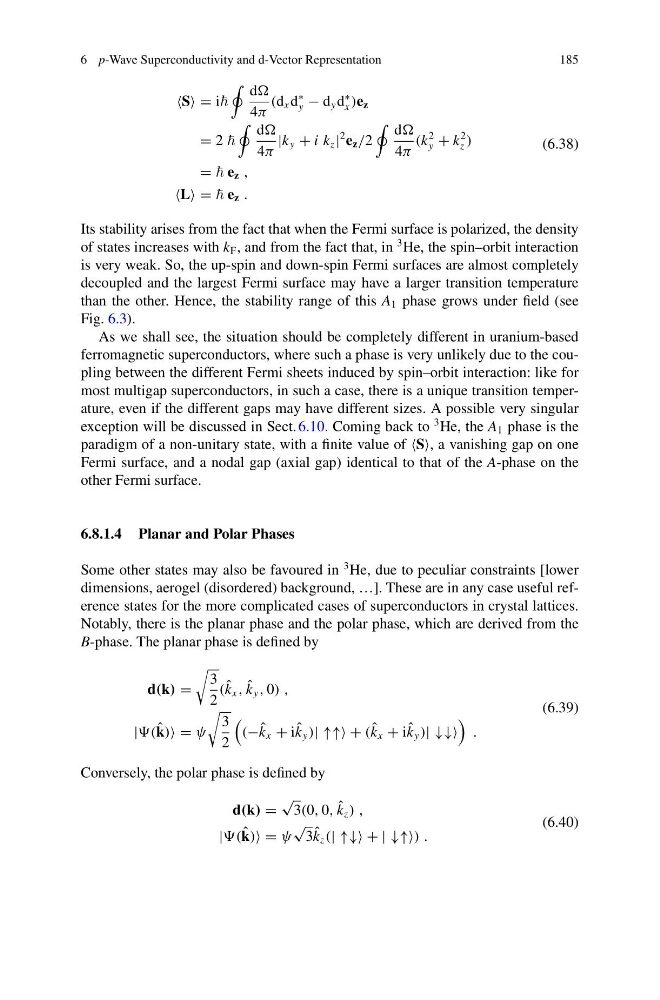
S = i
d
4π
(d x d
∗
y − d y d
∗
x )e z
= 2
d
4π
|k y + i k z |
2 e z /2
d
4π
(k
2
y + k
2
z )
= e z ,
L = e z .
(6.38)
Its stability arises from the fact that when the Fermi surface is polarized, the density
of states increases with k F , and from the fact that, in
3 He, the spin–orbit interaction
is very weak. So, the up-spin and down-spin Fermi surfaces are almost completely
decoupled and the largest Fermi surface may have a larger transition temperature
than the other. Hence, the stability range of this A 1 phase grows under field (see
Fig. 6.3).
As we shall see, the situation should be completely different in uranium-based
ferromagnetic superconductors, where such a phase is very unlikely due to the coupling between the different Fermi sheets induced by spin–orbit interaction: like for
most multigap superconductors, in such a case, there is a unique transition temperature, even if the different gaps may have different sizes. A possible very singular
exception will be discussed in Sect. 6.10. Coming back to
3 He, the A 1 phase is the
paradigm of a non-unitary state, with a finite value of S, a vanishing gap on one
Fermi surface, and a nodal gap (axial gap) identical to that of the A-phase on the
other Fermi surface.
6.8.1.4 Planar and Polar Phases
Some other states may also be favoured in
3 He, due to peculiar constraints [lower
dimensions, aerogel (disordered) background, …]. These are in any case useful reference states for the more complicated cases of superconductors in crystal lattices.
Notably, there is the planar phase and the polar phase, which are derived from the
B-phase. The planar phase is defined by
d(k) =
3
2
( ˆ
k x , ˆ
k y , 0) ,
|( ˆ
k) = ψ
3
2
(− ˆ
k x + i ˆ
k y )| ↑↑↑ + ( ˆ
k x + i ˆ
k y )| ↓↓↓
.
(6.39)
Conversely, the polar phase is defined by
d(k) =
√
3(0, 0, ˆ
k z ) ,
|( ˆ
k) = ψ
√
3 ˆ
k z (| ↑↓↓ + | ↓↑↑) .
(6.40)
185
S = i
d
4π
(d x d
∗
y − d y d
∗
x )e z
= 2
d
4π
|k y + i k z |
2 e z /2
d
4π
(k
2
y + k
2
z )
= e z ,
L = e z .
(6.38)
Its stability arises from the fact that when the Fermi surface is polarized, the density
of states increases with k F , and from the fact that, in
3 He, the spin–orbit interaction
is very weak. So, the up-spin and down-spin Fermi surfaces are almost completely
decoupled and the largest Fermi surface may have a larger transition temperature
than the other. Hence, the stability range of this A 1 phase grows under field (see
Fig. 6.3).
As we shall see, the situation should be completely different in uranium-based
ferromagnetic superconductors, where such a phase is very unlikely due to the coupling between the different Fermi sheets induced by spin–orbit interaction: like for
most multigap superconductors, in such a case, there is a unique transition temperature, even if the different gaps may have different sizes. A possible very singular
exception will be discussed in Sect. 6.10. Coming back to
3 He, the A 1 phase is the
paradigm of a non-unitary state, with a finite value of S, a vanishing gap on one
Fermi surface, and a nodal gap (axial gap) identical to that of the A-phase on the
other Fermi surface.
6.8.1.4 Planar and Polar Phases
Some other states may also be favoured in
3 He, due to peculiar constraints [lower
dimensions, aerogel (disordered) background, …]. These are in any case useful reference states for the more complicated cases of superconductors in crystal lattices.
Notably, there is the planar phase and the polar phase, which are derived from the
B-phase. The planar phase is defined by
d(k) =
3
2
( ˆ
k x , ˆ
k y , 0) ,
|( ˆ
k) = ψ
3
2
(− ˆ
k x + i ˆ
k y )| ↑↑↑ + ( ˆ
k x + i ˆ
k y )| ↓↓↓
.
(6.39)
Conversely, the polar phase is defined by
d(k) =
√
3(0, 0, ˆ
k z ) ,
|( ˆ
k) = ψ
√
3 ˆ
k z (| ↑↓↓ + | ↓↑↑) .
(6.40)