

6 p-Wave Superconductivity and d-Vector Representation
183
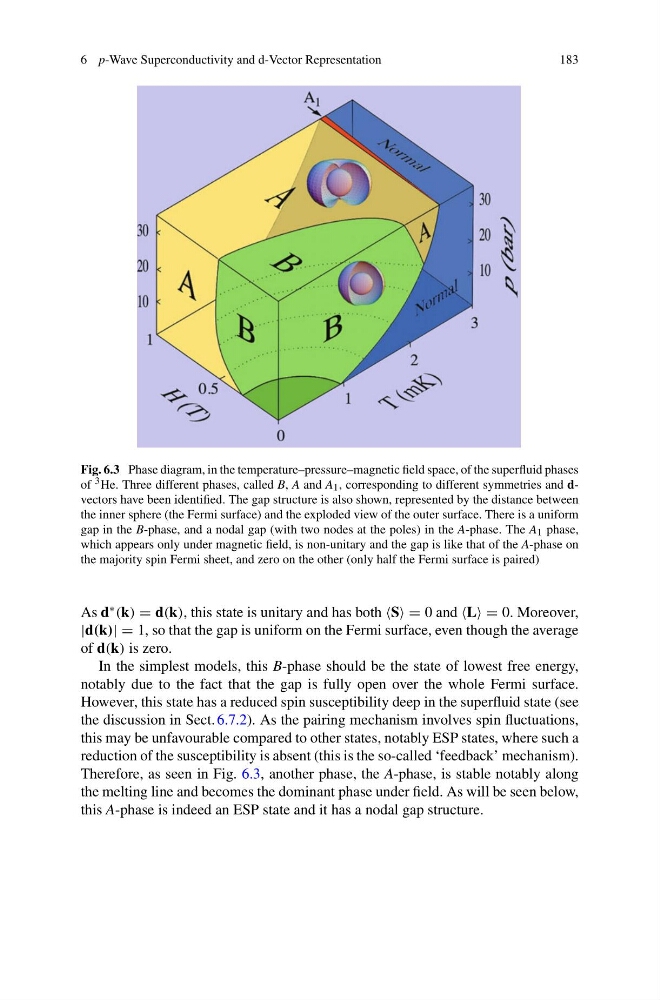
Fig. 6.3 Phase diagram, in the temperature–pressure–magnetic field space, of the superfluid phases
of 3 He. Three different phases, called B, A and A 1 , corresponding to different symmetries and dvectors have been identified. The gap structure is also shown, represented by the distance between
the inner sphere (the Fermi surface) and the exploded view of the outer surface. There is a uniform
gap in the B-phase, and a nodal gap (with two nodes at the poles) in the A-phase. The A 1 phase,
which appears only under magnetic field, is non-unitary and the gap is like that of the A-phase on
the majority spin Fermi sheet, and zero on the other (only half the Fermi surface is paired)
As d
∗
(k) = d(k), this state is unitary and has both S = 0 and L = 0. Moreover,
|d(k)| = 1, so that the gap is uniform on the Fermi surface, even though the average
of d(k) is zero.
In the simplest models, this B-phase should be the state of lowest free energy,
notably due to the fact that the gap is fully open over the whole Fermi surface.
However, this state has a reduced spin susceptibility deep in the superfluid state (see
the discussion in Sect. 6.7.2). As the pairing mechanism involves spin fluctuations,
this may be unfavourable compared to other states, notably ESP states, where such a
reduction of the susceptibility is absent (this is the so-called ‘feedback’ mechanism).
Therefore, as seen in Fig. 6.3, another phase, the A-phase, is stable notably along
the melting line and becomes the dominant phase under field. As will be seen below,
this A-phase is indeed an ESP state and it has a nodal gap structure.
183
Fig. 6.3 Phase diagram, in the temperature–pressure–magnetic field space, of the superfluid phases
of 3 He. Three different phases, called B, A and A 1 , corresponding to different symmetries and dvectors have been identified. The gap structure is also shown, represented by the distance between
the inner sphere (the Fermi surface) and the exploded view of the outer surface. There is a uniform
gap in the B-phase, and a nodal gap (with two nodes at the poles) in the A-phase. The A 1 phase,
which appears only under magnetic field, is non-unitary and the gap is like that of the A-phase on
the majority spin Fermi sheet, and zero on the other (only half the Fermi surface is paired)
As d
∗
(k) = d(k), this state is unitary and has both S = 0 and L = 0. Moreover,
|d(k)| = 1, so that the gap is uniform on the Fermi surface, even though the average
of d(k) is zero.
In the simplest models, this B-phase should be the state of lowest free energy,
notably due to the fact that the gap is fully open over the whole Fermi surface.
However, this state has a reduced spin susceptibility deep in the superfluid state (see
the discussion in Sect. 6.7.2). As the pairing mechanism involves spin fluctuations,
this may be unfavourable compared to other states, notably ESP states, where such a
reduction of the susceptibility is absent (this is the so-called ‘feedback’ mechanism).
Therefore, as seen in Fig. 6.3, another phase, the A-phase, is stable notably along
the melting line and becomes the dominant phase under field. As will be seen below,
this A-phase is indeed an ESP state and it has a nodal gap structure.