

178
J.-P. Brison
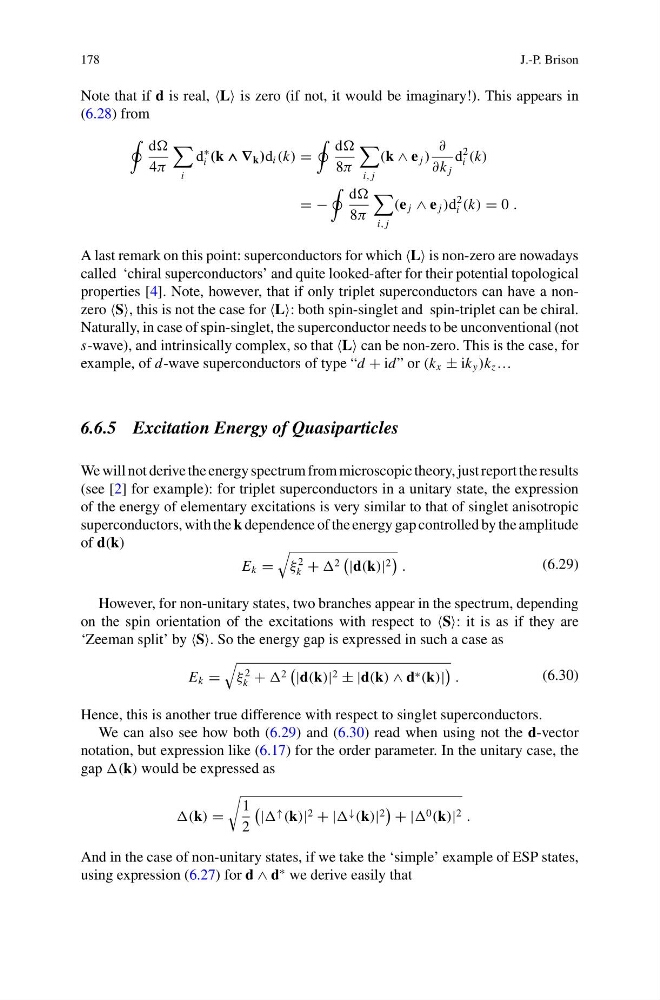
Note that if d is real, L is zero (if not, it would be imaginary!). This appears in
(6.28) from
d
4π
i
d
∗
i (k ∧ ∇ k )d i (k) =
d
8π
i, j
(k ∧ e j )
∂
∂k j
d
2
i (k)
= −
d
8π
i, j
(e j ∧ e j )d
2
i (k) = 0 .
A last remark on this point: superconductors for which L is non-zero are nowadays
called ‘chiral superconductors’ and quite looked-after for their potential topological
properties [4]. Note, however, that if only triplet superconductors can have a nonzero S, this is not the case for L: both spin-singlet and spin-triplet can be chiral.
Naturally, in case of spin-singlet, the superconductor needs to be unconventional (not
s-wave), and intrinsically complex, so that L can be non-zero. This is the case, for
example, of d-wave superconductors of type “d + id” or (k x ± ik y )k z …
6.6.5 Excitation Energy of Quasiparticles
We will not derive the energy spectrum from microscopic theory, just report the results
(see [2] for example): for triplet superconductors in a unitary state, the expression
of the energy of elementary excitations is very similar to that of singlet anisotropic
superconductors, with the k dependence of the energy gap controlled by the amplitude
of d(k)
E k =
ξ
2
k + 2
|d(k)| 2
.
(6.29)
However, for non-unitary states, two branches appear in the spectrum, depending
on the spin orientation of the excitations with respect to S: it is as if they are
‘Zeeman split’ by S. So the energy gap is expressed in such a case as
E k =
ξ
2
k + 2
|d(k)| 2 ± |d(k) ∧ d ∗ (k)|
.
(6.30)
Hence, this is another true difference with respect to singlet superconductors.
We can also see how both (6.29) and (6.30) read when using not the d-vector
notation, but expression like (6.17) for the order parameter. In the unitary case, the
gap (k) would be expressed as
(k) =
1
2
| ↑ (k)| 2 + | ↓ (k)| 2
+ | 0 (k)| 2 .
And in the case of non-unitary states, if we take the ‘simple’ example of ESP states,
using expression (6.27) for d ∧ d
∗ we derive easily that
J.-P. Brison
Note that if d is real, L is zero (if not, it would be imaginary!). This appears in
(6.28) from
d
4π
i
d
∗
i (k ∧ ∇ k )d i (k) =
d
8π
i, j
(k ∧ e j )
∂
∂k j
d
2
i (k)
= −
d
8π
i, j
(e j ∧ e j )d
2
i (k) = 0 .
A last remark on this point: superconductors for which L is non-zero are nowadays
called ‘chiral superconductors’ and quite looked-after for their potential topological
properties [4]. Note, however, that if only triplet superconductors can have a nonzero S, this is not the case for L: both spin-singlet and spin-triplet can be chiral.
Naturally, in case of spin-singlet, the superconductor needs to be unconventional (not
s-wave), and intrinsically complex, so that L can be non-zero. This is the case, for
example, of d-wave superconductors of type “d + id” or (k x ± ik y )k z …
6.6.5 Excitation Energy of Quasiparticles
We will not derive the energy spectrum from microscopic theory, just report the results
(see [2] for example): for triplet superconductors in a unitary state, the expression
of the energy of elementary excitations is very similar to that of singlet anisotropic
superconductors, with the k dependence of the energy gap controlled by the amplitude
of d(k)
E k =
ξ
2
k + 2
|d(k)| 2
.
(6.29)
However, for non-unitary states, two branches appear in the spectrum, depending
on the spin orientation of the excitations with respect to S: it is as if they are
‘Zeeman split’ by S. So the energy gap is expressed in such a case as
E k =
ξ
2
k + 2
|d(k)| 2 ± |d(k) ∧ d ∗ (k)|
.
(6.30)
Hence, this is another true difference with respect to singlet superconductors.
We can also see how both (6.29) and (6.30) read when using not the d-vector
notation, but expression like (6.17) for the order parameter. In the unitary case, the
gap (k) would be expressed as
(k) =
1
2
| ↑ (k)| 2 + | ↓ (k)| 2
+ | 0 (k)| 2 .
And in the case of non-unitary states, if we take the ‘simple’ example of ESP states,
using expression (6.27) for d ∧ d
∗ we derive easily that