

6 p-Wave Superconductivity and d-Vector Representation
179
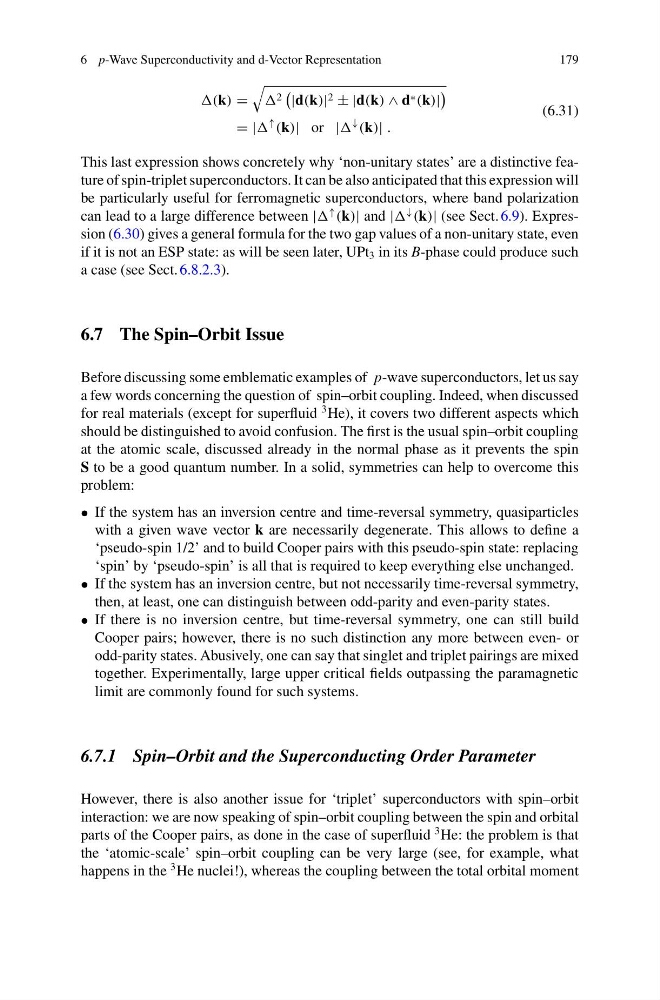
(k) =
2
|d(k)| 2 ± |d(k) ∧ d ∗ (k)|
= |
↑
(k)| or |
↓
(k)| .
(6.31)
This last expression shows concretely why ‘non-unitary states’ are a distinctive feature of spin-triplet superconductors. It can be also anticipated that this expression will
be particularly useful for ferromagnetic superconductors, where band polarization
can lead to a large difference between |
↑
(k)| and |
↓
(k)| (see Sect. 6.9). Expression (6.30) gives a general formula for the two gap values of a non-unitary state, even
if it is not an ESP state: as will be seen later, UPt 3 in its B-phase could produce such
a case (see Sect. 6.8.2.3).
6.7 The Spin–Orbit Issue
Before discussing some emblematic examples of p-wave superconductors, let us say
a few words concerning the question of spin–orbit coupling. Indeed, when discussed
for real materials (except for superfluid
3 He), it covers two different aspects which
should be distinguished to avoid confusion. The first is the usual spin–orbit coupling
at the atomic scale, discussed already in the normal phase as it prevents the spin
S to be a good quantum number. In a solid, symmetries can help to overcome this
problem:
• If the system has an inversion centre and time-reversal symmetry, quasiparticles
with a given wave vector k are necessarily degenerate. This allows to define a
‘pseudo-spin 1/2’ and to build Cooper pairs with this pseudo-spin state: replacing
‘spin’ by ‘pseudo-spin’ is all that is required to keep everything else unchanged.
• If the system has an inversion centre, but not necessarily time-reversal symmetry,
then, at least, one can distinguish between odd-parity and even-parity states.
• If there is no inversion centre, but time-reversal symmetry, one can still build
Cooper pairs; however, there is no such distinction any more between even- or
odd-parity states. Abusively, one can say that singlet and triplet pairings are mixed
together. Experimentally, large upper critical fields outpassing the paramagnetic
limit are commonly found for such systems.
6.7.1 Spin–Orbit and the Superconducting Order Parameter
However, there is also another issue for ‘triplet’ superconductors with spin–orbit
interaction: we are now speaking of spin–orbit coupling between the spin and orbital
parts of the Cooper pairs, as done in the case of superfluid
3 He: the problem is that
the ‘atomic-scale’ spin–orbit coupling can be very large (see, for example, what
happens in the
3 He nuclei!), whereas the coupling between the total orbital moment
179
(k) =
2
|d(k)| 2 ± |d(k) ∧ d ∗ (k)|
= |
↑
(k)| or |
↓
(k)| .
(6.31)
This last expression shows concretely why ‘non-unitary states’ are a distinctive feature of spin-triplet superconductors. It can be also anticipated that this expression will
be particularly useful for ferromagnetic superconductors, where band polarization
can lead to a large difference between |
↑
(k)| and |
↓
(k)| (see Sect. 6.9). Expression (6.30) gives a general formula for the two gap values of a non-unitary state, even
if it is not an ESP state: as will be seen later, UPt 3 in its B-phase could produce such
a case (see Sect. 6.8.2.3).
6.7 The Spin–Orbit Issue
Before discussing some emblematic examples of p-wave superconductors, let us say
a few words concerning the question of spin–orbit coupling. Indeed, when discussed
for real materials (except for superfluid
3 He), it covers two different aspects which
should be distinguished to avoid confusion. The first is the usual spin–orbit coupling
at the atomic scale, discussed already in the normal phase as it prevents the spin
S to be a good quantum number. In a solid, symmetries can help to overcome this
problem:
• If the system has an inversion centre and time-reversal symmetry, quasiparticles
with a given wave vector k are necessarily degenerate. This allows to define a
‘pseudo-spin 1/2’ and to build Cooper pairs with this pseudo-spin state: replacing
‘spin’ by ‘pseudo-spin’ is all that is required to keep everything else unchanged.
• If the system has an inversion centre, but not necessarily time-reversal symmetry,
then, at least, one can distinguish between odd-parity and even-parity states.
• If there is no inversion centre, but time-reversal symmetry, one can still build
Cooper pairs; however, there is no such distinction any more between even- or
odd-parity states. Abusively, one can say that singlet and triplet pairings are mixed
together. Experimentally, large upper critical fields outpassing the paramagnetic
limit are commonly found for such systems.
6.7.1 Spin–Orbit and the Superconducting Order Parameter
However, there is also another issue for ‘triplet’ superconductors with spin–orbit
interaction: we are now speaking of spin–orbit coupling between the spin and orbital
parts of the Cooper pairs, as done in the case of superfluid
3 He: the problem is that
the ‘atomic-scale’ spin–orbit coupling can be very large (see, for example, what
happens in the
3 He nuclei!), whereas the coupling between the total orbital moment