

6 p-Wave Superconductivity and d-Vector Representation
177
polarized, it is necessarily in a non-unitary state, where d
∗ is not proportional to d,
see Sect. 6.9 on ferromagnetic superconductors.
This notion of ‘non-unitary’ state is usually bewildering, and it is useful to make
some simple calculations in order to get more used to it. For example, we can check
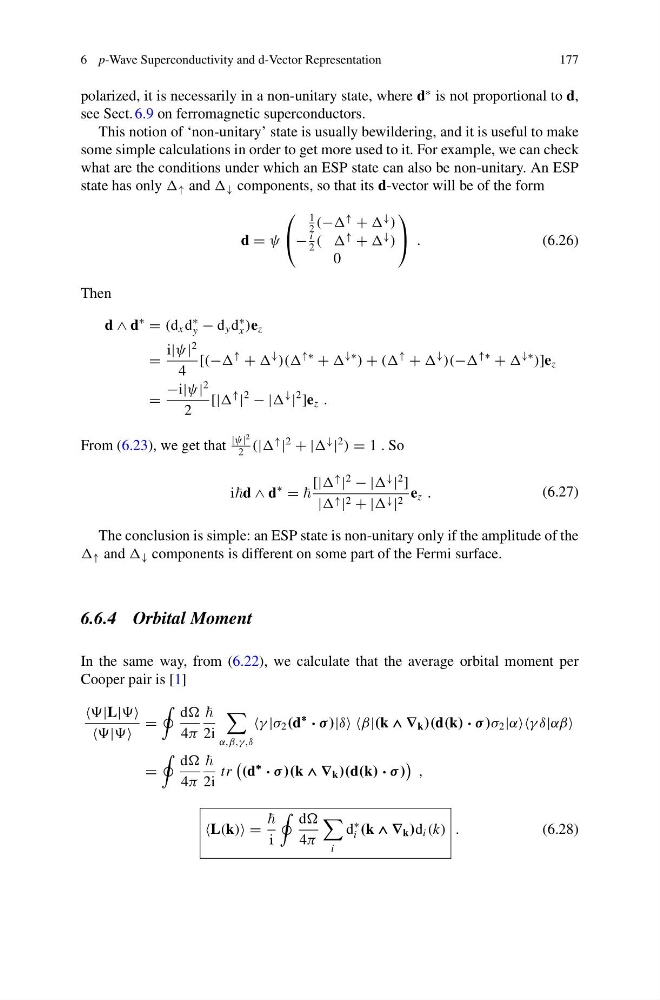
what are the conditions under which an ESP state can also be non-unitary. An ESP
state has only ↑ and ↓ components, so that its d-vector will be of the form
d = ψ
⎛
⎝
1
2
(−
↑
+
↓
)
−
i
2
( (
↑
+
↓
)
0
⎞
⎠ .
(6.26)
Then
d ∧ d
∗
= (d x d
∗
y − d y d
∗
x )e z
=
i|ψ|
2
4
[(−
↑
+
↓
)((
↑∗
+
↓∗
) + ((
↑
+
↓
)(−
↑∗
+
↓∗
)]e z
=
−i|ψ|
2
2
[|
↑
|
2
− |
↓
|
2
]e z .
From (6.23), we get that
|ψ|
2
2
(|
↑
|
2
+ |
↓
|
2
) = 1 . So
id ∧ d
∗
=
[|
↑
|
2
− |
↓
|
2
]
| ↑ | 2 + | ↓ | 2 e z .
(6.27)
The conclusion is simple: an ESP state is non-unitary only if the amplitude of the
↑ and ↓ components is different on some part of the Fermi surface.
6.6.4 Orbital Moment
In the same way, from (6.22), we calculate that the average orbital moment per
Cooper pair is [1]
|L|
|
=
d
4π
2i
α,β,γ ,δ
γ |σ 2 (d
∗
· σ )|δ β|(k ∧ ∇ k )(d(k) · σ )σ 2 |αγ δ|αβ
=
d
4π
2i
tr
(d
∗
· σ )(k ∧ ∇ k )(d(k) · σ )
,
L(k) =
i
d
4π
i
d
∗
i (k ∧ ∇ k )d i (k) .
(6.28)
177
polarized, it is necessarily in a non-unitary state, where d
∗ is not proportional to d,
see Sect. 6.9 on ferromagnetic superconductors.
This notion of ‘non-unitary’ state is usually bewildering, and it is useful to make
some simple calculations in order to get more used to it. For example, we can check
what are the conditions under which an ESP state can also be non-unitary. An ESP
state has only ↑ and ↓ components, so that its d-vector will be of the form
d = ψ
⎛
⎝
1
2
(−
↑
+
↓
)
−
i
2
( (
↑
+
↓
)
0
⎞
⎠ .
(6.26)
Then
d ∧ d
∗
= (d x d
∗
y − d y d
∗
x )e z
=
i|ψ|
2
4
[(−
↑
+
↓
)((
↑∗
+
↓∗
) + ((
↑
+
↓
)(−
↑∗
+
↓∗
)]e z
=
−i|ψ|
2
2
[|
↑
|
2
− |
↓
|
2
]e z .
From (6.23), we get that
|ψ|
2
2
(|
↑
|
2
+ |
↓
|
2
) = 1 . So
id ∧ d
∗
=
[|
↑
|
2
− |
↓
|
2
]
| ↑ | 2 + | ↓ | 2 e z .
(6.27)
The conclusion is simple: an ESP state is non-unitary only if the amplitude of the
↑ and ↓ components is different on some part of the Fermi surface.
6.6.4 Orbital Moment
In the same way, from (6.22), we calculate that the average orbital moment per
Cooper pair is [1]
|L|
|
=
d
4π
2i
α,β,γ ,δ
γ |σ 2 (d
∗
· σ )|δ β|(k ∧ ∇ k )(d(k) · σ )σ 2 |αγ δ|αβ
=
d
4π
2i
tr
(d
∗
· σ )(k ∧ ∇ k )(d(k) · σ )
,
L(k) =
i
d
4π
i
d
∗
i (k ∧ ∇ k )d i (k) .
(6.28)