

176
J.-P. Brison
6.6.2 Spin Direction
Up to now, we discussed the properties of the d-vector under rotation but we did not
unveil the signification of its direction. As announced, it cannot be straightforward,
as in the general case, d is a complex vector. But it should be related to the spin. So
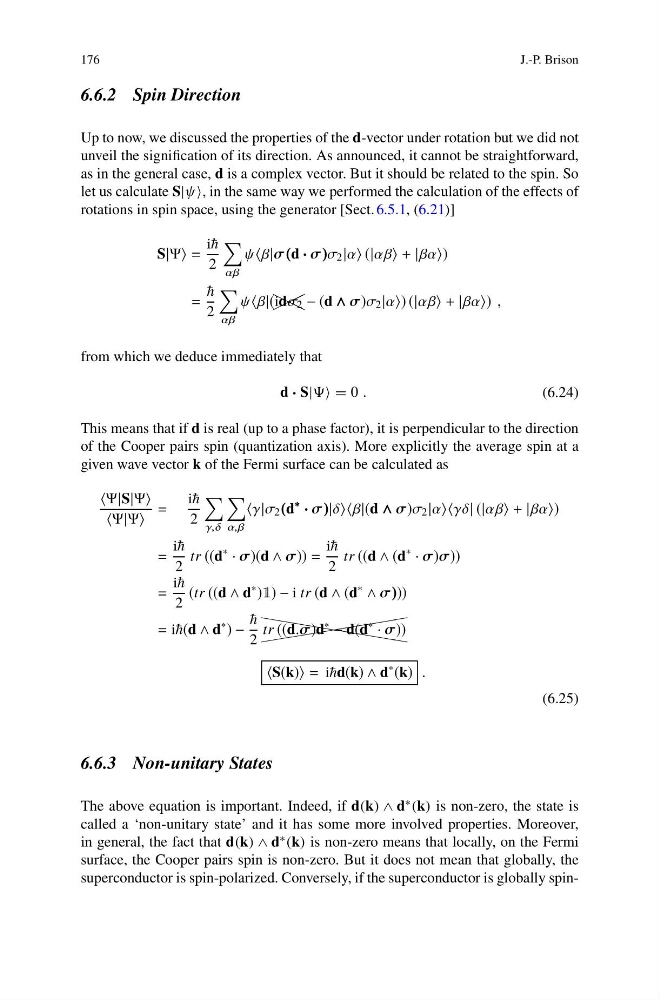
let us calculate S|ψ, in the same way we performed the calculation of the effects of
rotations in spin space, using the generator [Sect. 6.5.1, (6.21)]
from which we deduce immediately that
d · S| = 0 .
(6.24)
This means that if d is real (up to a phase factor), it is perpendicular to the direction
of the Cooper pairs spin (quantization axis). More explicitly the average spin at a
given wave vector k of the Fermi surface can be calculated as
(6.25)
6.6.3 Non-unitary States
The above equation is important. Indeed, if d(k) ∧ d
∗
(k) is non-zero, the state is
called a ‘non-unitary state’ and it has some more involved properties. Moreover,
in general, the fact that d(k) ∧ d
∗
(k) is non-zero means that locally, on the Fermi
surface, the Cooper pairs spin is non-zero. But it does not mean that globally, the
superconductor is spin-polarized. Conversely, if the superconductor is globally spin-
J.-P. Brison
6.6.2 Spin Direction
Up to now, we discussed the properties of the d-vector under rotation but we did not
unveil the signification of its direction. As announced, it cannot be straightforward,
as in the general case, d is a complex vector. But it should be related to the spin. So
let us calculate S|ψ, in the same way we performed the calculation of the effects of
rotations in spin space, using the generator [Sect. 6.5.1, (6.21)]
from which we deduce immediately that
d · S| = 0 .
(6.24)
This means that if d is real (up to a phase factor), it is perpendicular to the direction
of the Cooper pairs spin (quantization axis). More explicitly the average spin at a
given wave vector k of the Fermi surface can be calculated as
(6.25)
6.6.3 Non-unitary States
The above equation is important. Indeed, if d(k) ∧ d
∗
(k) is non-zero, the state is
called a ‘non-unitary state’ and it has some more involved properties. Moreover,
in general, the fact that d(k) ∧ d
∗
(k) is non-zero means that locally, on the Fermi
surface, the Cooper pairs spin is non-zero. But it does not mean that globally, the
superconductor is spin-polarized. Conversely, if the superconductor is globally spin-