

6 p-Wave Superconductivity and d-Vector Representation
173
R | = | (R(d)) .
So indeed, the effect of a change of the spin quantization axis on the order parameter
can be evaluated directly by the corresponding rotation of the (complex) d-vector
in 3D. And the calculation above makes a direct connection between the Cayley–
Klein transformation and the rather involved definition of the d-vector.
It is also useful (and simple) to evaluate the effect of a rotation using the generator
of rotations in spin space: this generator is simply −
i
ˆ
n·S, where the total spin
S = S 1 ⊗ 1 + 1 ⊗ S 2 .
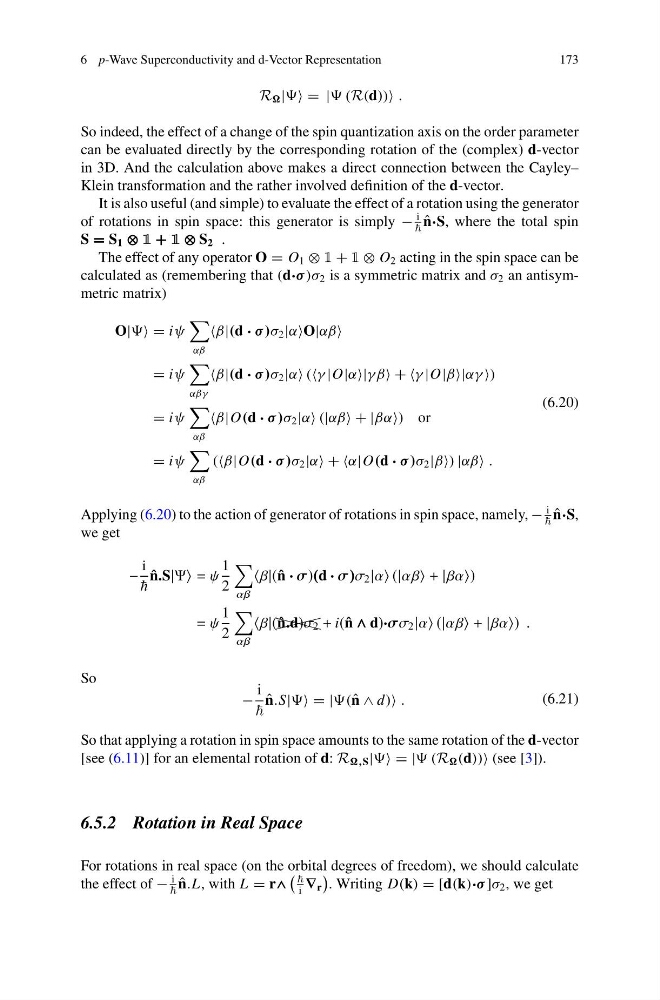
The effect of any operator O = O 1 ⊗ 1 + 1 ⊗ O 2 acting in the spin space can be
calculated as (remembering that (d·σ )σ 2 is a symmetric matrix and σ 2 an antisymmetric matrix)
O| = iψ
αβ
· σ )σ 2 |α
= iψ
αβγ
· σ )σ 2 |α ( |O|α|γβ + +γ |O|β|αγ )
= iψ
αβ
· σ )σ 2 |α (|αβ + |βα) or
= iψ
αβ
( · σ )σ 2 |α + +α|O(d · σ )σ 2 |β) |αβ .
(6.20)
Applying (6.20) to the action of generator of rotations in spin space, namely, −
i
ˆ
n·S,
we get
So
−
i
ˆ
n.S| = | ˆ
n ∧ d) .
(6.21)
So that applying a rotation in spin space amounts to the same rotation of the d-vector
[see (6.11)] for an elemental rotation of d: R | = | (R (d)) (see [3]).
6.5.2 Rotation in Real Space
For rotations in real space (on the orbital degrees of freedom), we should calculate
the effect of −
i
ˆ
n.L, with L = r∧
i
∇ r
. Writing D(k) = [d(k)·σ ]σ 2 , we get
173
R | = | (R(d)) .
So indeed, the effect of a change of the spin quantization axis on the order parameter
can be evaluated directly by the corresponding rotation of the (complex) d-vector
in 3D. And the calculation above makes a direct connection between the Cayley–
Klein transformation and the rather involved definition of the d-vector.
It is also useful (and simple) to evaluate the effect of a rotation using the generator
of rotations in spin space: this generator is simply −
i
ˆ
n·S, where the total spin
S = S 1 ⊗ 1 + 1 ⊗ S 2 .
The effect of any operator O = O 1 ⊗ 1 + 1 ⊗ O 2 acting in the spin space can be
calculated as (remembering that (d·σ )σ 2 is a symmetric matrix and σ 2 an antisymmetric matrix)
O| = iψ
αβ
· σ )σ 2 |α
= iψ
αβγ
· σ )σ 2 |α ( |O|α|γβ + +γ |O|β|αγ )
= iψ
αβ
· σ )σ 2 |α (|αβ + |βα) or
= iψ
αβ
( · σ )σ 2 |α + +α|O(d · σ )σ 2 |β) |αβ .
(6.20)
Applying (6.20) to the action of generator of rotations in spin space, namely, −
i
ˆ
n·S,
we get
So
−
i
ˆ
n.S| = | ˆ
n ∧ d) .
(6.21)
So that applying a rotation in spin space amounts to the same rotation of the d-vector
[see (6.11)] for an elemental rotation of d: R | = | (R (d)) (see [3]).
6.5.2 Rotation in Real Space
For rotations in real space (on the orbital degrees of freedom), we should calculate
the effect of −
i
ˆ
n.L, with L = r∧
i
∇ r
. Writing D(k) = [d(k)·σ ]σ 2 , we get