

174
J.-P. Brison
−
i
L| = − (r ∧ ∇ r )
dk e
−ik·r
ψ
αβ
β|D(k)|α|αβ
= ψ
αβ
dk i(r ∧ k)e
−ik.r
β|D(k)|α|αβ
= ψ
αβ
dk β|D(k)|α(k ∧ ∇ k )e
−ik.r
|αβ
= −ψ
αβ,i
dk
∂
∂k i
(β|D(k)|αk) ∧ ˆ
k i e
−ik.r
|αβ
= −ψ
αβ
dk e
−ik.r
β|(k ∧ ∇)D(k)|α|αβ ,
so
−
i
ˆ
n.L| = |(−i ˆ
n·L k d(k)), with L k = k ∧
1
i
∇ k .
(6.22)
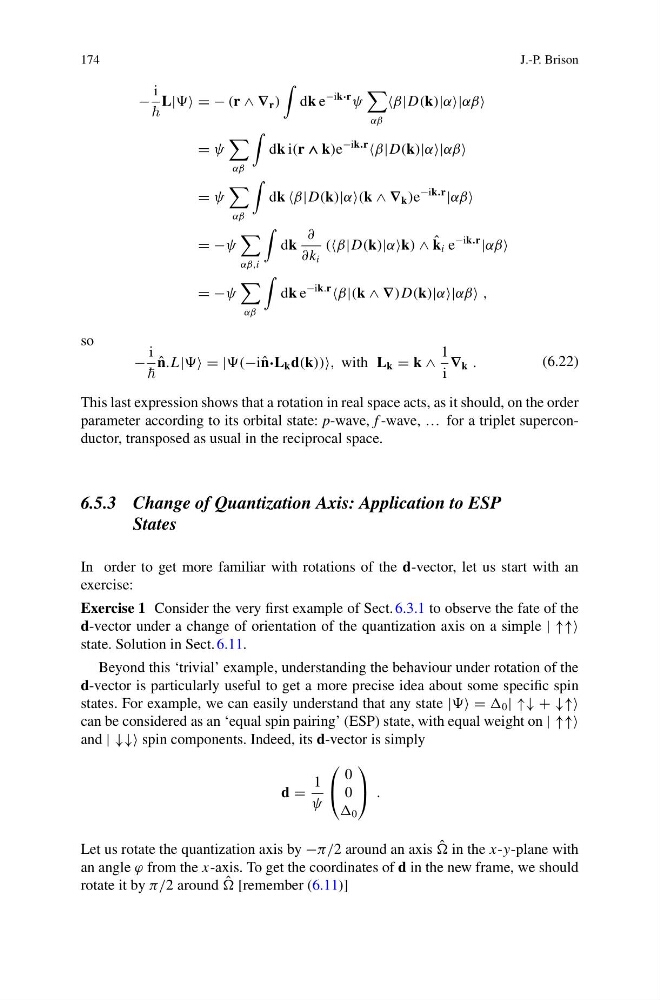
This last expression shows that a rotation in real space acts, as it should, on the order
parameter according to its orbital state: p-wave, f -wave, … for a triplet superconductor, transposed as usual in the reciprocal space.
6.5.3 Change of Quantization Axis: Application to ESP
States
In order to get more familiar with rotations of the d-vector, let us start with an
exercise:
Exercise 1 Consider the very first example of Sect. 6.3.1 to observe the fate of the
d-vector under a change of orientation of the quantization axis on a simple | ↑↑↑
state. Solution in Sect. 6.11.
Beyond this ‘trivial’ example, understanding the behaviour under rotation of the
d-vector is particularly useful to get a more precise idea about some specific spin
states. For example, we can easily understand that any state | = 0 | ↑↓ + ↓↑↑
can be considered as an ‘equal spin pairing’ (ESP) state, with equal weight on | ↑↑↑
and | ↓↓↓ spin components. Indeed, its d-vector is simply
d =
1
ψ
⎛
⎝
0
0
0
⎞
⎠ .
Let us rotate the quantization axis by −π/2 around an axis ˆ
in the x-y-plane with
an angle ϕ from the x-axis. To get the coordinates of d in the new frame, we should
rotate it by π/2 around ˆ
[remember (6.11)]
J.-P. Brison
−
i
L| = − (r ∧ ∇ r )
dk e
−ik·r
ψ
αβ
β|D(k)|α|αβ
= ψ
αβ
dk i(r ∧ k)e
−ik.r
β|D(k)|α|αβ
= ψ
αβ
dk β|D(k)|α(k ∧ ∇ k )e
−ik.r
|αβ
= −ψ
αβ,i
dk
∂
∂k i
(β|D(k)|αk) ∧ ˆ
k i e
−ik.r
|αβ
= −ψ
αβ
dk e
−ik.r
β|(k ∧ ∇)D(k)|α|αβ ,
so
−
i
ˆ
n.L| = |(−i ˆ
n·L k d(k)), with L k = k ∧
1
i
∇ k .
(6.22)
This last expression shows that a rotation in real space acts, as it should, on the order
parameter according to its orbital state: p-wave, f -wave, … for a triplet superconductor, transposed as usual in the reciprocal space.
6.5.3 Change of Quantization Axis: Application to ESP
States
In order to get more familiar with rotations of the d-vector, let us start with an
exercise:
Exercise 1 Consider the very first example of Sect. 6.3.1 to observe the fate of the
d-vector under a change of orientation of the quantization axis on a simple | ↑↑↑
state. Solution in Sect. 6.11.
Beyond this ‘trivial’ example, understanding the behaviour under rotation of the
d-vector is particularly useful to get a more precise idea about some specific spin
states. For example, we can easily understand that any state | = 0 | ↑↓ + ↓↑↑
can be considered as an ‘equal spin pairing’ (ESP) state, with equal weight on | ↑↑↑
and | ↓↓↓ spin components. Indeed, its d-vector is simply
d =
1
ψ
⎛
⎝
0
0
0
⎞
⎠ .
Let us rotate the quantization axis by −π/2 around an axis ˆ
in the x-y-plane with
an angle ϕ from the x-axis. To get the coordinates of d in the new frame, we should
rotate it by π/2 around ˆ
[remember (6.11)]