

172
J.-P. Brison
6.5 Behaviour under Rotations
6.5.1 Rotation in Spin Space
For d to be a true vector, it should behave appropriately under rotation. d is representing an order parameter which has both orbital and spin degrees of freedom,
but the specificity of odd-parity pairing, leading to the necessity of such a vector
representation, is coming from the spin degree of freedom. With the relationship
to the Cayley–Klein representation, one should expect that this choice leads to a
relationship between rotation in spin space and rotation of d. In fact, the effect of
rotations can be calculated both directly and with the generator of rotations. Let’s do
both methods.
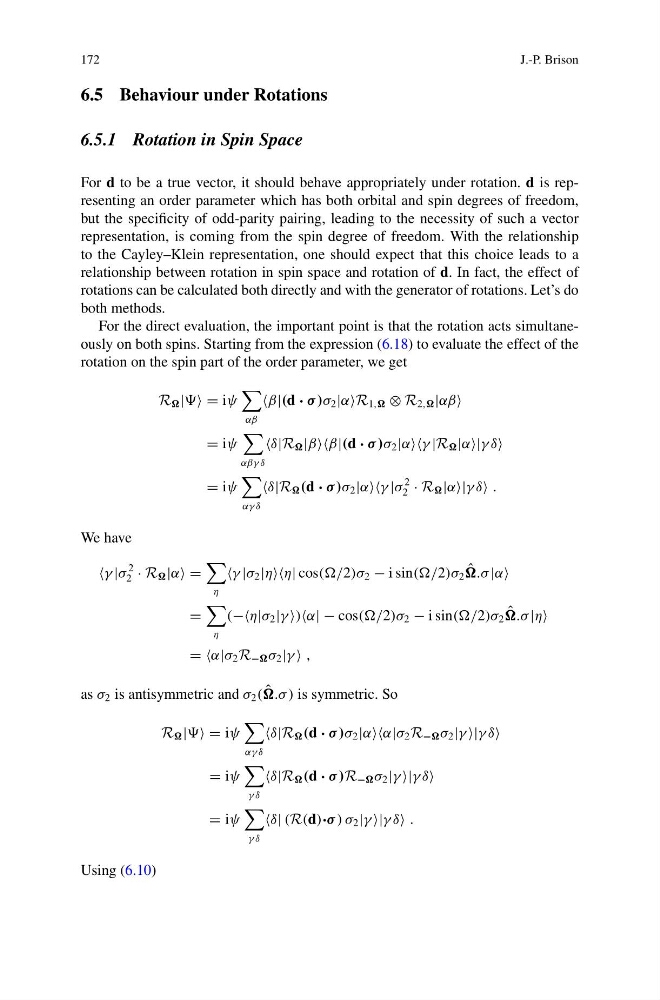
For the direct evaluation, the important point is that the rotation acts simultaneously on both spins. Starting from the expression (6.18) to evaluate the effect of the
rotation on the spin part of the order parameter, we get
R | = iψ
αβ
β|(d · σ )σ 2 |αR 1, ⊗ R 2, |αβ
= iψ
αβγ δ
δ|R |ββ|(d · σ )σ 2 |αγ |R |α|γ δ
= iψ
αγ δ
δ|R (d · σ )σ 2 |αγ |σ
2
2 · R |α|γ δ .
We have
γ |σ
2
2 · R |α =
η
γ |σ 2 |ηη| cos((/2)σ 2 − i sin((/2)σ 2 ˆ
.σ |α
=
η
(−−η|σ 2 |γ )α| − cos((/2)σ 2 − i sin((/2)σ 2 ˆ
.σ |η
= =α|σ 2 R − σ 2 |γ ,
as σ 2 is antisymmetric and σ 2 ( ˆ
.σ ) is symmetric. So
R | = iψ
αγ δ
δ|R (d · σ )σ 2 |αα|σ 2 R − σ 2 |γ |γ δ
= iψ
γ δ
δ|R (d · σ )R − σ 2 |γ |γ δ
= iψ
γ δ
δ| (R(d)·σ ) σ 2 |γ |γ δ .
Using (6.10)
J.-P. Brison
6.5 Behaviour under Rotations
6.5.1 Rotation in Spin Space
For d to be a true vector, it should behave appropriately under rotation. d is representing an order parameter which has both orbital and spin degrees of freedom,
but the specificity of odd-parity pairing, leading to the necessity of such a vector
representation, is coming from the spin degree of freedom. With the relationship
to the Cayley–Klein representation, one should expect that this choice leads to a
relationship between rotation in spin space and rotation of d. In fact, the effect of
rotations can be calculated both directly and with the generator of rotations. Let’s do
both methods.
For the direct evaluation, the important point is that the rotation acts simultaneously on both spins. Starting from the expression (6.18) to evaluate the effect of the
rotation on the spin part of the order parameter, we get
R | = iψ
αβ
β|(d · σ )σ 2 |αR 1, ⊗ R 2, |αβ
= iψ
αβγ δ
δ|R |ββ|(d · σ )σ 2 |αγ |R |α|γ δ
= iψ
αγ δ
δ|R (d · σ )σ 2 |αγ |σ
2
2 · R |α|γ δ .
We have
γ |σ
2
2 · R |α =
η
γ |σ 2 |ηη| cos((/2)σ 2 − i sin((/2)σ 2 ˆ
.σ |α
=
η
(−−η|σ 2 |γ )α| − cos((/2)σ 2 − i sin((/2)σ 2 ˆ
.σ |η
= =α|σ 2 R − σ 2 |γ ,
as σ 2 is antisymmetric and σ 2 ( ˆ
.σ ) is symmetric. So
R | = iψ
αγ δ
δ|R (d · σ )σ 2 |αα|σ 2 R − σ 2 |γ |γ δ
= iψ
γ δ
δ|R (d · σ )R − σ 2 |γ |γ δ
= iψ
γ δ
δ| (R(d)·σ ) σ 2 |γ |γ δ .
Using (6.10)