

6 p-Wave Superconductivity and d-Vector Representation
171
Comparison with expression (6.6) for a·σ doesn’t fit, notably as regards the nondiagonal symmetric terms. This is due to the σ 2 component of a·σ . It can be eliminated
if one calculates
i(a·σ ) · σ 2 = i
a 3
a 1 − ia 2
a 1 + ia 2 −a 3
0 −i
i 0
.
(6.15)
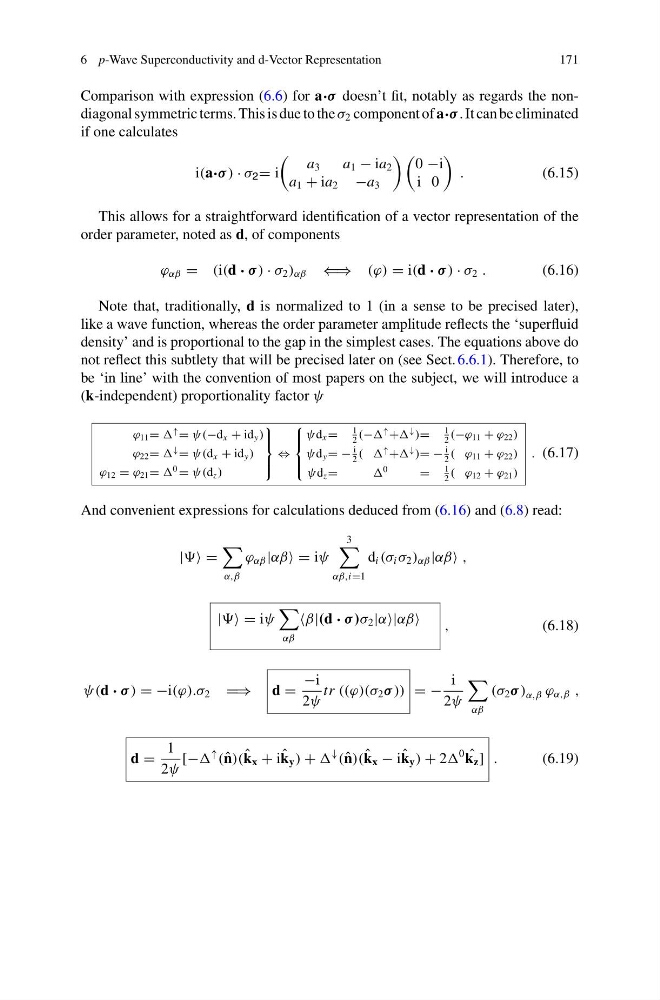
This allows for a straightforward identification of a vector representation of the
order parameter, noted as d, of components
ϕ αβ = (i(d · σ ) · σ 2 ) αβ ⇐⇒ (ϕ) = i(d · σ ) · σ 2 .
(6.16)
Note that, traditionally, d is normalized to 1 (in a sense to be precised later),
like a wave function, whereas the order parameter amplitude reflects the ‘superfluid
density’ and is proportional to the gap in the simplest cases. The equations above do
not reflect this subtlety that will be precised later on (see Sect. 6.6.1). Therefore, to
be ‘in line’ with the convention of most papers on the subject, we will introduce a
(k-independent) proportionality factor ψ
ϕ 11 =
↑ = ψ(−d x + id y )
ϕ 22 =
↓ = ψ(d x + id y )
ϕ 12 = ϕ 21 =
0 = ψ(d z )
⎫
⎪ ⎬
⎪ ⎭
⇔
⎧
⎪ ⎨
⎪ ⎩
ψd x =
1
2
(−
↑ +
↓ )=
1
2
(−ϕ 11 + ϕ 22 )
ψd y = −
i
2
( (
↑ +
↓ )= −
i
2
( ϕ 11 + ϕ 22 )
ψd z =
0
=
1
2
( ϕ 12 + ϕ 21 )
. (6.17)
And convenient expressions for calculations deduced from (6.16) and (6.8) read:
| =
α,β
ϕ αβ |αβ = iψ
3
αβ,i=1
d i (σ i σ 2 ) αβ |αβ ,
| = iψ
αβ
β|(d · σ )σ 2 |α|αβ
,
(6.18)
ψ(d · σ ) = −i(ϕ).σ 2 =⇒ d =
−i
2ψ
tr ((ϕ)(σ 2 σ )) = −
i
2ψ
αβ
(σ 2 σ ) α,β ϕ α,β ,
d =
1
2ψ
[−
↑
( ˆ
n)( ˆ
k x + i ˆ
k y ) +
↓
( ˆ
n)( ˆ
k x − i ˆ
k y ) + 2
0 ˆ
k z ] .
(6.19)
171
Comparison with expression (6.6) for a·σ doesn’t fit, notably as regards the nondiagonal symmetric terms. This is due to the σ 2 component of a·σ . It can be eliminated
if one calculates
i(a·σ ) · σ 2 = i
a 3
a 1 − ia 2
a 1 + ia 2 −a 3
0 −i
i 0
.
(6.15)
This allows for a straightforward identification of a vector representation of the
order parameter, noted as d, of components
ϕ αβ = (i(d · σ ) · σ 2 ) αβ ⇐⇒ (ϕ) = i(d · σ ) · σ 2 .
(6.16)
Note that, traditionally, d is normalized to 1 (in a sense to be precised later),
like a wave function, whereas the order parameter amplitude reflects the ‘superfluid
density’ and is proportional to the gap in the simplest cases. The equations above do
not reflect this subtlety that will be precised later on (see Sect. 6.6.1). Therefore, to
be ‘in line’ with the convention of most papers on the subject, we will introduce a
(k-independent) proportionality factor ψ
ϕ 11 =
↑ = ψ(−d x + id y )
ϕ 22 =
↓ = ψ(d x + id y )
ϕ 12 = ϕ 21 =
0 = ψ(d z )
⎫
⎪ ⎬
⎪ ⎭
⇔
⎧
⎪ ⎨
⎪ ⎩
ψd x =
1
2
(−
↑ +
↓ )=
1
2
(−ϕ 11 + ϕ 22 )
ψd y = −
i
2
( (
↑ +
↓ )= −
i
2
( ϕ 11 + ϕ 22 )
ψd z =
0
=
1
2
( ϕ 12 + ϕ 21 )
. (6.17)
And convenient expressions for calculations deduced from (6.16) and (6.8) read:
| =
α,β
ϕ αβ |αβ = iψ
3
αβ,i=1
d i (σ i σ 2 ) αβ |αβ ,
| = iψ
αβ
β|(d · σ )σ 2 |α|αβ
,
(6.18)
ψ(d · σ ) = −i(ϕ).σ 2 =⇒ d =
−i
2ψ
tr ((ϕ)(σ 2 σ )) = −
i
2ψ
αβ
(σ 2 σ ) α,β ϕ α,β ,
d =
1
2ψ
[−
↑
( ˆ
n)( ˆ
k x + i ˆ
k y ) +
↓
( ˆ
n)( ˆ
k x − i ˆ
k y ) + 2
0 ˆ
k z ] .
(6.19)