

170
J.-P. Brison
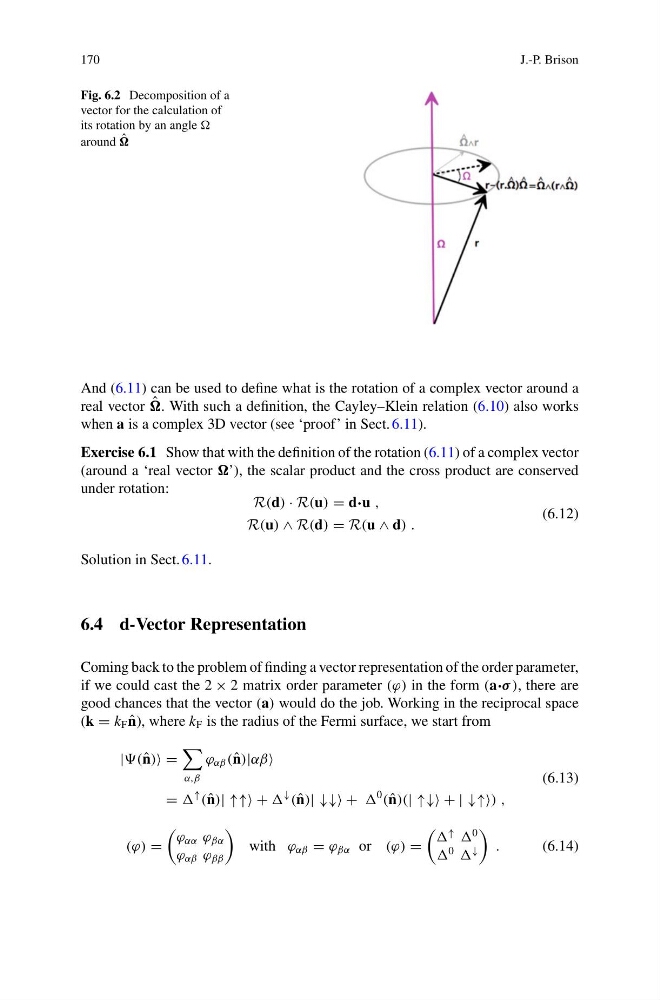
Fig. 6.2 Decomposition of a
vector for the calculation of
its rotation by an angle
around ˆ
And (6.11) can be used to define what is the rotation of a complex vector around a
real vector ˆ
. With such a definition, the Cayley–Klein relation (6.10) also works
when a is a complex 3D vector (see ‘proof’ in Sect. 6.11).
Exercise 6.1 Show that with the definition of the rotation (6.11) of a complex vector
(around a ‘real vector ’), the scalar product and the cross product are conserved
under rotation:
R(d) · R(u) = d·u ,
R(u) ∧ R(d) = R(u ∧ d) .
(6.12)
Solution in Sect. 6.11.
6.4 d-Vector Representation
Coming back to the problem of finding a vector representation of the order parameter,
if we could cast the 2 × 2 matrix order parameter (ϕ) in the form (a·σ ), there are
good chances that the vector (a) would do the job. Working in the reciprocal space
(k = k F ˆ
n), where k F is the radius of the Fermi surface, we start from
|( ˆ
n) =
α,β
ϕ αβ ( ˆ
n)|αβ
=
↑
( ˆ
n)| ↑↑↑ +
↓
( ˆ
n)| ↓↓↓ +
0
( ˆ
n)(| ↑↓↓ + | ↓↑↑) ,
(6.13)
(ϕ) =
ϕ αα ϕ βα
ϕ αβ ϕ ββ
with ϕ αβ = ϕ βα or (ϕ) =
↑
0
0
↓
.
(6.14)
J.-P. Brison
Fig. 6.2 Decomposition of a
vector for the calculation of
its rotation by an angle
around ˆ
And (6.11) can be used to define what is the rotation of a complex vector around a
real vector ˆ
. With such a definition, the Cayley–Klein relation (6.10) also works
when a is a complex 3D vector (see ‘proof’ in Sect. 6.11).
Exercise 6.1 Show that with the definition of the rotation (6.11) of a complex vector
(around a ‘real vector ’), the scalar product and the cross product are conserved
under rotation:
R(d) · R(u) = d·u ,
R(u) ∧ R(d) = R(u ∧ d) .
(6.12)
Solution in Sect. 6.11.
6.4 d-Vector Representation
Coming back to the problem of finding a vector representation of the order parameter,
if we could cast the 2 × 2 matrix order parameter (ϕ) in the form (a·σ ), there are
good chances that the vector (a) would do the job. Working in the reciprocal space
(k = k F ˆ
n), where k F is the radius of the Fermi surface, we start from
|( ˆ
n) =
α,β
ϕ αβ ( ˆ
n)|αβ
=
↑
( ˆ
n)| ↑↑↑ +
↓
( ˆ
n)| ↓↓↓ +
0
( ˆ
n)(| ↑↓↓ + | ↓↑↑) ,
(6.13)
(ϕ) =
ϕ αα ϕ βα
ϕ αβ ϕ ββ
with ϕ αβ = ϕ βα or (ϕ) =
↑
0
0
↓
.
(6.14)