

6 p-Wave Superconductivity and d-Vector Representation
167
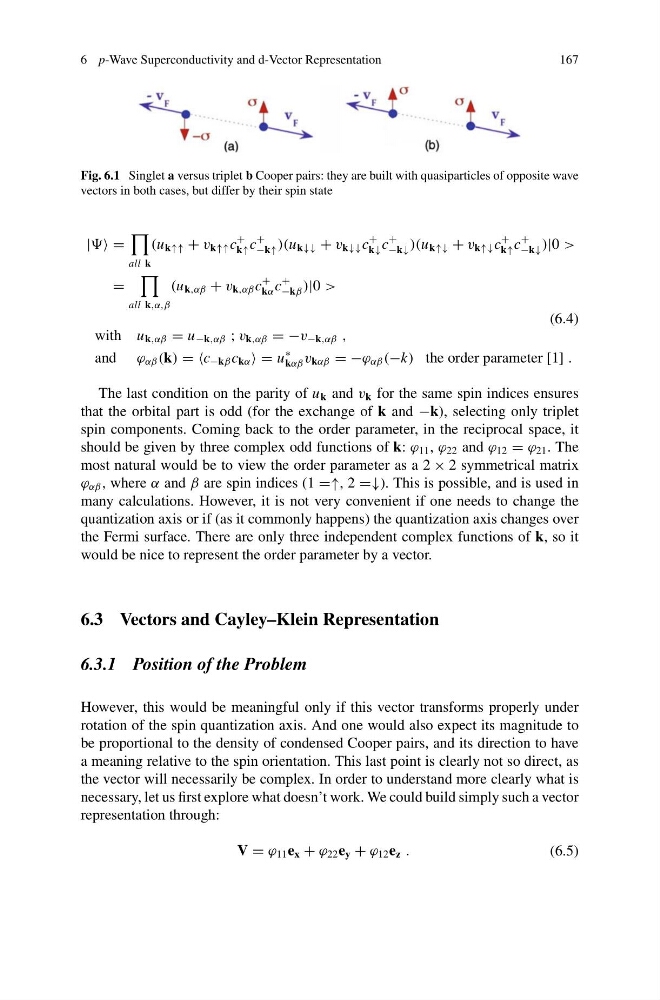
Fig. 6.1 Singlet a versus triplet b Cooper pairs: they are built with quasiparticles of opposite wave
vectors in both cases, but differ by their spin state
| =
all k
(u k↑↑ + v k↑↑ c
+
k↑ c
+
−k↑ )(u k↓↓ + v k↓↓ c
+
k↓ c
+
−k↓ )(u k↑↓ + v k↑↓ c
+
k↑ c
+
−k↓ )|0 >
=
all k,α,β
(u k,αβ + v k,αβ c
+
kα c
+
−kβ )|0 >
(6.4)
with u k,αβ = u −k,αβ ; v k,αβ = −v −k,αβ ,
and ϕ αβ (k) = =c −kβ c kα = u
∗
kαβ v kαβ = −ϕ αβ (−k) the order parameter [1] .
The last condition on the parity of u k and v k for the same spin indices ensures
that the orbital part is odd (for the exchange of k and −k), selecting only triplet
spin components. Coming back to the order parameter, in the reciprocal space, it
should be given by three complex odd functions of k: ϕ 11 , ϕ 22 and ϕ 12 = ϕ 21 . The
most natural would be to view the order parameter as a 2 × 2 symmetrical matrix
ϕ αβ , where α and β are spin indices (1 =↑, 2 =↓). This is possible, and is used in
many calculations. However, it is not very convenient if one needs to change the
quantization axis or if (as it commonly happens) the quantization axis changes over
the Fermi surface. There are only three independent complex functions of k, so it
would be nice to represent the order parameter by a vector.
6.3 Vectors and Cayley–Klein Representation
6.3.1 Position of the Problem
However, this would be meaningful only if this vector transforms properly under
rotation of the spin quantization axis. And one would also expect its magnitude to
be proportional to the density of condensed Cooper pairs, and its direction to have
a meaning relative to the spin orientation. This last point is clearly not so direct, as
the vector will necessarily be complex. In order to understand more clearly what is
necessary, let us first explore what doesn’t work. We could build simply such a vector
representation through:
V = ϕ 11 e x + ϕ 22 e y + ϕ 12 e z .
(6.5)
167
Fig. 6.1 Singlet a versus triplet b Cooper pairs: they are built with quasiparticles of opposite wave
vectors in both cases, but differ by their spin state
| =
all k
(u k↑↑ + v k↑↑ c
+
k↑ c
+
−k↑ )(u k↓↓ + v k↓↓ c
+
k↓ c
+
−k↓ )(u k↑↓ + v k↑↓ c
+
k↑ c
+
−k↓ )|0 >
=
all k,α,β
(u k,αβ + v k,αβ c
+
kα c
+
−kβ )|0 >
(6.4)
with u k,αβ = u −k,αβ ; v k,αβ = −v −k,αβ ,
and ϕ αβ (k) = =c −kβ c kα = u
∗
kαβ v kαβ = −ϕ αβ (−k) the order parameter [1] .
The last condition on the parity of u k and v k for the same spin indices ensures
that the orbital part is odd (for the exchange of k and −k), selecting only triplet
spin components. Coming back to the order parameter, in the reciprocal space, it
should be given by three complex odd functions of k: ϕ 11 , ϕ 22 and ϕ 12 = ϕ 21 . The
most natural would be to view the order parameter as a 2 × 2 symmetrical matrix
ϕ αβ , where α and β are spin indices (1 =↑, 2 =↓). This is possible, and is used in
many calculations. However, it is not very convenient if one needs to change the
quantization axis or if (as it commonly happens) the quantization axis changes over
the Fermi surface. There are only three independent complex functions of k, so it
would be nice to represent the order parameter by a vector.
6.3 Vectors and Cayley–Klein Representation
6.3.1 Position of the Problem
However, this would be meaningful only if this vector transforms properly under
rotation of the spin quantization axis. And one would also expect its magnitude to
be proportional to the density of condensed Cooper pairs, and its direction to have
a meaning relative to the spin orientation. This last point is clearly not so direct, as
the vector will necessarily be complex. In order to understand more clearly what is
necessary, let us first explore what doesn’t work. We could build simply such a vector
representation through:
V = ϕ 11 e x + ϕ 22 e y + ϕ 12 e z .
(6.5)