

166
J.-P. Brison
those, let us choose to quote only two: the seminal Reviews of Modern Physics
paper “A theoretical description of the new phases of liquid
3 He” by A. J. Leggett
[1], which gives both very advanced and detailed insights on the theory of the pwave order parameter of superfluid
3 He, and pedagogical and enlightening treatment
of the microscopic Bardeen–Cooper–Schrieffer (BCS) theory of anisotropic superconductors and the other, which covers the very important symmetry aspects of
unconventional superconductors in crystalline materials, is the book ‘Introduction to
unconventional superconductivity’ by V. P. Mineev and K. V. Samokhin [2].
In the following, we concentrate on some basic aspects of the description of spintriplet superconductors, which are often bewildering, at least to experimentalists.
6.2 Odd-Parity Pairing: BCS Wave Function and Order
Parameter
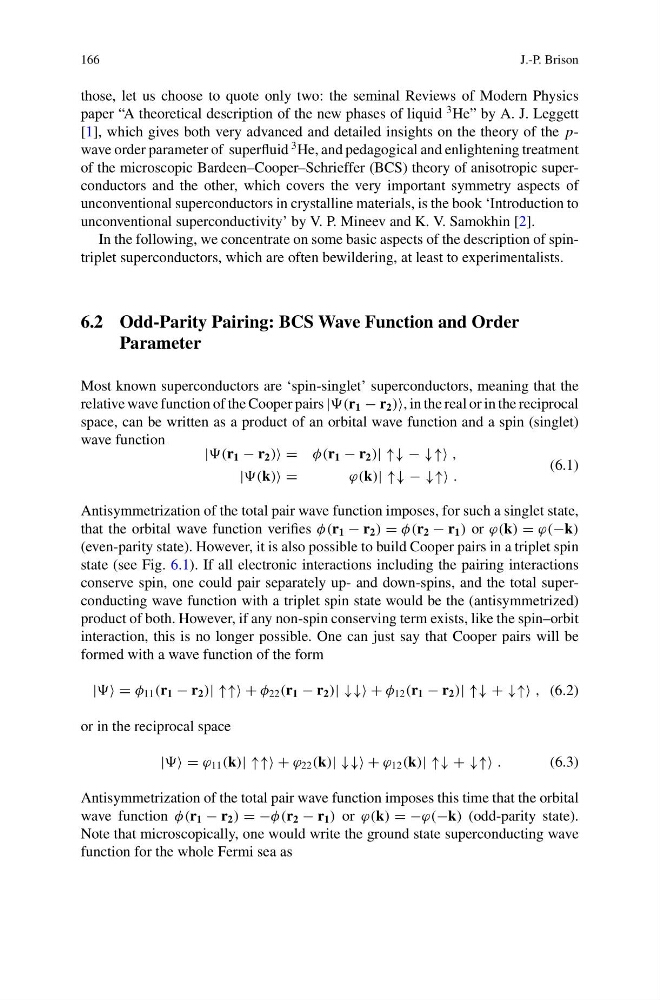
Most known superconductors are ‘spin-singlet’ superconductors, meaning that the
relative wave function of the Cooper pairs |(r 1 − r 2 ), in the real or in the reciprocal
space, can be written as a product of an orbital wave function and a spin (singlet)
wave function
|(r 1 − r 2 ) = φ(r 1 − r 2 )| ↑↓ − ↓↑↑ ,
|(k) =
ϕ(k)| ↑↓ − ↓↑↑ .
(6.1)
Antisymmetrization of the total pair wave function imposes, for such a singlet state,
that the orbital wave function verifies φ(r 1 − r 2 ) = φ(r 2 − r 1 ) or ϕ(k) = ϕ(−k)
(even-parity state). However, it is also possible to build Cooper pairs in a triplet spin
state (see Fig. 6.1). If all electronic interactions including the pairing interactions
conserve spin, one could pair separately up- and down-spins, and the total superconducting wave function with a triplet spin state would be the (antisymmetrized)
product of both. However, if any non-spin conserving term exists, like the spin–orbit
interaction, this is no longer possible. One can just say that Cooper pairs will be
formed with a wave function of the form
| = φ 11 (r 1 − r 2 )| ↑↑↑ + φ 22 (r 1 − r 2 )| ↓↓↓ + φ 12 (r 1 − r 2 )| ↑↓ + ↓↑↑ , (6.2)
or in the reciprocal space
| = ϕ 11 (k)| ↑↑↑ + ϕ 22 (k)| ↓↓↓ + ϕ 12 (k)| ↑↓ + ↓↑↑ .
(6.3)
Antisymmetrization of the total pair wave function imposes this time that the orbital
wave function φ(r 1 − r 2 ) = −φ(r 2 − r 1 ) or ϕ(k) = −ϕ(−k) (odd-parity state).
Note that microscopically, one would write the ground state superconducting wave
function for the whole Fermi sea as
J.-P. Brison
those, let us choose to quote only two: the seminal Reviews of Modern Physics
paper “A theoretical description of the new phases of liquid
3 He” by A. J. Leggett
[1], which gives both very advanced and detailed insights on the theory of the pwave order parameter of superfluid
3 He, and pedagogical and enlightening treatment
of the microscopic Bardeen–Cooper–Schrieffer (BCS) theory of anisotropic superconductors and the other, which covers the very important symmetry aspects of
unconventional superconductors in crystalline materials, is the book ‘Introduction to
unconventional superconductivity’ by V. P. Mineev and K. V. Samokhin [2].
In the following, we concentrate on some basic aspects of the description of spintriplet superconductors, which are often bewildering, at least to experimentalists.
6.2 Odd-Parity Pairing: BCS Wave Function and Order
Parameter
Most known superconductors are ‘spin-singlet’ superconductors, meaning that the
relative wave function of the Cooper pairs |(r 1 − r 2 ), in the real or in the reciprocal
space, can be written as a product of an orbital wave function and a spin (singlet)
wave function
|(r 1 − r 2 ) = φ(r 1 − r 2 )| ↑↓ − ↓↑↑ ,
|(k) =
ϕ(k)| ↑↓ − ↓↑↑ .
(6.1)
Antisymmetrization of the total pair wave function imposes, for such a singlet state,
that the orbital wave function verifies φ(r 1 − r 2 ) = φ(r 2 − r 1 ) or ϕ(k) = ϕ(−k)
(even-parity state). However, it is also possible to build Cooper pairs in a triplet spin
state (see Fig. 6.1). If all electronic interactions including the pairing interactions
conserve spin, one could pair separately up- and down-spins, and the total superconducting wave function with a triplet spin state would be the (antisymmetrized)
product of both. However, if any non-spin conserving term exists, like the spin–orbit
interaction, this is no longer possible. One can just say that Cooper pairs will be
formed with a wave function of the form
| = φ 11 (r 1 − r 2 )| ↑↑↑ + φ 22 (r 1 − r 2 )| ↓↓↓ + φ 12 (r 1 − r 2 )| ↑↓ + ↓↑↑ , (6.2)
or in the reciprocal space
| = ϕ 11 (k)| ↑↑↑ + ϕ 22 (k)| ↓↓↓ + ϕ 12 (k)| ↑↓ + ↓↑↑ .
(6.3)
Antisymmetrization of the total pair wave function imposes this time that the orbital
wave function φ(r 1 − r 2 ) = −φ(r 2 − r 1 ) or ϕ(k) = −ϕ(−k) (odd-parity state).
Note that microscopically, one would write the ground state superconducting wave
function for the whole Fermi sea as