

5 Spintronics and Synchrotron Radiation
155
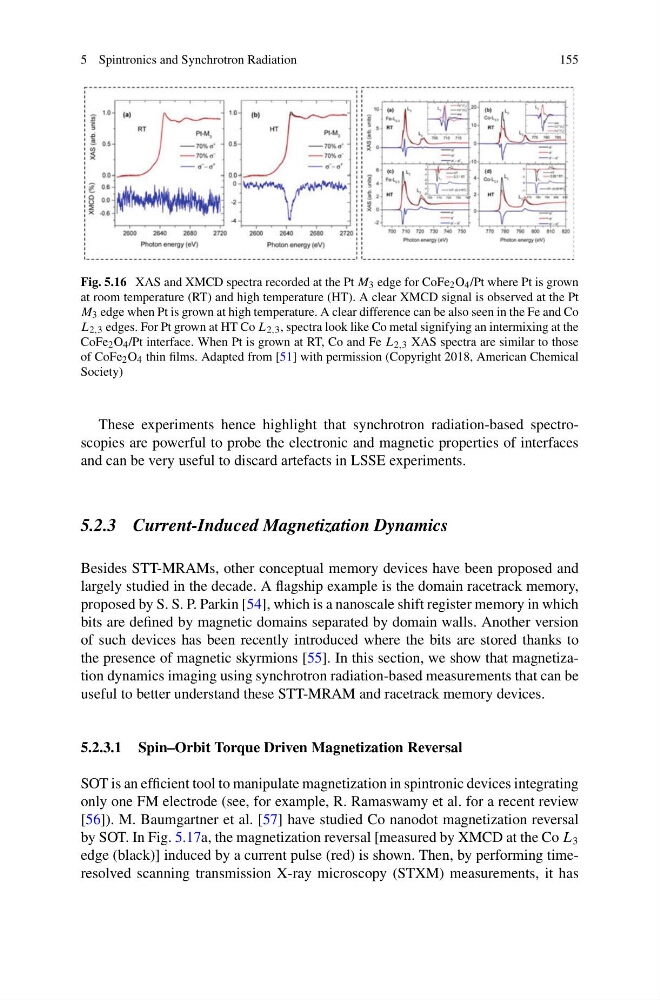
Fig. 5.16 XAS and XMCD spectra recorded at the Pt M 3 edge for CoFe 2 O 4 /Pt where Pt is grown
at room temperature (RT) and high temperature (HT). A clear XMCD signal is observed at the Pt
M 3 edge when Pt is grown at high temperature. A clear difference can be also seen in the Fe and Co
L 2,3 edges. For Pt grown at HT Co L 2,3 , spectra look like Co metal signifying an intermixing at the
CoFe 2 O 4 /Pt interface. When Pt is grown at RT, Co and Fe L 2,3 XAS spectra are similar to those
of CoFe 2 O 4 thin films. Adapted from [51] with permission (Copyright 2018, American Chemical
Society)
These experiments hence highlight that synchrotron radiation-based spectroscopies are powerful to probe the electronic and magnetic properties of interfaces
and can be very useful to discard artefacts in LSSE experiments.
5.2.3 Current-Induced Magnetization Dynamics
Besides STT-MRAMs, other conceptual memory devices have been proposed and
largely studied in the decade. A flagship example is the domain racetrack memory,
proposed by S. S. P. Parkin [54], which is a nanoscale shift register memory in which
bits are defined by magnetic domains separated by domain walls. Another version
of such devices has been recently introduced where the bits are stored thanks to
the presence of magnetic skyrmions [55]. In this section, we show that magnetization dynamics imaging using synchrotron radiation-based measurements that can be
useful to better understand these STT-MRAM and racetrack memory devices.
5.2.3.1 Spin–Orbit Torque Driven Magnetization Reversal
SOT is an efficient tool to manipulate magnetization in spintronic devices integrating
only one FM electrode (see, for example, R. Ramaswamy et al. for a recent review
[56]). M. Baumgartner et al. [57] have studied Co nanodot magnetization reversal
by SOT. In Fig. 5.17a, the magnetization reversal [measured by XMCD at the Co L 3
edge (black)] induced by a current pulse (red) is shown. Then, by performing timeresolved scanning transmission X-ray microscopy (STXM) measurements, it has
155
Fig. 5.16 XAS and XMCD spectra recorded at the Pt M 3 edge for CoFe 2 O 4 /Pt where Pt is grown
at room temperature (RT) and high temperature (HT). A clear XMCD signal is observed at the Pt
M 3 edge when Pt is grown at high temperature. A clear difference can be also seen in the Fe and Co
L 2,3 edges. For Pt grown at HT Co L 2,3 , spectra look like Co metal signifying an intermixing at the
CoFe 2 O 4 /Pt interface. When Pt is grown at RT, Co and Fe L 2,3 XAS spectra are similar to those
of CoFe 2 O 4 thin films. Adapted from [51] with permission (Copyright 2018, American Chemical
Society)
These experiments hence highlight that synchrotron radiation-based spectroscopies are powerful to probe the electronic and magnetic properties of interfaces
and can be very useful to discard artefacts in LSSE experiments.
5.2.3 Current-Induced Magnetization Dynamics
Besides STT-MRAMs, other conceptual memory devices have been proposed and
largely studied in the decade. A flagship example is the domain racetrack memory,
proposed by S. S. P. Parkin [54], which is a nanoscale shift register memory in which
bits are defined by magnetic domains separated by domain walls. Another version
of such devices has been recently introduced where the bits are stored thanks to
the presence of magnetic skyrmions [55]. In this section, we show that magnetization dynamics imaging using synchrotron radiation-based measurements that can be
useful to better understand these STT-MRAM and racetrack memory devices.
5.2.3.1 Spin–Orbit Torque Driven Magnetization Reversal
SOT is an efficient tool to manipulate magnetization in spintronic devices integrating
only one FM electrode (see, for example, R. Ramaswamy et al. for a recent review
[56]). M. Baumgartner et al. [57] have studied Co nanodot magnetization reversal
by SOT. In Fig. 5.17a, the magnetization reversal [measured by XMCD at the Co L 3
edge (black)] induced by a current pulse (red) is shown. Then, by performing timeresolved scanning transmission X-ray microscopy (STXM) measurements, it has