

154
R. Mattana et al.
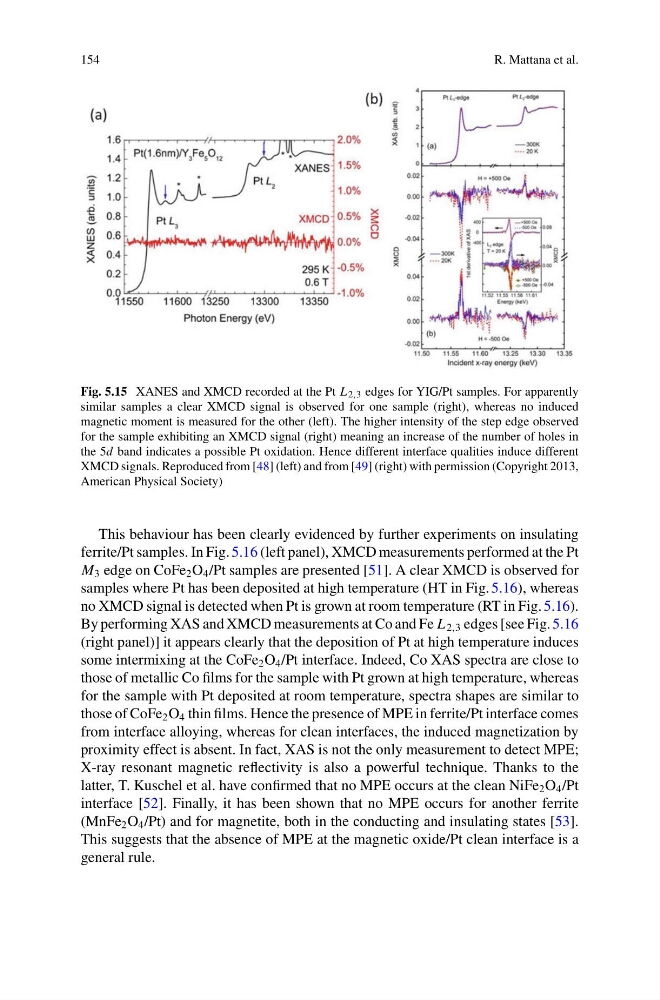
Fig. 5.15 XANES and XMCD recorded at the Pt L 2,3 edges for YIG/Pt samples. For apparently
similar samples a clear XMCD signal is observed for one sample (right), whereas no induced
magnetic moment is measured for the other (left). The higher intensity of the step edge observed
for the sample exhibiting an XMCD signal (right) meaning an increase of the number of holes in
the 5d band indicates a possible Pt oxidation. Hence different interface qualities induce different
XMCD signals. Reproduced from [48] (left) and from [49] (right) with permission (Copyright 2013,
American Physical Society)
This behaviour has been clearly evidenced by further experiments on insulating
ferrite/Pt samples. In Fig. 5.16 (left panel), XMCD measurements performed at the Pt
M 3 edge on CoFe 2 O 4 /Pt samples are presented [51]. A clear XMCD is observed for
samples where Pt has been deposited at high temperature (HT in Fig. 5.16), whereas
no XMCD signal is detected when Pt is grown at room temperature (RT in Fig. 5.16).
By performing XAS and XMCD measurements at Co and Fe L 2,3 edges [see Fig. 5.16
(right panel)] it appears clearly that the deposition of Pt at high temperature induces
some intermixing at the CoFe 2 O 4 /Pt interface. Indeed, Co XAS spectra are close to
those of metallic Co films for the sample with Pt grown at high temperature, whereas
for the sample with Pt deposited at room temperature, spectra shapes are similar to
those of CoFe 2 O 4 thin films. Hence the presence of MPE in ferrite/Pt interface comes
from interface alloying, whereas for clean interfaces, the induced magnetization by
proximity effect is absent. In fact, XAS is not the only measurement to detect MPE;
X-ray resonant magnetic reflectivity is also a powerful technique. Thanks to the
latter, T. Kuschel et al. have confirmed that no MPE occurs at the clean NiFe 2 O 4 /Pt
interface [52]. Finally, it has been shown that no MPE occurs for another ferrite
(MnFe 2 O 4 /Pt) and for magnetite, both in the conducting and insulating states [53].
This suggests that the absence of MPE at the magnetic oxide/Pt clean interface is a
general rule.
R. Mattana et al.
Fig. 5.15 XANES and XMCD recorded at the Pt L 2,3 edges for YIG/Pt samples. For apparently
similar samples a clear XMCD signal is observed for one sample (right), whereas no induced
magnetic moment is measured for the other (left). The higher intensity of the step edge observed
for the sample exhibiting an XMCD signal (right) meaning an increase of the number of holes in
the 5d band indicates a possible Pt oxidation. Hence different interface qualities induce different
XMCD signals. Reproduced from [48] (left) and from [49] (right) with permission (Copyright 2013,
American Physical Society)
This behaviour has been clearly evidenced by further experiments on insulating
ferrite/Pt samples. In Fig. 5.16 (left panel), XMCD measurements performed at the Pt
M 3 edge on CoFe 2 O 4 /Pt samples are presented [51]. A clear XMCD is observed for
samples where Pt has been deposited at high temperature (HT in Fig. 5.16), whereas
no XMCD signal is detected when Pt is grown at room temperature (RT in Fig. 5.16).
By performing XAS and XMCD measurements at Co and Fe L 2,3 edges [see Fig. 5.16
(right panel)] it appears clearly that the deposition of Pt at high temperature induces
some intermixing at the CoFe 2 O 4 /Pt interface. Indeed, Co XAS spectra are close to
those of metallic Co films for the sample with Pt grown at high temperature, whereas
for the sample with Pt deposited at room temperature, spectra shapes are similar to
those of CoFe 2 O 4 thin films. Hence the presence of MPE in ferrite/Pt interface comes
from interface alloying, whereas for clean interfaces, the induced magnetization by
proximity effect is absent. In fact, XAS is not the only measurement to detect MPE;
X-ray resonant magnetic reflectivity is also a powerful technique. Thanks to the
latter, T. Kuschel et al. have confirmed that no MPE occurs at the clean NiFe 2 O 4 /Pt
interface [52]. Finally, it has been shown that no MPE occurs for another ferrite
(MnFe 2 O 4 /Pt) and for magnetite, both in the conducting and insulating states [53].
This suggests that the absence of MPE at the magnetic oxide/Pt clean interface is a
general rule.