

5 Spintronics and Synchrotron Radiation
145
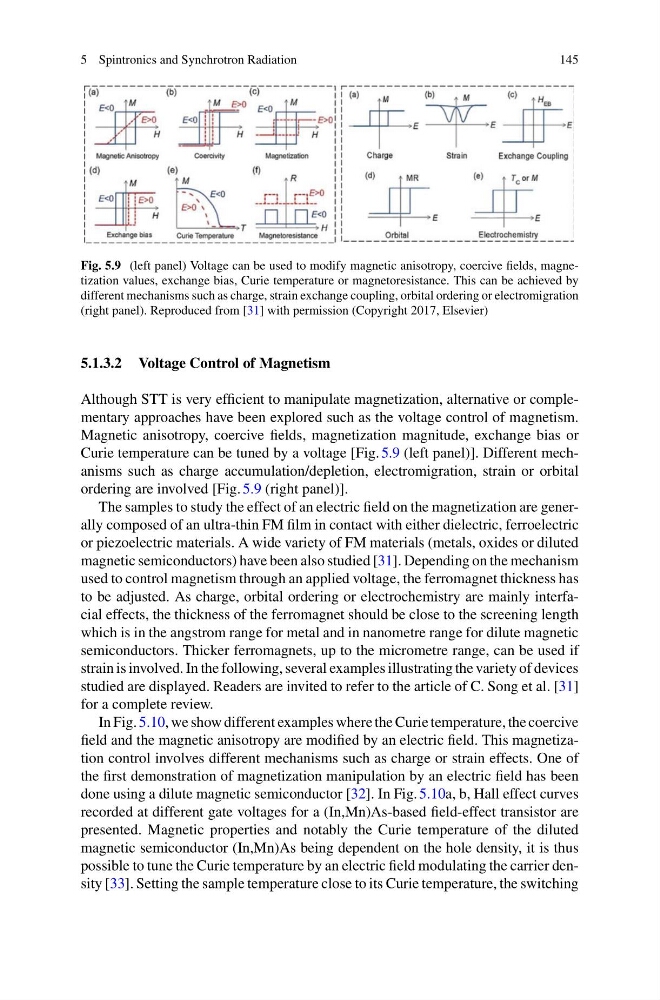
Fig. 5.9 (left panel) Voltage can be used to modify magnetic anisotropy, coercive fields, magnetization values, exchange bias, Curie temperature or magnetoresistance. This can be achieved by
different mechanisms such as charge, strain exchange coupling, orbital ordering or electromigration
(right panel). Reproduced from [31] with permission (Copyright 2017, Elsevier)
5.1.3.2 Voltage Control of Magnetism
Although STT is very efficient to manipulate magnetization, alternative or complementary approaches have been explored such as the voltage control of magnetism.
Magnetic anisotropy, coercive fields, magnetization magnitude, exchange bias or
Curie temperature can be tuned by a voltage [Fig. 5.9 (left panel)]. Different mechanisms such as charge accumulation/depletion, electromigration, strain or orbital
ordering are involved [Fig. 5.9 (right panel)].
The samples to study the effect of an electric field on the magnetization are generally composed of an ultra-thin FM film in contact with either dielectric, ferroelectric
or piezoelectric materials. A wide variety of FM materials (metals, oxides or diluted
magnetic semiconductors) have been also studied [31]. Depending on the mechanism
used to control magnetism through an applied voltage, the ferromagnet thickness has
to be adjusted. As charge, orbital ordering or electrochemistry are mainly interfacial effects, the thickness of the ferromagnet should be close to the screening length
which is in the angstrom range for metal and in nanometre range for dilute magnetic
semiconductors. Thicker ferromagnets, up to the micrometre range, can be used if
strain is involved. In the following, several examples illustrating the variety of devices
studied are displayed. Readers are invited to refer to the article of C. Song et al. [31]
for a complete review.
In Fig. 5.10, we show different examples where the Curie temperature, the coercive
field and the magnetic anisotropy are modified by an electric field. This magnetization control involves different mechanisms such as charge or strain effects. One of
the first demonstration of magnetization manipulation by an electric field has been
done using a dilute magnetic semiconductor [32]. In Fig. 5.10a, b, Hall effect curves
recorded at different gate voltages for a (In,Mn)As-based field-effect transistor are
presented. Magnetic properties and notably the Curie temperature of the diluted
magnetic semiconductor (In,Mn)As being dependent on the hole density, it is thus
possible to tune the Curie temperature by an electric field modulating the carrier density [33]. Setting the sample temperature close to its Curie temperature, the switching
145
Fig. 5.9 (left panel) Voltage can be used to modify magnetic anisotropy, coercive fields, magnetization values, exchange bias, Curie temperature or magnetoresistance. This can be achieved by
different mechanisms such as charge, strain exchange coupling, orbital ordering or electromigration
(right panel). Reproduced from [31] with permission (Copyright 2017, Elsevier)
5.1.3.2 Voltage Control of Magnetism
Although STT is very efficient to manipulate magnetization, alternative or complementary approaches have been explored such as the voltage control of magnetism.
Magnetic anisotropy, coercive fields, magnetization magnitude, exchange bias or
Curie temperature can be tuned by a voltage [Fig. 5.9 (left panel)]. Different mechanisms such as charge accumulation/depletion, electromigration, strain or orbital
ordering are involved [Fig. 5.9 (right panel)].
The samples to study the effect of an electric field on the magnetization are generally composed of an ultra-thin FM film in contact with either dielectric, ferroelectric
or piezoelectric materials. A wide variety of FM materials (metals, oxides or diluted
magnetic semiconductors) have been also studied [31]. Depending on the mechanism
used to control magnetism through an applied voltage, the ferromagnet thickness has
to be adjusted. As charge, orbital ordering or electrochemistry are mainly interfacial effects, the thickness of the ferromagnet should be close to the screening length
which is in the angstrom range for metal and in nanometre range for dilute magnetic
semiconductors. Thicker ferromagnets, up to the micrometre range, can be used if
strain is involved. In the following, several examples illustrating the variety of devices
studied are displayed. Readers are invited to refer to the article of C. Song et al. [31]
for a complete review.
In Fig. 5.10, we show different examples where the Curie temperature, the coercive
field and the magnetic anisotropy are modified by an electric field. This magnetization control involves different mechanisms such as charge or strain effects. One of
the first demonstration of magnetization manipulation by an electric field has been
done using a dilute magnetic semiconductor [32]. In Fig. 5.10a, b, Hall effect curves
recorded at different gate voltages for a (In,Mn)As-based field-effect transistor are
presented. Magnetic properties and notably the Curie temperature of the diluted
magnetic semiconductor (In,Mn)As being dependent on the hole density, it is thus
possible to tune the Curie temperature by an electric field modulating the carrier density [33]. Setting the sample temperature close to its Curie temperature, the switching