

146
R. Mattana et al.
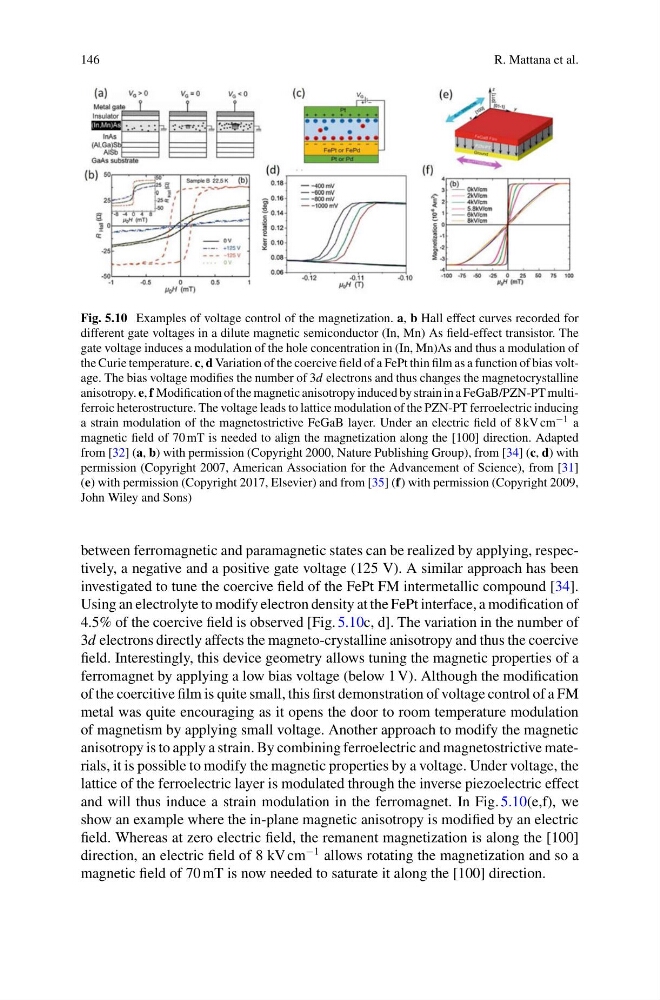
Fig. 5.10 Examples of voltage control of the magnetization. a, b Hall effect curves recorded for
different gate voltages in a dilute magnetic semiconductor (In, Mn) As field-effect transistor. The
gate voltage induces a modulation of the hole concentration in (In, Mn)As and thus a modulation of
the Curie temperature. c, d Variation of the coercive field of a FePt thin film as a function of bias voltage. The bias voltage modifies the number of 3d electrons and thus changes the magnetocrystalline
anisotropy. e, f Modification of the magnetic anisotropy induced by strain in a FeGaB/PZN-PT multiferroic heterostructure. The voltage leads to lattice modulation of the PZN-PT ferroelectric inducing
a strain modulation of the magnetostrictive FeGaB layer. Under an electric field of 8 kV cm −1 a
magnetic field of 70 mT is needed to align the magnetization along the [100] direction. Adapted
from [32] (a, b) with permission (Copyright 2000, Nature Publishing Group), from [34] (c, d) with
permission (Copyright 2007, American Association for the Advancement of Science), from [31]
(e) with permission (Copyright 2017, Elsevier) and from [35] (f) with permission (Copyright 2009,
John Wiley and Sons)
between ferromagnetic and paramagnetic states can be realized by applying, respectively, a negative and a positive gate voltage (125 V). A similar approach has been
investigated to tune the coercive field of the FePt FM intermetallic compound [34].
Using an electrolyte to modify electron density at the FePt interface, a modification of
4.5% of the coercive field is observed [Fig. 5.10c, d]. The variation in the number of
3d electrons directly affects the magneto-crystalline anisotropy and thus the coercive
field. Interestingly, this device geometry allows tuning the magnetic properties of a
ferromagnet by applying a low bias voltage (below 1 V). Although the modification
of the coercitive film is quite small, this first demonstration of voltage control of a FM
metal was quite encouraging as it opens the door to room temperature modulation
of magnetism by applying small voltage. Another approach to modify the magnetic
anisotropy is to apply a strain. By combining ferroelectric and magnetostrictive materials, it is possible to modify the magnetic properties by a voltage. Under voltage, the
lattice of the ferroelectric layer is modulated through the inverse piezoelectric effect
and will thus induce a strain modulation in the ferromagnet. In Fig. 5.10(e,f), we
show an example where the in-plane magnetic anisotropy is modified by an electric
field. Whereas at zero electric field, the remanent magnetization is along the [100]
direction, an electric field of 8 kV cm
−1 allows rotating the magnetization and so a
magnetic field of 70 mT is now needed to saturate it along the [100] direction.
R. Mattana et al.
Fig. 5.10 Examples of voltage control of the magnetization. a, b Hall effect curves recorded for
different gate voltages in a dilute magnetic semiconductor (In, Mn) As field-effect transistor. The
gate voltage induces a modulation of the hole concentration in (In, Mn)As and thus a modulation of
the Curie temperature. c, d Variation of the coercive field of a FePt thin film as a function of bias voltage. The bias voltage modifies the number of 3d electrons and thus changes the magnetocrystalline
anisotropy. e, f Modification of the magnetic anisotropy induced by strain in a FeGaB/PZN-PT multiferroic heterostructure. The voltage leads to lattice modulation of the PZN-PT ferroelectric inducing
a strain modulation of the magnetostrictive FeGaB layer. Under an electric field of 8 kV cm −1 a
magnetic field of 70 mT is needed to align the magnetization along the [100] direction. Adapted
from [32] (a, b) with permission (Copyright 2000, Nature Publishing Group), from [34] (c, d) with
permission (Copyright 2007, American Association for the Advancement of Science), from [31]
(e) with permission (Copyright 2017, Elsevier) and from [35] (f) with permission (Copyright 2009,
John Wiley and Sons)
between ferromagnetic and paramagnetic states can be realized by applying, respectively, a negative and a positive gate voltage (125 V). A similar approach has been
investigated to tune the coercive field of the FePt FM intermetallic compound [34].
Using an electrolyte to modify electron density at the FePt interface, a modification of
4.5% of the coercive field is observed [Fig. 5.10c, d]. The variation in the number of
3d electrons directly affects the magneto-crystalline anisotropy and thus the coercive
field. Interestingly, this device geometry allows tuning the magnetic properties of a
ferromagnet by applying a low bias voltage (below 1 V). Although the modification
of the coercitive film is quite small, this first demonstration of voltage control of a FM
metal was quite encouraging as it opens the door to room temperature modulation
of magnetism by applying small voltage. Another approach to modify the magnetic
anisotropy is to apply a strain. By combining ferroelectric and magnetostrictive materials, it is possible to modify the magnetic properties by a voltage. Under voltage, the
lattice of the ferroelectric layer is modulated through the inverse piezoelectric effect
and will thus induce a strain modulation in the ferromagnet. In Fig. 5.10(e,f), we
show an example where the in-plane magnetic anisotropy is modified by an electric
field. Whereas at zero electric field, the remanent magnetization is along the [100]
direction, an electric field of 8 kV cm
−1 allows rotating the magnetization and so a
magnetic field of 70 mT is now needed to saturate it along the [100] direction.