

144
R. Mattana et al.
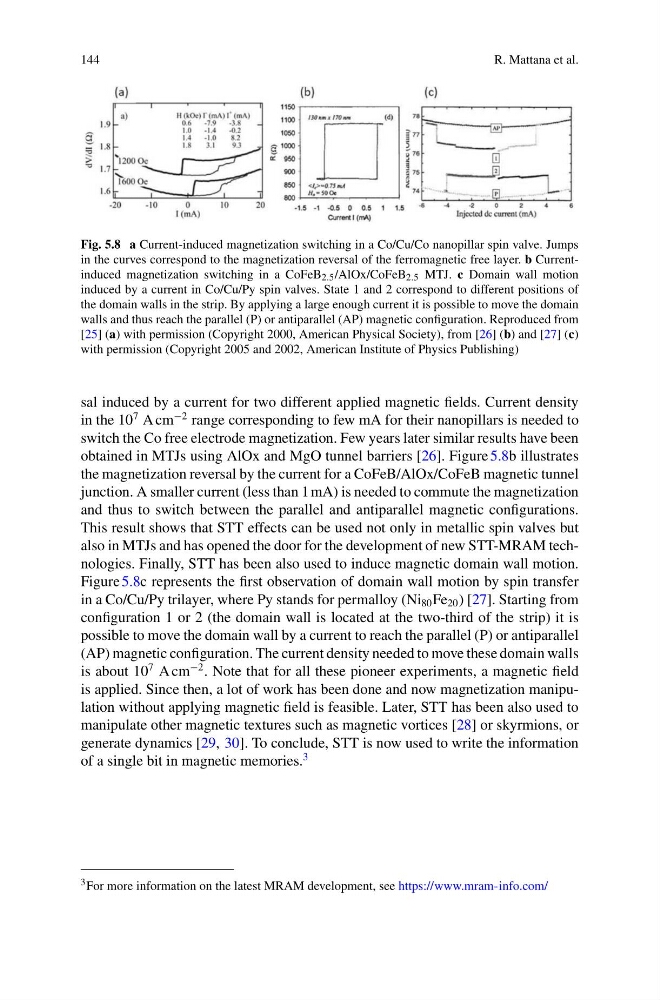
Fig. 5.8 a Current-induced magnetization switching in a Co/Cu/Co nanopillar spin valve. Jumps
in the curves correspond to the magnetization reversal of the ferromagnetic free layer. b Currentinduced magnetization switching in a CoFeB 2.5 /AlOx/CoFeB 2.5 MTJ. c Domain wall motion
induced by a current in Co/Cu/Py spin valves. State 1 and 2 correspond to different positions of
the domain walls in the strip. By applying a large enough current it is possible to move the domain
walls and thus reach the parallel (P) or antiparallel (AP) magnetic configuration. Reproduced from
[25] (a) with permission (Copyright 2000, American Physical Society), from [26] (b) and [27] (c)
with permission (Copyright 2005 and 2002, American Institute of Physics Publishing)
sal induced by a current for two different applied magnetic fields. Current density
in the 10
7 A cm
−2 range corresponding to few mA for their nanopillars is needed to
switch the Co free electrode magnetization. Few years later similar results have been
obtained in MTJs using AlOx and MgO tunnel barriers [26]. Figure 5.8b illustrates
the magnetization reversal by the current for a CoFeB/AlOx/CoFeB magnetic tunnel
junction. A smaller current (less than 1 mA) is needed to commute the magnetization
and thus to switch between the parallel and antiparallel magnetic configurations.
This result shows that STT effects can be used not only in metallic spin valves but
also in MTJs and has opened the door for the development of new STT-MRAM technologies. Finally, STT has been also used to induce magnetic domain wall motion.
Figure 5.8c represents the first observation of domain wall motion by spin transfer
in a Co/Cu/Py trilayer, where Py stands for permalloy (Ni 80 Fe 20 ) [27]. Starting from
configuration 1 or 2 (the domain wall is located at the two-third of the strip) it is
possible to move the domain wall by a current to reach the parallel (P) or antiparallel
(AP) magnetic configuration. The current density needed to move these domain walls
is about 10
7 A cm
−2 . Note that for all these pioneer experiments, a magnetic field
is applied. Since then, a lot of work has been done and now magnetization manipulation without applying magnetic field is feasible. Later, STT has been also used to
manipulate other magnetic textures such as magnetic vortices [28] or skyrmions, or
generate dynamics [29, 30]. To conclude, STT is now used to write the information
of a single bit in magnetic memories.
3
3 For more information on the latest MRAM development, see https://www.mram-info.com/
R. Mattana et al.
Fig. 5.8 a Current-induced magnetization switching in a Co/Cu/Co nanopillar spin valve. Jumps
in the curves correspond to the magnetization reversal of the ferromagnetic free layer. b Currentinduced magnetization switching in a CoFeB 2.5 /AlOx/CoFeB 2.5 MTJ. c Domain wall motion
induced by a current in Co/Cu/Py spin valves. State 1 and 2 correspond to different positions of
the domain walls in the strip. By applying a large enough current it is possible to move the domain
walls and thus reach the parallel (P) or antiparallel (AP) magnetic configuration. Reproduced from
[25] (a) with permission (Copyright 2000, American Physical Society), from [26] (b) and [27] (c)
with permission (Copyright 2005 and 2002, American Institute of Physics Publishing)
sal induced by a current for two different applied magnetic fields. Current density
in the 10
7 A cm
−2 range corresponding to few mA for their nanopillars is needed to
switch the Co free electrode magnetization. Few years later similar results have been
obtained in MTJs using AlOx and MgO tunnel barriers [26]. Figure 5.8b illustrates
the magnetization reversal by the current for a CoFeB/AlOx/CoFeB magnetic tunnel
junction. A smaller current (less than 1 mA) is needed to commute the magnetization
and thus to switch between the parallel and antiparallel magnetic configurations.
This result shows that STT effects can be used not only in metallic spin valves but
also in MTJs and has opened the door for the development of new STT-MRAM technologies. Finally, STT has been also used to induce magnetic domain wall motion.
Figure 5.8c represents the first observation of domain wall motion by spin transfer
in a Co/Cu/Py trilayer, where Py stands for permalloy (Ni 80 Fe 20 ) [27]. Starting from
configuration 1 or 2 (the domain wall is located at the two-third of the strip) it is
possible to move the domain wall by a current to reach the parallel (P) or antiparallel
(AP) magnetic configuration. The current density needed to move these domain walls
is about 10
7 A cm
−2 . Note that for all these pioneer experiments, a magnetic field
is applied. Since then, a lot of work has been done and now magnetization manipulation without applying magnetic field is feasible. Later, STT has been also used to
manipulate other magnetic textures such as magnetic vortices [28] or skyrmions, or
generate dynamics [29, 30]. To conclude, STT is now used to write the information
of a single bit in magnetic memories.
3
3 For more information on the latest MRAM development, see https://www.mram-info.com/