

4 X-ray Dichroisms in Spherical Tensor and Green’s Function Formalism
117
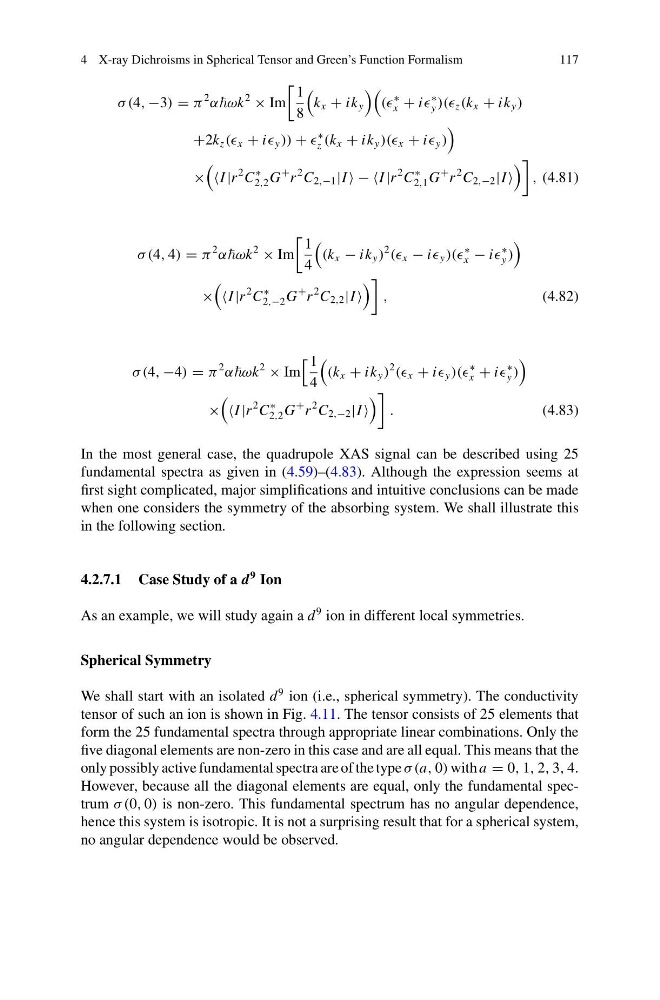
σ (4, −3) = π
2
αωk
2
× Im
1
8
k x + ik y
((
∗
x + i
∗
y )(( z (k x + ik y )
+2k z (( x + i y )) +
∗
z (k x + ik y )(( x + i y )
×
I |r
2 C
∗
2,2 G
+ r
2 C 2,−1 |I − −I |r
2 C
∗
2,1 G
+ r
2 C 2,−2 |I
, (4.81)
σ (4, 4) = π
2
αωk
2
× Im
1
4
(k x − ik y )
2
(( x − i y )((
∗
x − i
∗
y )
×
I |r
2 C
∗
2,−2 G
+ r
2 C 2,2 |I
,
(4.82)
σ (4, −4) = π
2
αωk
2
× Im
1
4
(k x + ik y )
2
(( x + i y )((
∗
x + i
∗
y )
×
I |r
2 C
∗
2,2 G
+ r
2 C 2,−2 |I
.
(4.83)
In the most general case, the quadrupole XAS signal can be described using 25
fundamental spectra as given in (4.59)–(4.83). Although the expression seems at
first sight complicated, major simplifications and intuitive conclusions can be made
when one considers the symmetry of the absorbing system. We shall illustrate this
in the following section.
4.2.7.1 Case Study of a d
9 Ion
As an example, we will study again a d
9 ion in different local symmetries.
Spherical Symmetry
We shall start with an isolated d
9 ion (i.e., spherical symmetry). The conductivity
tensor of such an ion is shown in Fig. 4.11. The tensor consists of 25 elements that
form the 25 fundamental spectra through appropriate linear combinations. Only the
five diagonal elements are non-zero in this case and are all equal. This means that the
only possibly active fundamental spectra are of the type σ (a, 0) with a = 0, 1, 2, 3, 4.
However, because all the diagonal elements are equal, only the fundamental spectrum σ (0, 0) is non-zero. This fundamental spectrum has no angular dependence,
hence this system is isotropic. It is not a surprising result that for a spherical system,
no angular dependence would be observed.
117
σ (4, −3) = π
2
αωk
2
× Im
1
8
k x + ik y
((
∗
x + i
∗
y )(( z (k x + ik y )
+2k z (( x + i y )) +
∗
z (k x + ik y )(( x + i y )
×
I |r
2 C
∗
2,2 G
+ r
2 C 2,−1 |I − −I |r
2 C
∗
2,1 G
+ r
2 C 2,−2 |I
, (4.81)
σ (4, 4) = π
2
αωk
2
× Im
1
4
(k x − ik y )
2
(( x − i y )((
∗
x − i
∗
y )
×
I |r
2 C
∗
2,−2 G
+ r
2 C 2,2 |I
,
(4.82)
σ (4, −4) = π
2
αωk
2
× Im
1
4
(k x + ik y )
2
(( x + i y )((
∗
x + i
∗
y )
×
I |r
2 C
∗
2,2 G
+ r
2 C 2,−2 |I
.
(4.83)
In the most general case, the quadrupole XAS signal can be described using 25
fundamental spectra as given in (4.59)–(4.83). Although the expression seems at
first sight complicated, major simplifications and intuitive conclusions can be made
when one considers the symmetry of the absorbing system. We shall illustrate this
in the following section.
4.2.7.1 Case Study of a d
9 Ion
As an example, we will study again a d
9 ion in different local symmetries.
Spherical Symmetry
We shall start with an isolated d
9 ion (i.e., spherical symmetry). The conductivity
tensor of such an ion is shown in Fig. 4.11. The tensor consists of 25 elements that
form the 25 fundamental spectra through appropriate linear combinations. Only the
five diagonal elements are non-zero in this case and are all equal. This means that the
only possibly active fundamental spectra are of the type σ (a, 0) with a = 0, 1, 2, 3, 4.
However, because all the diagonal elements are equal, only the fundamental spectrum σ (0, 0) is non-zero. This fundamental spectrum has no angular dependence,
hence this system is isotropic. It is not a surprising result that for a spherical system,
no angular dependence would be observed.