

118
H. Elnaggar et al.
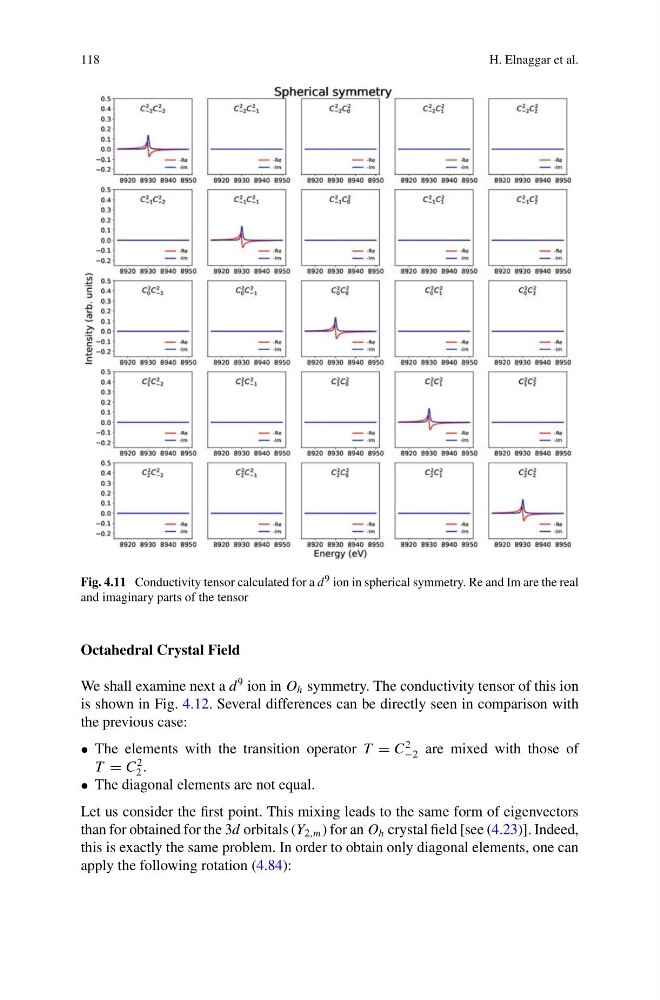
Fig. 4.11 Conductivity tensor calculated for a d 9 ion in spherical symmetry. Re and Im are the real
and imaginary parts of the tensor
Octahedral Crystal Field
We shall examine next a d
9 ion in O h symmetry. The conductivity tensor of this ion
is shown in Fig. 4.12. Several differences can be directly seen in comparison with
the previous case:
• The elements with the transition operator T = C
2
−2 are mixed with those of
T = C
2
2 .
• The diagonal elements are not equal.
Let us consider the first point. This mixing leads to the same form of eigenvectors
than for obtained for the 3d orbitals (Y 2,m ) for an O h crystal field [see (4.23)]. Indeed,
this is exactly the same problem. In order to obtain only diagonal elements, one can
apply the following rotation (4.84):
H. Elnaggar et al.
Fig. 4.11 Conductivity tensor calculated for a d 9 ion in spherical symmetry. Re and Im are the real
and imaginary parts of the tensor
Octahedral Crystal Field
We shall examine next a d
9 ion in O h symmetry. The conductivity tensor of this ion
is shown in Fig. 4.12. Several differences can be directly seen in comparison with
the previous case:
• The elements with the transition operator T = C
2
−2 are mixed with those of
T = C
2
2 .
• The diagonal elements are not equal.
Let us consider the first point. This mixing leads to the same form of eigenvectors
than for obtained for the 3d orbitals (Y 2,m ) for an O h crystal field [see (4.23)]. Indeed,
this is exactly the same problem. In order to obtain only diagonal elements, one can
apply the following rotation (4.84):