

4 X-ray Dichroisms in Spherical Tensor and Green’s Function Formalism
109
ˆ
T =
2
b=0
(−1)
b
{
1
⊗ k
1
}
b
.{r
1
⊗ r
1
}
b
,
ˆ
T † =
2
c=0
(−1)
c
{
1∗
⊗ k
1
}
c
.{r
1
⊗ r
1
}
c
.
(4.49)
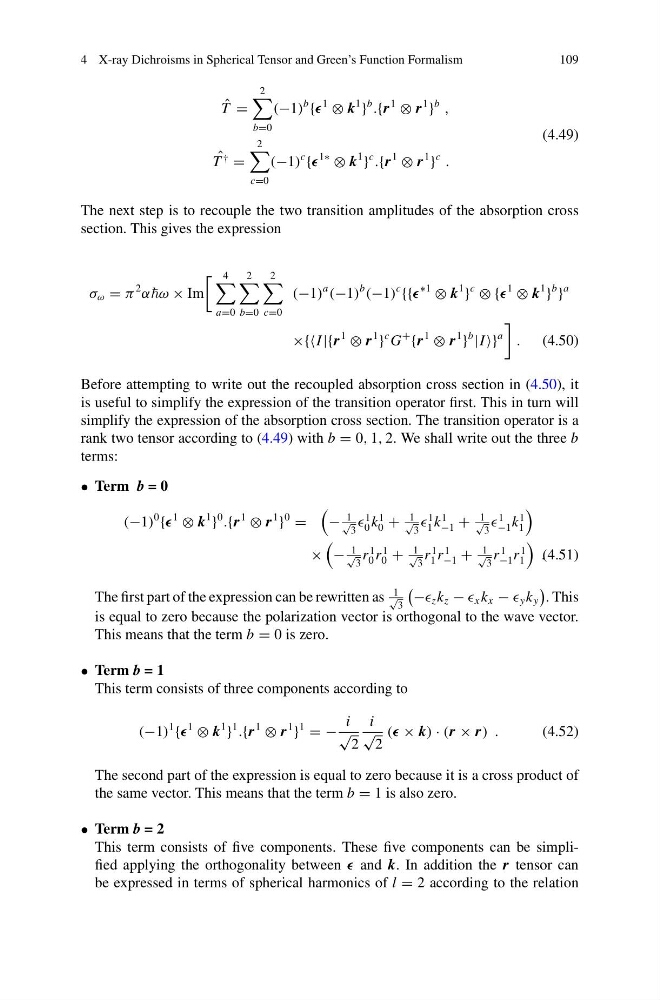
The next step is to recouple the two transition amplitudes of the absorption cross
section. This gives the expression
σ ω = π
2
αω × Im
4
a=0
2
b=0
2
c=0
(−1)
a
(−1)
b
(−1)
c
{{
∗1
⊗ k
1
}
c
⊗ {
1
⊗ k
1
}
b
}
a
×{{I |{r
1
⊗ r
1
}
c G
+
{r
1
⊗ r
1
}
b
|I }
a
. (4.50)
Before attempting to write out the recoupled absorption cross section in (4.50), it
is useful to simplify the expression of the transition operator first. This in turn will
simplify the expression of the absorption cross section. The transition operator is a
rank two tensor according to (4.49) with b = 0, 1, 2. We shall write out the three b
terms:
• Term b = 0
(−1)
0
{
1
⊗ k
1
}
0
.{r
1
⊗ r
1
}
0
=
−
1
√
3
1
0 k
1
0 +
1
√
3
1
1 k
1
−1 +
1
√
3
1
−1 k
1
1
×
−
1
√
3
r
1
0 r
1
0 +
1
√
3
r
1
1 r
1
−1 +
1
√
3
r
1
−1 r
1
1
. (4.51)
The first part of the expression can be rewritten as
1
√
3
− z k z − x k x − y k y
. This
is equal to zero because the polarization vector is orthogonal to the wave vector.
This means that the term b = 0 is zero.
• Term b = 1
This term consists of three components according to
(−1)
1
{
1
⊗ k
1
}
1
.{r
1
⊗ r
1
}
1
= −
i
√
2
i
√
2
( × k) · (r × r) .
(4.52)
The second part of the expression is equal to zero because it is a cross product of
the same vector. This means that the term b = 1 is also zero.
• Term b = 2
This term consists of five components. These five components can be simplified applying the orthogonality between and k. In addition the r tensor can
be expressed in terms of spherical harmonics of l = 2 according to the relation
109
ˆ
T =
2
b=0
(−1)
b
{
1
⊗ k
1
}
b
.{r
1
⊗ r
1
}
b
,
ˆ
T † =
2
c=0
(−1)
c
{
1∗
⊗ k
1
}
c
.{r
1
⊗ r
1
}
c
.
(4.49)
The next step is to recouple the two transition amplitudes of the absorption cross
section. This gives the expression
σ ω = π
2
αω × Im
4
a=0
2
b=0
2
c=0
(−1)
a
(−1)
b
(−1)
c
{{
∗1
⊗ k
1
}
c
⊗ {
1
⊗ k
1
}
b
}
a
×{{I |{r
1
⊗ r
1
}
c G
+
{r
1
⊗ r
1
}
b
|I }
a
. (4.50)
Before attempting to write out the recoupled absorption cross section in (4.50), it
is useful to simplify the expression of the transition operator first. This in turn will
simplify the expression of the absorption cross section. The transition operator is a
rank two tensor according to (4.49) with b = 0, 1, 2. We shall write out the three b
terms:
• Term b = 0
(−1)
0
{
1
⊗ k
1
}
0
.{r
1
⊗ r
1
}
0
=
−
1
√
3
1
0 k
1
0 +
1
√
3
1
1 k
1
−1 +
1
√
3
1
−1 k
1
1
×
−
1
√
3
r
1
0 r
1
0 +
1
√
3
r
1
1 r
1
−1 +
1
√
3
r
1
−1 r
1
1
. (4.51)
The first part of the expression can be rewritten as
1
√
3
− z k z − x k x − y k y
. This
is equal to zero because the polarization vector is orthogonal to the wave vector.
This means that the term b = 0 is zero.
• Term b = 1
This term consists of three components according to
(−1)
1
{
1
⊗ k
1
}
1
.{r
1
⊗ r
1
}
1
= −
i
√
2
i
√
2
( × k) · (r × r) .
(4.52)
The second part of the expression is equal to zero because it is a cross product of
the same vector. This means that the term b = 1 is also zero.
• Term b = 2
This term consists of five components. These five components can be simplified applying the orthogonality between and k. In addition the r tensor can
be expressed in terms of spherical harmonics of l = 2 according to the relation