

108
H. Elnaggar et al.
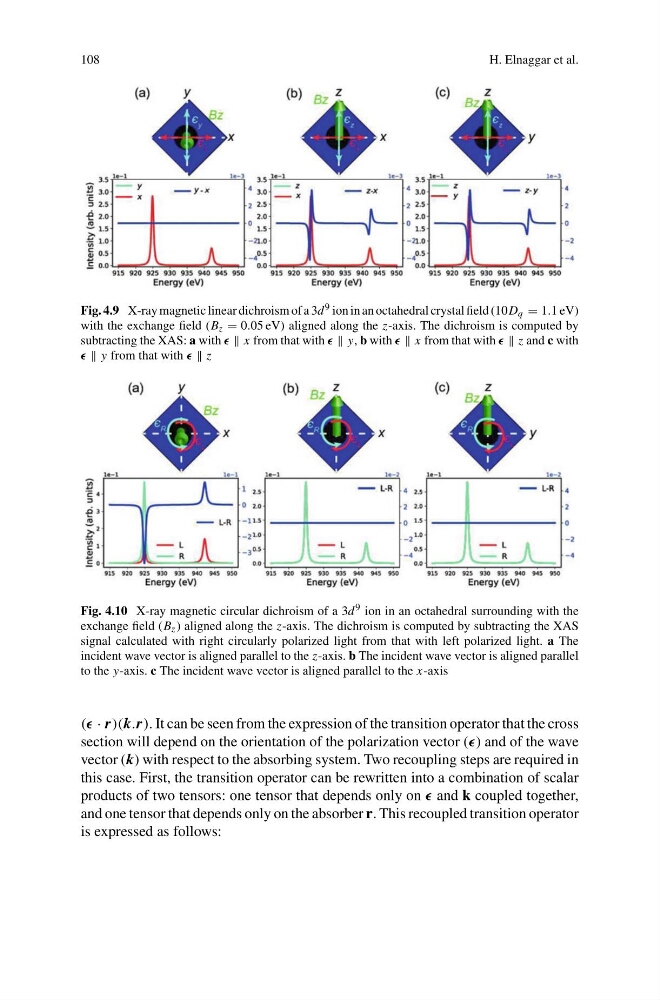
Fig. 4.9 X-ray magnetic linear dichroism of a 3d 9 ion in an octahedral crystal field (10D q = 1.1 eV)
with the exchange field (B z = 0.05 eV) aligned along the z-axis. The dichroism is computed by
subtracting the XAS: a with x from that with y, b with x from that with z and c with
y from that with z
Fig. 4.10 X-ray magnetic circular dichroism of a 3d 9 ion in an octahedral surrounding with the
exchange field (B z ) aligned along the z-axis. The dichroism is computed by subtracting the XAS
signal calculated with right circularly polarized light from that with left polarized light. a The
incident wave vector is aligned parallel to the z-axis. b The incident wave vector is aligned parallel
to the y-axis. c The incident wave vector is aligned parallel to the x-axis
( · r)(k.r). It can be seen from the expression of the transition operator that the cross
section will depend on the orientation of the polarization vector () and of the wave
vector (k) with respect to the absorbing system. Two recoupling steps are required in
this case. First, the transition operator can be rewritten into a combination of scalar
products of two tensors: one tensor that depends only on and k coupled together,
and one tensor that depends only on the absorber r. This recoupled transition operator
is expressed as follows:
H. Elnaggar et al.
Fig. 4.9 X-ray magnetic linear dichroism of a 3d 9 ion in an octahedral crystal field (10D q = 1.1 eV)
with the exchange field (B z = 0.05 eV) aligned along the z-axis. The dichroism is computed by
subtracting the XAS: a with x from that with y, b with x from that with z and c with
y from that with z
Fig. 4.10 X-ray magnetic circular dichroism of a 3d 9 ion in an octahedral surrounding with the
exchange field (B z ) aligned along the z-axis. The dichroism is computed by subtracting the XAS
signal calculated with right circularly polarized light from that with left polarized light. a The
incident wave vector is aligned parallel to the z-axis. b The incident wave vector is aligned parallel
to the y-axis. c The incident wave vector is aligned parallel to the x-axis
( · r)(k.r). It can be seen from the expression of the transition operator that the cross
section will depend on the orientation of the polarization vector () and of the wave
vector (k) with respect to the absorbing system. Two recoupling steps are required in
this case. First, the transition operator can be rewritten into a combination of scalar
products of two tensors: one tensor that depends only on and k coupled together,
and one tensor that depends only on the absorber r. This recoupled transition operator
is expressed as follows: