

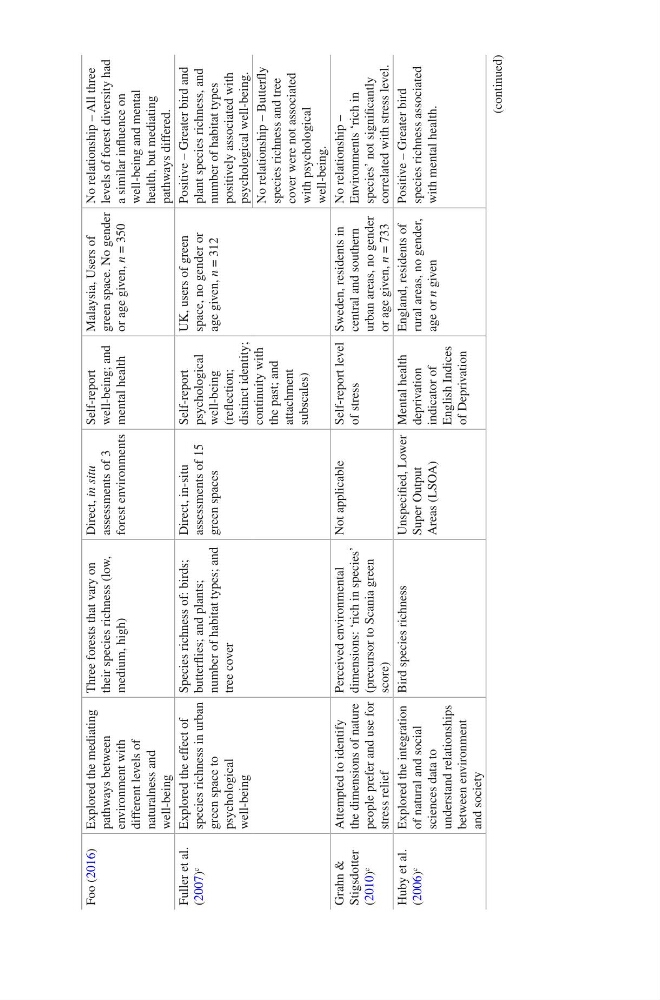
Reference
Objectives
Biodiversity indicator
Contact with
nature
a
Health outcome
(measure
b
)
Population
General result
Foo (2016)
Explored the mediating
pathways between
environment with
different levels of
naturalness and
well-being
Three forests that vary on
their species richness (low,
medium, high)
Direct, in situ
assessments of 3
forest environments
Self-report
well-being; and
mental health
Malaysia, Users of
green space. No gender
or age given, n = 350
No relationship – All three
levels of forest diversity had
a similar influence on
well-being and mental
health, but mediating
pathways differed.
Fuller et al.
(2007)
c
Explored the effect of
species richness in urban
green space to
psychological
well-being
Species richness of: birds;
butterflies; and plants;
number of habitat types; and
tree cover
Direct, in-situ
assessments of 15
green spaces
Self-report
psychological
well-being
(reflection;
distinct identity;
continuity with
the past; and
attachment
subscales)
UK, users of green
space, no gender or
age given, n = 312
Positive – Greater bird and
plant species richness, and
number of habitat types
positively associated with
psychological well-being.
No relationship – Butterfly
species richness and tree
cover were not associated
with psychological
well-being.
Grahn &
Stigsdotter
(2010)
c
Attempted to identify
the dimensions of nature
people prefer and use for
stress relief
Perceived environmental
dimensions: ‘rich in species’
(precursor to Scania green
score)
Not applicable
Self-report level
of stress
Sweden, residents in
central and southern
urban areas, no gender
or age given, n = 733
No relationship –
Environments ‘rich in
species’ not significantly
correlated with stress level.
Huby et al.
(2006)
c
Explored the integration
of natural and social
sciences data to
understand relationships
between environment
and society
Bird species richness
Unspecified, Lower
Super Output
Areas (LSOA)
Mental health
deprivation
indicator of
English Indices
of Deprivation
England, residents of
rural areas, no gender,
age or n
given
Positive – Greater bird
species richness associated
with mental health.
(continued)
Objectives
Biodiversity indicator
Contact with
nature
a
Health outcome
(measure
b
)
Population
General result
Foo (2016)
Explored the mediating
pathways between
environment with
different levels of
naturalness and
well-being
Three forests that vary on
their species richness (low,
medium, high)
Direct, in situ
assessments of 3
forest environments
Self-report
well-being; and
mental health
Malaysia, Users of
green space. No gender
or age given, n = 350
No relationship – All three
levels of forest diversity had
a similar influence on
well-being and mental
health, but mediating
pathways differed.
Fuller et al.
(2007)
c
Explored the effect of
species richness in urban
green space to
psychological
well-being
Species richness of: birds;
butterflies; and plants;
number of habitat types; and
tree cover
Direct, in-situ
assessments of 15
green spaces
Self-report
psychological
well-being
(reflection;
distinct identity;
continuity with
the past; and
attachment
subscales)
UK, users of green
space, no gender or
age given, n = 312
Positive – Greater bird and
plant species richness, and
number of habitat types
positively associated with
psychological well-being.
No relationship – Butterfly
species richness and tree
cover were not associated
with psychological
well-being.
Grahn &
Stigsdotter
(2010)
c
Attempted to identify
the dimensions of nature
people prefer and use for
stress relief
Perceived environmental
dimensions: ‘rich in species’
(precursor to Scania green
score)
Not applicable
Self-report level
of stress
Sweden, residents in
central and southern
urban areas, no gender
or age given, n = 733
No relationship –
Environments ‘rich in
species’ not significantly
correlated with stress level.
Huby et al.
(2006)
c
Explored the integration
of natural and social
sciences data to
understand relationships
between environment
and society
Bird species richness
Unspecified, Lower
Super Output
Areas (LSOA)
Mental health
deprivation
indicator of
English Indices
of Deprivation
England, residents of
rural areas, no gender,
age or n
given
Positive – Greater bird
species richness associated
with mental health.
(continued)