

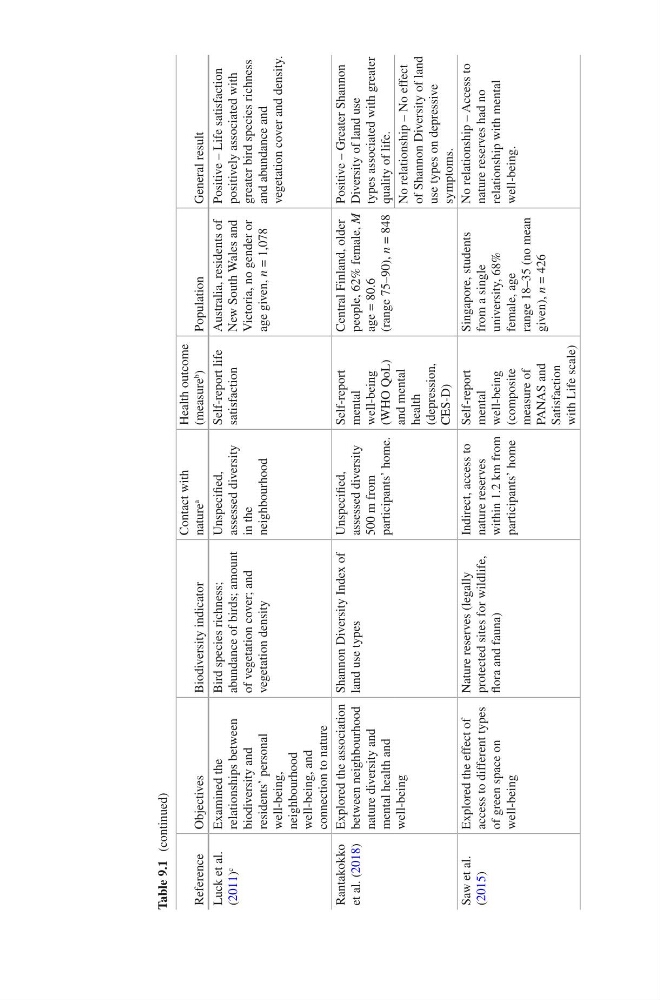
Table 9.1 (continued)
Reference
Objectives
Biodiversity indicator
Contact with
nature
a
Health outcome
(measure
b
)
Population
General result
Luck et al.
(2011)
c
Examined the
relationships between
biodiversity and
residents’ personal
well-being,
neighbourhood
well- being, and
connection to nature
Bird species richness;
abundance of birds; amount
of vegetation cover; and
vegetation density
Unspecified,
assessed diversity
in the
neighbourhood
Self-report life
satisfaction
Australia, residents of
New South Wales and
Victoria, no gender or
age given, n = 1,078
Positive – Life satisfaction
positively associated with
greater bird species richness
and abundance and
vegetation cover and density.
Rantakokko
et al. (2018)
Explored the association
between neighbourhood
nature diversity and
mental health and
well-being
Shannon Diversity Index of
land use types
Unspecified,
assessed diversity
500 m from
participants’ home.
Self-report
mental
well-being
(WHO QoL)
and mental
health
(depression,
CES-D)
Central Finland, older
people, 62% female, M
age = 80.6
(range 75–90), n = 848
Positive – Greater Shannon
Diversity of land use
types associated with greater
quality of life.
No relationship – No effect
of Shannon Diversity of land
use types on depressive
symptoms.
Saw et al.
(2015)
Explored the effect of
access to different types
of green space on
well-being
Nature reserves (legally
protected sites for wildlife,
flora and fauna)
Indirect, access to
nature reserves
within 1.2 km from
participants’ home
Self-report
mental
well-being
(composite
measure of
PANAS and
Satisfaction
with Life scale)
Singapore, students
from a single
university, 68%
female, age
range 18–35 (no mean
given), n = 426
No relationship – Access to
nature reserves had no
relationship with mental
well-being.
Reference
Objectives
Biodiversity indicator
Contact with
nature
a
Health outcome
(measure
b
)
Population
General result
Luck et al.
(2011)
c
Examined the
relationships between
biodiversity and
residents’ personal
well-being,
neighbourhood
well- being, and
connection to nature
Bird species richness;
abundance of birds; amount
of vegetation cover; and
vegetation density
Unspecified,
assessed diversity
in the
neighbourhood
Self-report life
satisfaction
Australia, residents of
New South Wales and
Victoria, no gender or
age given, n = 1,078
Positive – Life satisfaction
positively associated with
greater bird species richness
and abundance and
vegetation cover and density.
Rantakokko
et al. (2018)
Explored the association
between neighbourhood
nature diversity and
mental health and
well-being
Shannon Diversity Index of
land use types
Unspecified,
assessed diversity
500 m from
participants’ home.
Self-report
mental
well-being
(WHO QoL)
and mental
health
(depression,
CES-D)
Central Finland, older
people, 62% female, M
age = 80.6
(range 75–90), n = 848
Positive – Greater Shannon
Diversity of land use
types associated with greater
quality of life.
No relationship – No effect
of Shannon Diversity of land
use types on depressive
symptoms.
Saw et al.
(2015)
Explored the effect of
access to different types
of green space on
well-being
Nature reserves (legally
protected sites for wildlife,
flora and fauna)
Indirect, access to
nature reserves
within 1.2 km from
participants’ home
Self-report
mental
well-being
(composite
measure of
PANAS and
Satisfaction
with Life scale)
Singapore, students
from a single
university, 68%
female, age
range 18–35 (no mean
given), n = 426
No relationship – Access to
nature reserves had no
relationship with mental
well-being.