

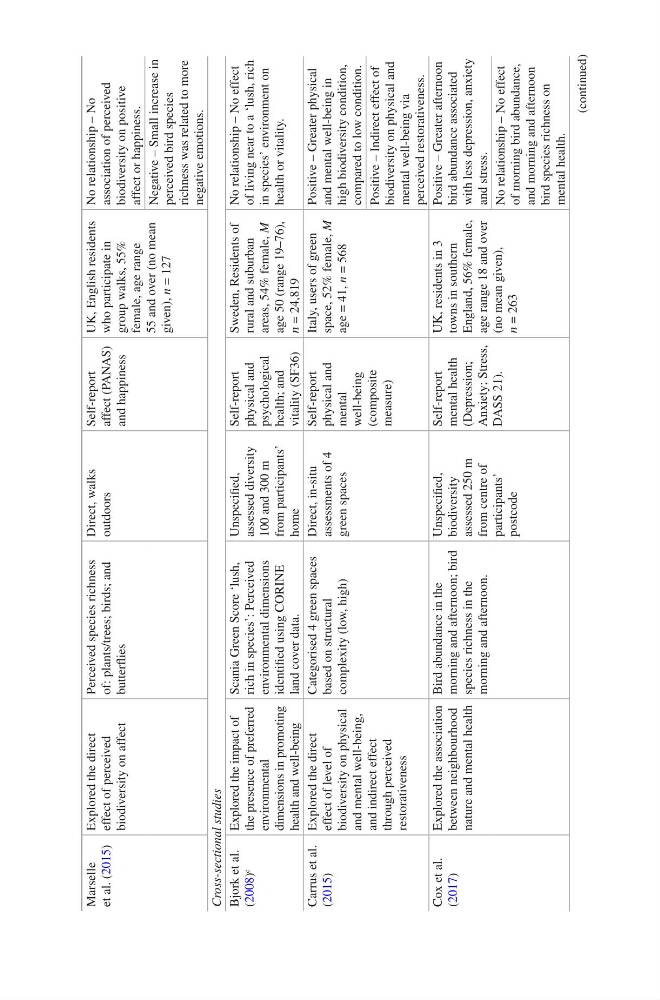
Reference
Objectives
Biodiversity indicator
Contact with
nature
a
Health outcome
(measure
b
)
Population
General result
Marselle
et al. (2015)
Explored the direct
effect of perceived
biodiversity on affect
Perceived species richness
of: plants/trees; birds; and
butterflies
Direct, walks
outdoors
Self-report
affect (PANAS)
and happiness
UK, English residents
who participate in
group walks, 55%
female, age range
55 and over (no mean
given), n = 127
No relationship – No
association of perceived
biodiversity on positive
affect or happiness.
Negative – Small increase in
perceived bird species
richness was related to more
negative emotions.
Cross-sectional studies
Bjork et al.
(2008)
c
Explored the impact of
the presence of preferred
environmental
dimensions in promoting
health and well-being
Scania Green Score ‘lush,
rich in species’: Perceived
environmental dimensions
identified using CORINE
land cover data.
Unspecified,
assessed diversity
100 and 300 m
from participants’
home
Self-report
physical and
psychological
health; and
vitality (SF36)
Sweden, Residents of
rural and suburban
areas, 54% female, M
age 50 (range 19–76),
n = 24,819
No relationship – No effect
of living near to a ‘lush, rich
in species’ environment on
health or vitality.
Carrus et al.
(2015)
Explored the direct
effect of level of
biodiversity on physical
and mental well-being,
and indirect effect
through perceived
restorativeness
Categorised 4 green spaces
based on structural
complexity (low, high)
Direct, in-situ
assessments of 4
green spaces
Self-report
physical and
mental
well-being
(composite
measure)
Italy, users of green
space, 52% female, M
age = 41, n = 568
Positive – Greater physical
and mental well-being in
high biodiversity condition,
compared to low condition.
Positive – Indirect effect of
biodiversity on physical and
mental well-being via
perceived restorativeness.
Cox et al.
(2017)
Explored the association
between neighbourhood
nature and mental health
Bird abundance in the
morning and afternoon; bird
species richness in the
morning and afternoon.
Unspecified,
biodiversity
assessed 250 m
from centre of
participants’
postcode
Self-report
mental health
(Depression;
Anxiety; Stress,
DASS 21).
UK, residents in 3
towns in southern
England, 56% female,
age range 18 and over
(no mean given),
n = 263
Positive – Greater afternoon
bird abundance associated
with less depression, anxiety
and stress.
No relationship – No effect
of morning bird abundance,
and morning and afternoon
bird species richness on
mental health.
(continued)
Objectives
Biodiversity indicator
Contact with
nature
a
Health outcome
(measure
b
)
Population
General result
Marselle
et al. (2015)
Explored the direct
effect of perceived
biodiversity on affect
Perceived species richness
of: plants/trees; birds; and
butterflies
Direct, walks
outdoors
Self-report
affect (PANAS)
and happiness
UK, English residents
who participate in
group walks, 55%
female, age range
55 and over (no mean
given), n = 127
No relationship – No
association of perceived
biodiversity on positive
affect or happiness.
Negative – Small increase in
perceived bird species
richness was related to more
negative emotions.
Cross-sectional studies
Bjork et al.
(2008)
c
Explored the impact of
the presence of preferred
environmental
dimensions in promoting
health and well-being
Scania Green Score ‘lush,
rich in species’: Perceived
environmental dimensions
identified using CORINE
land cover data.
Unspecified,
assessed diversity
100 and 300 m
from participants’
home
Self-report
physical and
psychological
health; and
vitality (SF36)
Sweden, Residents of
rural and suburban
areas, 54% female, M
age 50 (range 19–76),
n = 24,819
No relationship – No effect
of living near to a ‘lush, rich
in species’ environment on
health or vitality.
Carrus et al.
(2015)
Explored the direct
effect of level of
biodiversity on physical
and mental well-being,
and indirect effect
through perceived
restorativeness
Categorised 4 green spaces
based on structural
complexity (low, high)
Direct, in-situ
assessments of 4
green spaces
Self-report
physical and
mental
well-being
(composite
measure)
Italy, users of green
space, 52% female, M
age = 41, n = 568
Positive – Greater physical
and mental well-being in
high biodiversity condition,
compared to low condition.
Positive – Indirect effect of
biodiversity on physical and
mental well-being via
perceived restorativeness.
Cox et al.
(2017)
Explored the association
between neighbourhood
nature and mental health
Bird abundance in the
morning and afternoon; bird
species richness in the
morning and afternoon.
Unspecified,
biodiversity
assessed 250 m
from centre of
participants’
postcode
Self-report
mental health
(Depression;
Anxiety; Stress,
DASS 21).
UK, residents in 3
towns in southern
England, 56% female,
age range 18 and over
(no mean given),
n = 263
Positive – Greater afternoon
bird abundance associated
with less depression, anxiety
and stress.
No relationship – No effect
of morning bird abundance,
and morning and afternoon
bird species richness on
mental health.
(continued)