

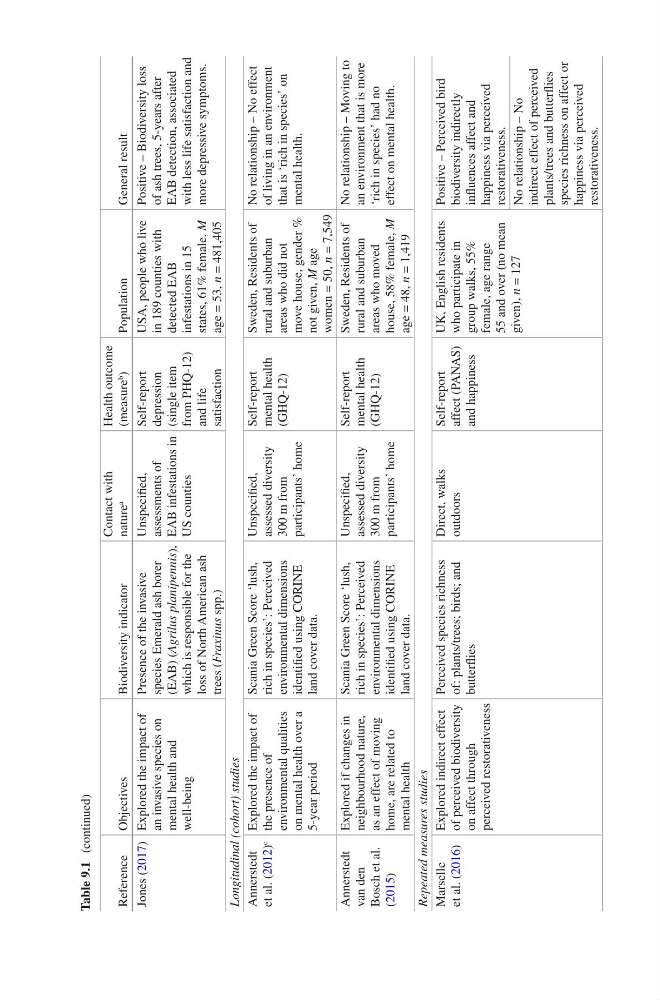
Table 9.1 (continued)
Reference
Objectives
Biodiversity indicator
Contact with
nature
a
Health outcome
(measure
b
)
Population
General result
Jones (2017) Explored the impact of
an invasive species on
mental health and
well-being
Presence of the invasive
species Emerald ash borer
(EAB) (Agrilus planipennis),
which is responsible for the
loss of North American ash
trees (Fraxinus spp.)
Unspecified,
assessments of
EAB infestations in
US counties
Self-report
depression
(single item
from PHQ-12)
and life
satisfaction
USA, people who live
in 189 counties with
detected EAB
infestations in 15
states, 61% female, M
age = 53, n = 481,405
Positive – Biodiversity loss
of ash trees, 5-years after
EAB detection, associated
with less life satisfaction and
more depressive symptoms.
Longitudinal (cohort) studies
Annerstedt
et al. (2012)
c
Explored the impact of
the presence of
environmental qualities
on mental health over a
5-year period
Scania Green Score ‘lush,
rich in species’: Perceived
environmental dimensions
identified using CORINE
land cover data.
Unspecified,
assessed diversity
300 m from
participants’ home
Self-report
mental health
(GHQ-12)
Sweden, Residents of
rural and suburban
areas who did not
move house, gender %
not given, M
age
women = 50, n = 7,549
No relationship – No effect
of living in an environment
that is ‘rich in species’ on
mental health.
Annerstedt
van den
Bosch et al.
(2015)
Explored if changes in
neighbourhood nature,
as an effect of moving
home, are related to
mental health
Scania Green Score ‘lush,
rich in species’: Perceived
environmental dimensions
identified using CORINE
land cover data.
Unspecified,
assessed diversity
300 m from
participants’ home
Self-report
mental health
(GHQ-12)
Sweden, Residents of
rural and suburban
areas who moved
house, 58% female, M
age = 48, n = 1,419
No relationship – Moving to
an environment that is more
‘rich in species’ had no
effect on mental health.
Repeated measures studies
Marselle
et al. (2016)
Explored indirect effect
of perceived biodiversity
on affect through
perceived restorativeness
Perceived species richness
of: plants/trees; birds; and
butterflies
Direct, walks
outdoors
Self-report
affect (PANAS)
and happiness
UK, English residents
who participate in
group walks, 55%
female, age range
55 and over (no mean
given), n = 127
Positive – Perceived bird
biodiversity indirectly
influences affect and
happiness via perceived
restorativeness.
No relationship – No
indirect effect of perceived
plants/trees and butterflies
species richness on affect or
happiness via perceived
restorativeness.
Reference
Objectives
Biodiversity indicator
Contact with
nature
a
Health outcome
(measure
b
)
Population
General result
Jones (2017) Explored the impact of
an invasive species on
mental health and
well-being
Presence of the invasive
species Emerald ash borer
(EAB) (Agrilus planipennis),
which is responsible for the
loss of North American ash
trees (Fraxinus spp.)
Unspecified,
assessments of
EAB infestations in
US counties
Self-report
depression
(single item
from PHQ-12)
and life
satisfaction
USA, people who live
in 189 counties with
detected EAB
infestations in 15
states, 61% female, M
age = 53, n = 481,405
Positive – Biodiversity loss
of ash trees, 5-years after
EAB detection, associated
with less life satisfaction and
more depressive symptoms.
Longitudinal (cohort) studies
Annerstedt
et al. (2012)
c
Explored the impact of
the presence of
environmental qualities
on mental health over a
5-year period
Scania Green Score ‘lush,
rich in species’: Perceived
environmental dimensions
identified using CORINE
land cover data.
Unspecified,
assessed diversity
300 m from
participants’ home
Self-report
mental health
(GHQ-12)
Sweden, Residents of
rural and suburban
areas who did not
move house, gender %
not given, M
age
women = 50, n = 7,549
No relationship – No effect
of living in an environment
that is ‘rich in species’ on
mental health.
Annerstedt
van den
Bosch et al.
(2015)
Explored if changes in
neighbourhood nature,
as an effect of moving
home, are related to
mental health
Scania Green Score ‘lush,
rich in species’: Perceived
environmental dimensions
identified using CORINE
land cover data.
Unspecified,
assessed diversity
300 m from
participants’ home
Self-report
mental health
(GHQ-12)
Sweden, Residents of
rural and suburban
areas who moved
house, 58% female, M
age = 48, n = 1,419
No relationship – Moving to
an environment that is more
‘rich in species’ had no
effect on mental health.
Repeated measures studies
Marselle
et al. (2016)
Explored indirect effect
of perceived biodiversity
on affect through
perceived restorativeness
Perceived species richness
of: plants/trees; birds; and
butterflies
Direct, walks
outdoors
Self-report
affect (PANAS)
and happiness
UK, English residents
who participate in
group walks, 55%
female, age range
55 and over (no mean
given), n = 127
Positive – Perceived bird
biodiversity indirectly
influences affect and
happiness via perceived
restorativeness.
No relationship – No
indirect effect of perceived
plants/trees and butterflies
species richness on affect or
happiness via perceived
restorativeness.