

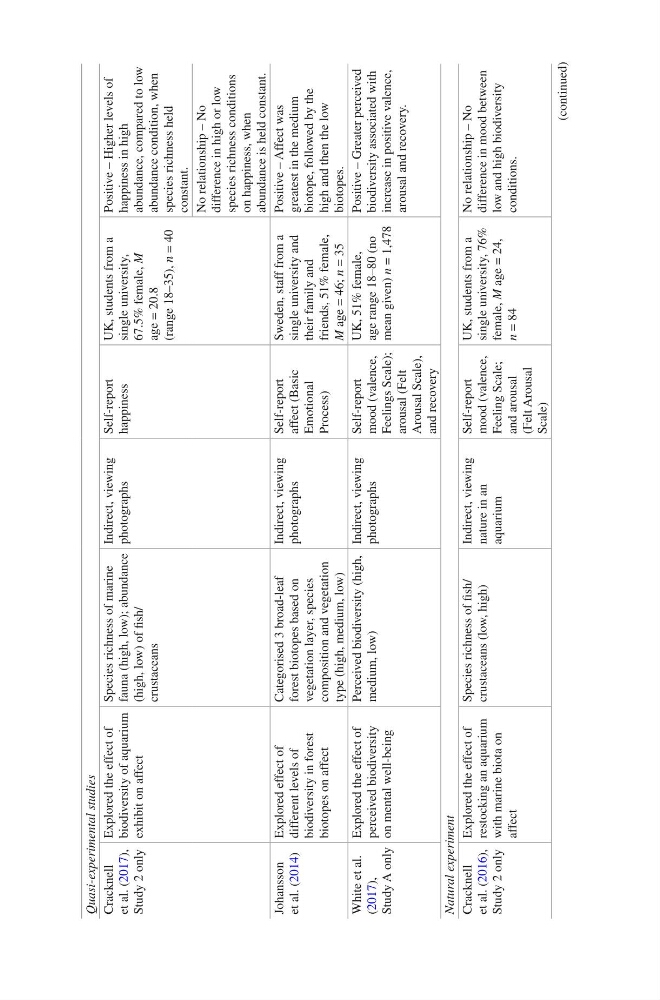
Reference
Objectives
Biodiversity indicator
Contact with
nature
a
Health outcome
(measure
b
)
Population
General result
Quasi-experimental studies
Cracknell
et al. (2017),
Study 2 only
Explored the effect of
biodiversity of aquarium
exhibit on affect
Species richness of marine
fauna (high, low); abundance
(high, low) of fish/
crustaceans
Indirect, viewing
photographs
Self-report
happiness
UK, students from a
single university,
67.5% female, M
age = 20.8
(range 18–35), n = 40
Positive – Higher levels of
happiness in high
abundance, compared to low
abundance condition, when
species richness held
constant.
No relationship – No
difference in high or low
species richness conditions
on happiness, when
abundance is held constant.
Johansson
et al. (2014)
Explored effect of
different levels of
biodiversity in forest
biotopes on affect
Categorised 3 broad-leaf
forest biotopes based on
vegetation layer, species
composition and vegetation
type (high, medium, low)
Indirect, viewing
photographs
Self-report
affect (Basic
Emotional
Process)
Sweden, staff from a
single university and
their family and
friends, 51% female,
M
age = 46; n = 35
Positive – Affect was
greatest in the medium
biotope, followed by the
high and then the low
biotopes.
White et al.
(2017),
Study A only
Explored the effect of
perceived biodiversity
on mental well-being
Perceived biodiversity (high,
medium, low)
Indirect, viewing
photographs
Self-report
mood (valence,
Feelings Scale);
arousal (Felt
Arousal Scale),
and recovery
UK, 51% female,
age range 18–80 (no
mean given) n = 1,478
Positive – Greater perceived
biodiversity associated with
increase in positive valence,
arousal and recovery.
Natural experiment
Cracknell
et al. (2016),
Study 2 only
Explored the effect of
restocking an aquarium
with marine biota on
affect
Species richness of fish/
crustaceans (low, high)
Indirect, viewing
nature in an
aquarium
Self-report
mood (valence,
Feeling Scale;
and arousal
(Felt Arousal
Scale)
UK, students from a
single university, 76%
female, M
age = 24,
n = 84
No relationship – No
difference in mood between
low and high biodiversity
conditions.
(continued)
Objectives
Biodiversity indicator
Contact with
nature
a
Health outcome
(measure
b
)
Population
General result
Quasi-experimental studies
Cracknell
et al. (2017),
Study 2 only
Explored the effect of
biodiversity of aquarium
exhibit on affect
Species richness of marine
fauna (high, low); abundance
(high, low) of fish/
crustaceans
Indirect, viewing
photographs
Self-report
happiness
UK, students from a
single university,
67.5% female, M
age = 20.8
(range 18–35), n = 40
Positive – Higher levels of
happiness in high
abundance, compared to low
abundance condition, when
species richness held
constant.
No relationship – No
difference in high or low
species richness conditions
on happiness, when
abundance is held constant.
Johansson
et al. (2014)
Explored effect of
different levels of
biodiversity in forest
biotopes on affect
Categorised 3 broad-leaf
forest biotopes based on
vegetation layer, species
composition and vegetation
type (high, medium, low)
Indirect, viewing
photographs
Self-report
affect (Basic
Emotional
Process)
Sweden, staff from a
single university and
their family and
friends, 51% female,
M
age = 46; n = 35
Positive – Affect was
greatest in the medium
biotope, followed by the
high and then the low
biotopes.
White et al.
(2017),
Study A only
Explored the effect of
perceived biodiversity
on mental well-being
Perceived biodiversity (high,
medium, low)
Indirect, viewing
photographs
Self-report
mood (valence,
Feelings Scale);
arousal (Felt
Arousal Scale),
and recovery
UK, 51% female,
age range 18–80 (no
mean given) n = 1,478
Positive – Greater perceived
biodiversity associated with
increase in positive valence,
arousal and recovery.
Natural experiment
Cracknell
et al. (2016),
Study 2 only
Explored the effect of
restocking an aquarium
with marine biota on
affect
Species richness of fish/
crustaceans (low, high)
Indirect, viewing
nature in an
aquarium
Self-report
mood (valence,
Feeling Scale;
and arousal
(Felt Arousal
Scale)
UK, students from a
single university, 76%
female, M
age = 24,
n = 84
No relationship – No
difference in mood between
low and high biodiversity
conditions.
(continued)