

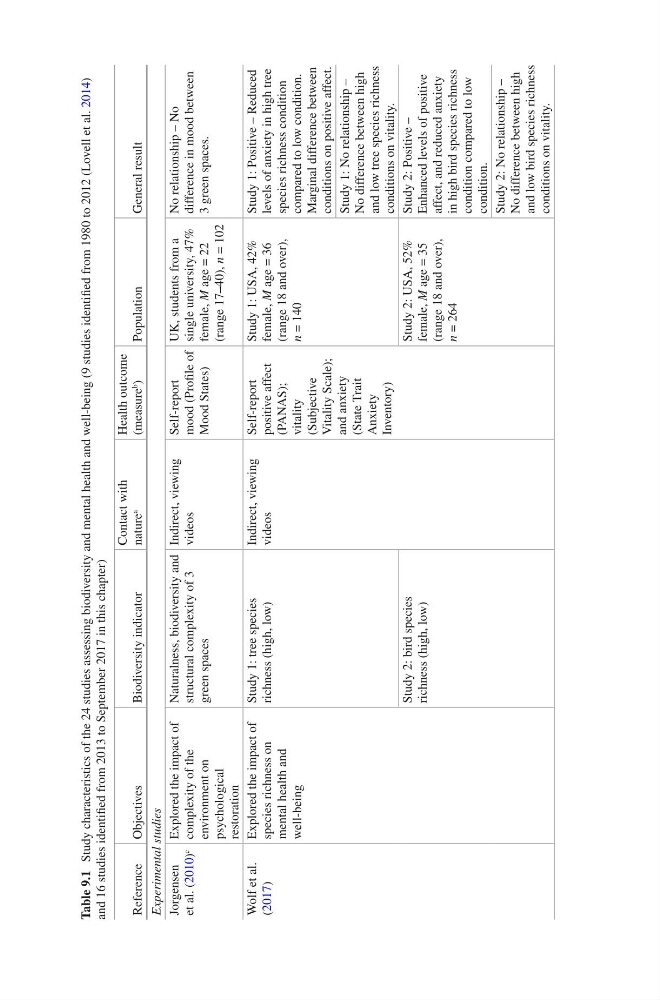
Table 9.1 Study characteristics of the 24 studies assessing biodiversity and mental health and well-being (9 studies identified from 1980 to 2012 (Lovell et al. 2014)
and 16 studies identified from 2013 to September 2017 in this chapter)
Reference
Objectives
Biodiversity indicator
Contact with
nature
a
Health outcome
(measure
b
)
Population
General result
Experimental studies
Jorgensen
et al. (2010)
c
Explored the impact of
complexity of the
environment on
psychological
restoration
Naturalness, biodiversity and
structural complexity of 3
green spaces
Indirect, viewing
videos
Self-report
mood (Profile of
Mood States)
UK, students from a
single university, 47%
female, M
age = 22
(range 17–40), n = 102
No relationship – No
difference in mood between
3 green spaces.
Wolf et al.
(2017)
Explored the impact of
species richness on
mental health and
well-being
Study 1: tree species
richness (high, low)
Indirect, viewing
videos
Self-report
positive affect
(PANAS);
vitality
(Subjective
Vitality Scale);
and anxiety
(State Trait
Anxiety
Inventory)
Study 1: USA, 42%
female, M
age = 36
(range 18 and over),
n = 140
Study 1: Positive – Reduced
levels of anxiety in high tree
species richness condition
compared to low condition.
Marginal difference between
conditions on positive affect.
Study 1: No relationship –
No difference between high
and low tree species richness
conditions on vitality.
Study 2: bird species
richness (high, low)
Study 2: USA, 52%
female, M
age = 35
(range 18 and over),
n = 264
Study 2: Positive –
Enhanced levels of positive
affect, and reduced anxiety
in high bird species richness
condition compared to low
condition.
Study 2: No relationship –
No difference between high
and low bird species richness
conditions on vitality.
and 16 studies identified from 2013 to September 2017 in this chapter)
Reference
Objectives
Biodiversity indicator
Contact with
nature
a
Health outcome
(measure
b
)
Population
General result
Experimental studies
Jorgensen
et al. (2010)
c
Explored the impact of
complexity of the
environment on
psychological
restoration
Naturalness, biodiversity and
structural complexity of 3
green spaces
Indirect, viewing
videos
Self-report
mood (Profile of
Mood States)
UK, students from a
single university, 47%
female, M
age = 22
(range 17–40), n = 102
No relationship – No
difference in mood between
3 green spaces.
Wolf et al.
(2017)
Explored the impact of
species richness on
mental health and
well-being
Study 1: tree species
richness (high, low)
Indirect, viewing
videos
Self-report
positive affect
(PANAS);
vitality
(Subjective
Vitality Scale);
and anxiety
(State Trait
Anxiety
Inventory)
Study 1: USA, 42%
female, M
age = 36
(range 18 and over),
n = 140
Study 1: Positive – Reduced
levels of anxiety in high tree
species richness condition
compared to low condition.
Marginal difference between
conditions on positive affect.
Study 1: No relationship –
No difference between high
and low tree species richness
conditions on vitality.
Study 2: bird species
richness (high, low)
Study 2: USA, 52%
female, M
age = 35
(range 18 and over),
n = 264
Study 2: Positive –
Enhanced levels of positive
affect, and reduced anxiety
in high bird species richness
condition compared to low
condition.
Study 2: No relationship –
No difference between high
and low bird species richness
conditions on vitality.