

179
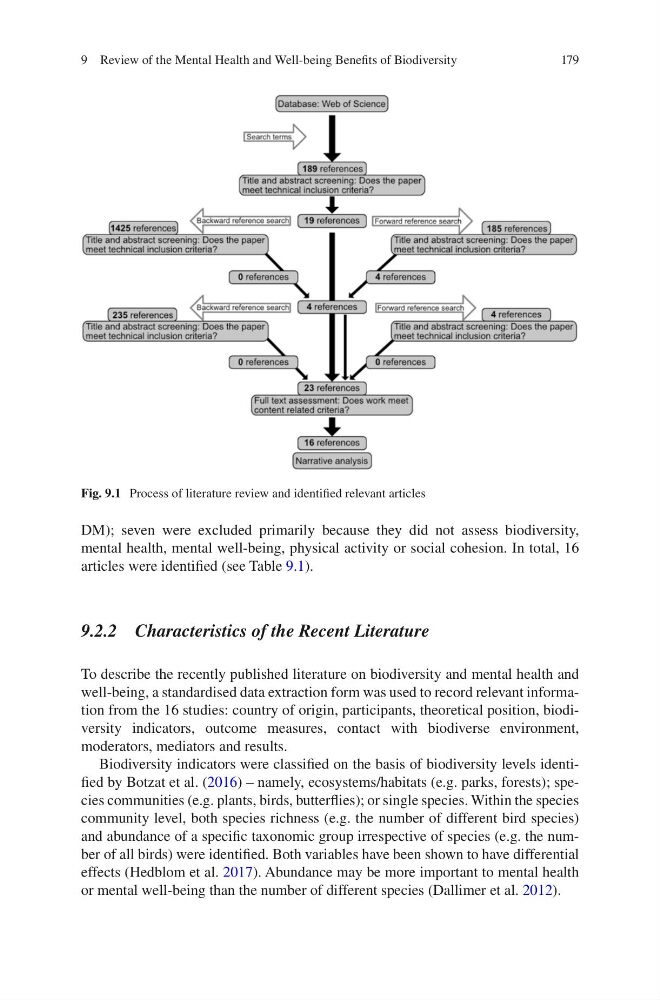
DM); seven were excluded primarily because they did not assess biodiversity,
mental health, mental well-being, physical activity or social cohesion. In total, 16
articles were identified (see Table 9.1).
9.2.2 Characteristics of the Recent Literature
To describe the recently published literature on biodiversity and mental health and
well-being, a standardised data extraction form was used to record relevant information from the 16 studies: country of origin, participants, theoretical position, biodiversity indicators, outcome measures, contact with biodiverse environment,
moderators, mediators and results.
Biodiversity indicators were classified on the basis of biodiversity levels identified by Botzat et al. (2016) – namely, ecosystems/habitats (e.g. parks, forests); species communities (e.g. plants, birds, butterflies); or single species. Within the species
community level, both species richness (e.g. the number of different bird species)
and abundance of a specific taxonomic group irrespective of species (e.g. the number of all birds) were identified. Both variables have been shown to have differential
effects (Hedblom et al. 2017). Abundance may be more important to mental health
or mental well-being than the number of different species (Dallimer et al. 2012).
Fig. 9.1 Process of literature review and identified relevant articles
9 Review of the Mental Health and Well-being Benefits of Biodiversity
DM); seven were excluded primarily because they did not assess biodiversity,
mental health, mental well-being, physical activity or social cohesion. In total, 16
articles were identified (see Table 9.1).
9.2.2 Characteristics of the Recent Literature
To describe the recently published literature on biodiversity and mental health and
well-being, a standardised data extraction form was used to record relevant information from the 16 studies: country of origin, participants, theoretical position, biodiversity indicators, outcome measures, contact with biodiverse environment,
moderators, mediators and results.
Biodiversity indicators were classified on the basis of biodiversity levels identified by Botzat et al. (2016) – namely, ecosystems/habitats (e.g. parks, forests); species communities (e.g. plants, birds, butterflies); or single species. Within the species
community level, both species richness (e.g. the number of different bird species)
and abundance of a specific taxonomic group irrespective of species (e.g. the number of all birds) were identified. Both variables have been shown to have differential
effects (Hedblom et al. 2017). Abundance may be more important to mental health
or mental well-being than the number of different species (Dallimer et al. 2012).
Fig. 9.1 Process of literature review and identified relevant articles
9 Review of the Mental Health and Well-being Benefits of Biodiversity