

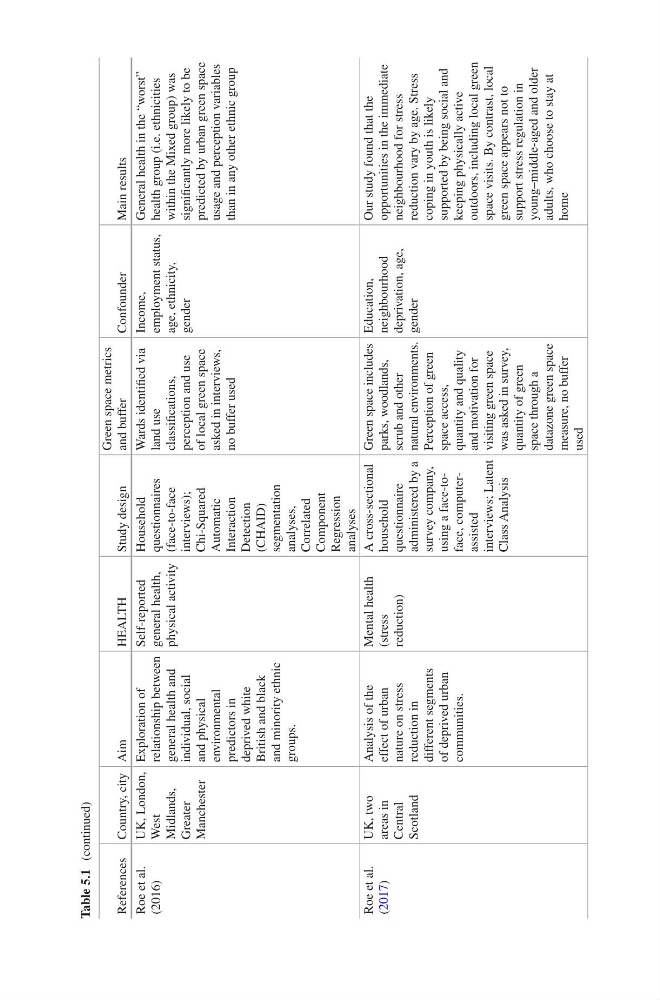
Table 5.1 (continued)
References Country, city Aim
HEALTH
Study design
Green space metrics
and buffer
Confounder
Main results
Roe et al.
(2016)
UK, London,
West
Midlands,
Greater
Manchester
Exploration of
relationship between
general health and
individual, social
and physical
environmental
predictors in
deprived white
British and black
and minority ethnic
groups.
Self-reported
general health,
physical activity
Household
questionnaires
(face-to-face
interviews);
Chi-Squared
Automatic
Interaction
Detection
(CHAID)
segmentation
analyses,
Correlated
Component
Regression
analyses
Wards identified via
land use
classifications,
perception and use
of local green space
asked in interviews,
no buffer used
Income,
employment status,
age, ethnicity,
gender
General health in the “worst”
health group (i.e. ethnicities
within the Mixed group) was
significantly more likely to be
predicted by urban green space
usage and perception variables
than in any other ethnic group
Roe et al.
(2017)
UK, two
areas in
Central
Scotland
Analysis of the
effect of urban
nature on stress
reduction in
different segments
of deprived urban
communities.
Mental health
(stress
reduction)
A cross- sectional
household
questionnaire
administered by a
survey company,
using a face-toface, computerassisted
interviews; Latent
Class Analysis
Green space includes
parks, woodlands,
scrub and other
natural environments.
Perception of green
space access,
quantity and quality
and motivation for
visiting green space
was asked in survey,
quantity of green
space through a
datazone green space
measure, no buffer
used
Education,
neighbourhood
deprivation, age,
gender
Our study found that the
opportunities in the immediate
neighbourhood for stress
reduction vary by age. Stress
coping in youth is likely
supported by being social and
keeping physically active
outdoors, including local green
space visits. By contrast, local
green space appears not to
support stress regulation in
young–middle- aged and older
adults, who choose to stay at
home
References Country, city Aim
HEALTH
Study design
Green space metrics
and buffer
Confounder
Main results
Roe et al.
(2016)
UK, London,
West
Midlands,
Greater
Manchester
Exploration of
relationship between
general health and
individual, social
and physical
environmental
predictors in
deprived white
British and black
and minority ethnic
groups.
Self-reported
general health,
physical activity
Household
questionnaires
(face-to-face
interviews);
Chi-Squared
Automatic
Interaction
Detection
(CHAID)
segmentation
analyses,
Correlated
Component
Regression
analyses
Wards identified via
land use
classifications,
perception and use
of local green space
asked in interviews,
no buffer used
Income,
employment status,
age, ethnicity,
gender
General health in the “worst”
health group (i.e. ethnicities
within the Mixed group) was
significantly more likely to be
predicted by urban green space
usage and perception variables
than in any other ethnic group
Roe et al.
(2017)
UK, two
areas in
Central
Scotland
Analysis of the
effect of urban
nature on stress
reduction in
different segments
of deprived urban
communities.
Mental health
(stress
reduction)
A cross- sectional
household
questionnaire
administered by a
survey company,
using a face-toface, computerassisted
interviews; Latent
Class Analysis
Green space includes
parks, woodlands,
scrub and other
natural environments.
Perception of green
space access,
quantity and quality
and motivation for
visiting green space
was asked in survey,
quantity of green
space through a
datazone green space
measure, no buffer
used
Education,
neighbourhood
deprivation, age,
gender
Our study found that the
opportunities in the immediate
neighbourhood for stress
reduction vary by age. Stress
coping in youth is likely
supported by being social and
keeping physically active
outdoors, including local green
space visits. By contrast, local
green space appears not to
support stress regulation in
young–middle- aged and older
adults, who choose to stay at
home