

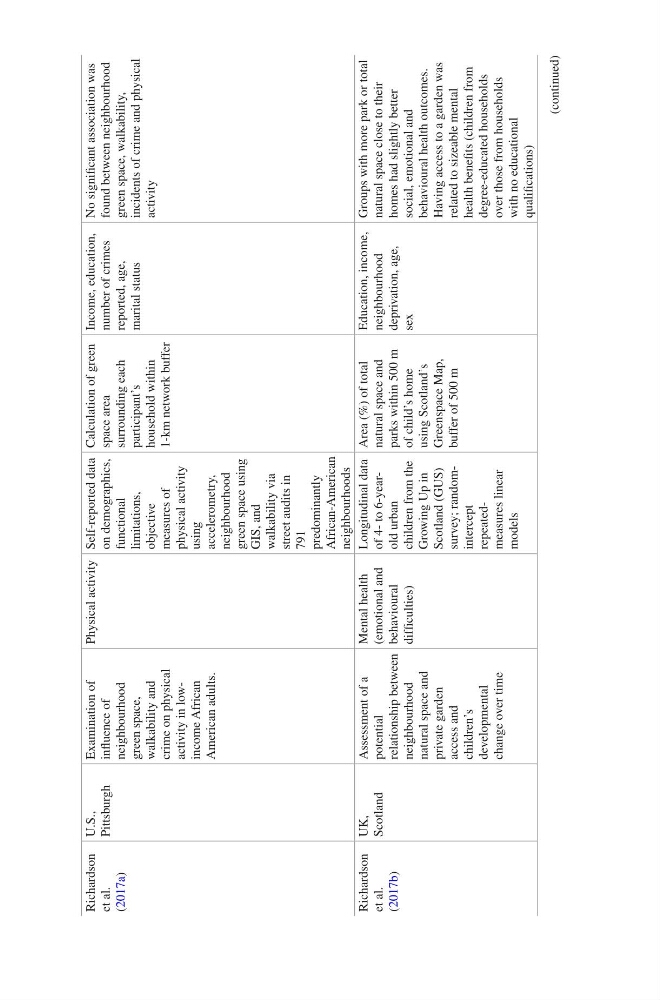
References Country, city Aim
HEALTH
Study design
Green space metrics
and buffer
Confounder
Main results
Richardson
et al.
(2017a)
U.S.,
Pittsburgh
Examination of
influence of
neighbourhood
green space,
walkability and
crime on physical
activity in lowincome African
American adults.
Physical activity Self-reported data
on demographics,
functional
limitations,
objective
measures of
physical activity
using
accelerometry,
neighbourhood
green space using
GIS, and
walkability via
street audits in
791
predominantly
African- American
neighbourhoods
Calculation of green
space area
surrounding each
participant’s
household within
1-km network buffer
Income, education,
number of crimes
reported, age,
marital status
No significant association was
found between neighbourhood
green space, walkability,
incidents of crime and physical
activity
Richardson
et al.
(2017b)
UK,
Scotland
Assessment of a
potential
relationship between
neighbourhood
natural space and
private garden
access and
children’s
developmental
change over time
Mental health
(emotional and
behavioural
difficulties)
Longitudinal data
of 4- to 6-yearold urban
children from the
Growing Up in
Scotland (GUS)
survey; randomintercept
repeatedmeasures linear
models
Area (%) of total
natural space and
parks within 500 m
of child’s home
using Scotland’s
Greenspace Map,
buffer of 500 m
Education, income,
neighbourhood
deprivation, age,
sex
Groups with more park or total
natural space close to their
homes had slightly better
social, emotional and
behavioural health outcomes.
Having access to a garden was
related to sizeable mental
health benefits (children from
degree-educated households
over those from households
with no educational
qualifications)
(continued)
HEALTH
Study design
Green space metrics
and buffer
Confounder
Main results
Richardson
et al.
(2017a)
U.S.,
Pittsburgh
Examination of
influence of
neighbourhood
green space,
walkability and
crime on physical
activity in lowincome African
American adults.
Physical activity Self-reported data
on demographics,
functional
limitations,
objective
measures of
physical activity
using
accelerometry,
neighbourhood
green space using
GIS, and
walkability via
street audits in
791
predominantly
African- American
neighbourhoods
Calculation of green
space area
surrounding each
participant’s
household within
1-km network buffer
Income, education,
number of crimes
reported, age,
marital status
No significant association was
found between neighbourhood
green space, walkability,
incidents of crime and physical
activity
Richardson
et al.
(2017b)
UK,
Scotland
Assessment of a
potential
relationship between
neighbourhood
natural space and
private garden
access and
children’s
developmental
change over time
Mental health
(emotional and
behavioural
difficulties)
Longitudinal data
of 4- to 6-yearold urban
children from the
Growing Up in
Scotland (GUS)
survey; randomintercept
repeatedmeasures linear
models
Area (%) of total
natural space and
parks within 500 m
of child’s home
using Scotland’s
Greenspace Map,
buffer of 500 m
Education, income,
neighbourhood
deprivation, age,
sex
Groups with more park or total
natural space close to their
homes had slightly better
social, emotional and
behavioural health outcomes.
Having access to a garden was
related to sizeable mental
health benefits (children from
degree-educated households
over those from households
with no educational
qualifications)
(continued)