

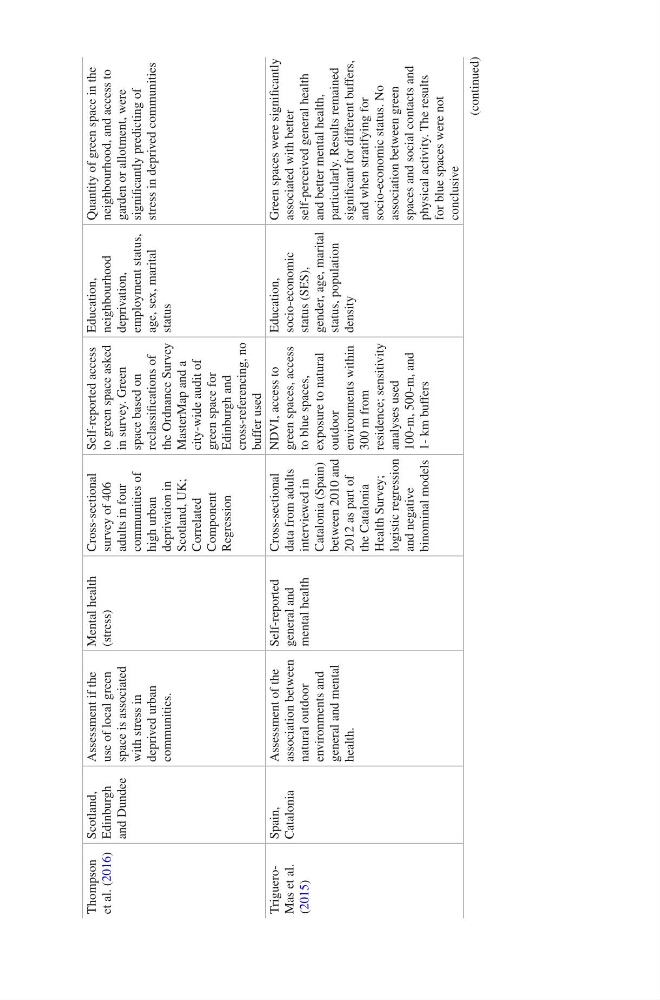
References Country, city Aim
HEALTH
Study design
Green space metrics
and buffer
Confounder
Main results
Thompson
et al. (2016)
Scotland,
Edinburgh
and Dundee
Assessment if the
use of local green
space is associated
with stress in
deprived urban
communities.
Mental health
(stress)
Cross-sectional
survey of 406
adults in four
communities of
high urban
deprivation in
Scotland, UK;
Correlated
Component
Regression
Self-reported access
to green space asked
in survey. Green
space based on
reclassifications of
the Ordnance Survey
MasterMap and a
city-wide audit of
green space for
Edinburgh and
cross- referencing, no
buffer used
Education,
neighbourhood
deprivation,
employment status,
age, sex, marital
status
Quantity of green space in the
neighbourhood, and access to
garden or allotment, were
significantly predicting of
stress in deprived communities
TrigueroMas et al.
(2015)
Spain,
Catalonia
Assessment of the
association between
natural outdoor
environments and
general and mental
health.
Self-reported
general and
mental health
Cross-sectional
data from adults
interviewed in
Catalonia (Spain)
between 2010 and
2012 as part of
the Catalonia
Health Survey;
logistic regression
and negative
binominal models
NDVI, access to
green spaces, access
to blue spaces,
exposure to natural
outdoor
environments within
300 m from
residence; sensitivity
analyses used
100-m, 500-m, and
1- km buffers
Education,
socio-economic
status (SES),
gender, age, marital
status, population
density
Green spaces were significantly
associated with better
self- perceived general health
and better mental health,
particularly. Results remained
significant for different buffers,
and when stratifying for
socio-economic status. No
association between green
spaces and social contacts and
physical activity. The results
for blue spaces were not
conclusive
(continued)
HEALTH
Study design
Green space metrics
and buffer
Confounder
Main results
Thompson
et al. (2016)
Scotland,
Edinburgh
and Dundee
Assessment if the
use of local green
space is associated
with stress in
deprived urban
communities.
Mental health
(stress)
Cross-sectional
survey of 406
adults in four
communities of
high urban
deprivation in
Scotland, UK;
Correlated
Component
Regression
Self-reported access
to green space asked
in survey. Green
space based on
reclassifications of
the Ordnance Survey
MasterMap and a
city-wide audit of
green space for
Edinburgh and
cross- referencing, no
buffer used
Education,
neighbourhood
deprivation,
employment status,
age, sex, marital
status
Quantity of green space in the
neighbourhood, and access to
garden or allotment, were
significantly predicting of
stress in deprived communities
TrigueroMas et al.
(2015)
Spain,
Catalonia
Assessment of the
association between
natural outdoor
environments and
general and mental
health.
Self-reported
general and
mental health
Cross-sectional
data from adults
interviewed in
Catalonia (Spain)
between 2010 and
2012 as part of
the Catalonia
Health Survey;
logistic regression
and negative
binominal models
NDVI, access to
green spaces, access
to blue spaces,
exposure to natural
outdoor
environments within
300 m from
residence; sensitivity
analyses used
100-m, 500-m, and
1- km buffers
Education,
socio-economic
status (SES),
gender, age, marital
status, population
density
Green spaces were significantly
associated with better
self- perceived general health
and better mental health,
particularly. Results remained
significant for different buffers,
and when stratifying for
socio-economic status. No
association between green
spaces and social contacts and
physical activity. The results
for blue spaces were not
conclusive
(continued)