

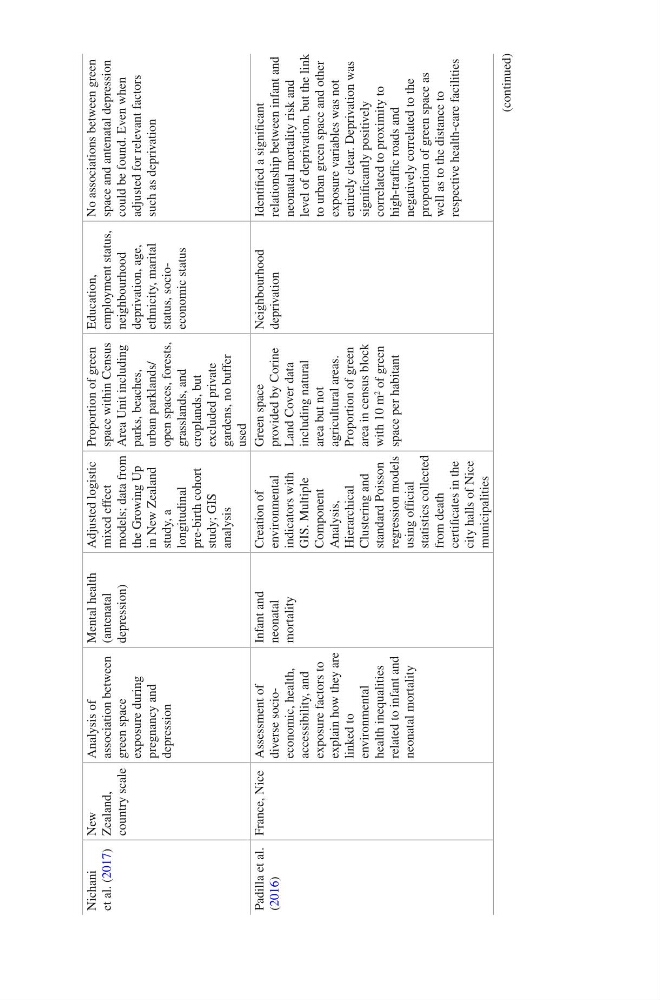
References Country, city Aim
HEALTH
Study design
Green space metrics
and buffer
Confounder
Main results
Nichani
et al. (2017)
New
Zealand,
country scale
Analysis of
association between
green space
exposure during
pregnancy and
depression
Mental health
(antenatal
depression)
Adjusted logistic
mixed effect
models; data from
the Growing Up
in New Zealand
study, a
longitudinal
pre-birth cohort
study; GIS
analysis
Proportion of green
space within Census
Area Unit including
parks, beaches,
urban parklands/
open spaces, forests,
grasslands, and
croplands, but
excluded private
gardens, no buffer
used
Education,
employment status,
neighbourhood
deprivation, age,
ethnicity, marital
status, socioeconomic status
No associations between green
space and antenatal depression
could be found. Even when
adjusted for relevant factors
such as deprivation
Padilla et al.
(2016)
France, Nice Assessment of
diverse socioeconomic, health,
accessibility, and
exposure factors to
explain how they are
linked to
environmental
health inequalities
related to infant and
neonatal mortality
Infant and
neonatal
mortality
Creation of
environmental
indicators with
GIS. Multiple
Component
Analysis,
Hierarchical
Clustering and
standard Poisson
regression models
using official
statistics collected
from death
certificates in the
city halls of Nice
municipalities
Green space
provided by Corine
Land Cover data
including natural
area but not
agricultural areas.
Proportion of green
area in census block
with 10 m 2
of green
space per habitant
Neighbourhood
deprivation
Identified a significant
relationship between infant and
neonatal mortality risk and
level of deprivation, but the link
to urban green space and other
exposure variables was not
entirely clear. Deprivation was
significantly positively
correlated to proximity to
high-traffic roads and
negatively correlated to the
proportion of green space as
well as to the distance to
respective health-care facilities
(continued)
HEALTH
Study design
Green space metrics
and buffer
Confounder
Main results
Nichani
et al. (2017)
New
Zealand,
country scale
Analysis of
association between
green space
exposure during
pregnancy and
depression
Mental health
(antenatal
depression)
Adjusted logistic
mixed effect
models; data from
the Growing Up
in New Zealand
study, a
longitudinal
pre-birth cohort
study; GIS
analysis
Proportion of green
space within Census
Area Unit including
parks, beaches,
urban parklands/
open spaces, forests,
grasslands, and
croplands, but
excluded private
gardens, no buffer
used
Education,
employment status,
neighbourhood
deprivation, age,
ethnicity, marital
status, socioeconomic status
No associations between green
space and antenatal depression
could be found. Even when
adjusted for relevant factors
such as deprivation
Padilla et al.
(2016)
France, Nice Assessment of
diverse socioeconomic, health,
accessibility, and
exposure factors to
explain how they are
linked to
environmental
health inequalities
related to infant and
neonatal mortality
Infant and
neonatal
mortality
Creation of
environmental
indicators with
GIS. Multiple
Component
Analysis,
Hierarchical
Clustering and
standard Poisson
regression models
using official
statistics collected
from death
certificates in the
city halls of Nice
municipalities
Green space
provided by Corine
Land Cover data
including natural
area but not
agricultural areas.
Proportion of green
area in census block
with 10 m 2
of green
space per habitant
Neighbourhood
deprivation
Identified a significant
relationship between infant and
neonatal mortality risk and
level of deprivation, but the link
to urban green space and other
exposure variables was not
entirely clear. Deprivation was
significantly positively
correlated to proximity to
high-traffic roads and
negatively correlated to the
proportion of green space as
well as to the distance to
respective health-care facilities
(continued)