

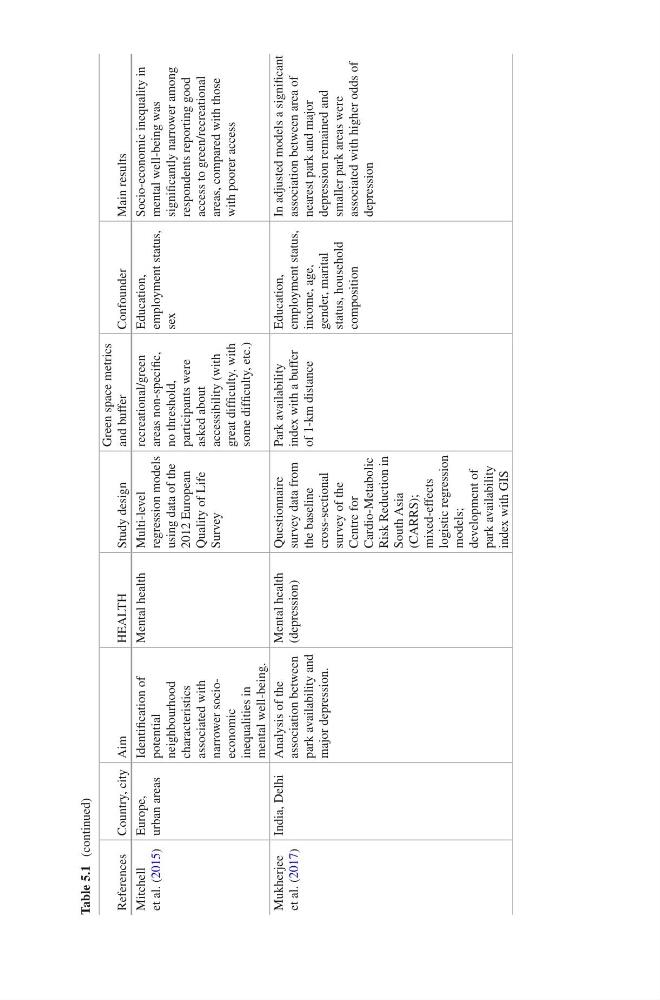
Table 5.1 (continued)
References Country, city Aim
HEALTH
Study design
Green space metrics
and buffer
Confounder
Main results
Mitchell
et al. (2015)
Europe,
urban areas
Identification of
potential
neighbourhood
characteristics
associated with
narrower socioeconomic
inequalities in
mental well-being.
Mental health
Multi-level
regression models
using data of the
2012 European
Quality of Life
Survey
recreational/green
areas non-specific,
no threshold,
participants were
asked about
accessibility (with
great difficulty, with
some difficulty, etc.)
Education,
employment status,
sex
Socio-economic inequality in
mental well- being was
significantly narrower among
respondents reporting good
access to green/recreational
areas, compared with those
with poorer access
Mukherjee
et al. (2017)
India, Delhi Analysis of the
association between
park availability and
major depression.
Mental health
(depression)
Questionnaire
survey data from
the baseline
cross-sectional
survey of the
Centre for
Cardio- Metabolic
Risk Reduction in
South Asia
(CARRS);
mixed-effects
logistic regression
models;
development of
park availability
index with GIS
Park availability
index with a buffer
of 1-km distance
Education,
employment status,
income, age,
gender, marital
status, household
composition
In adjusted models a significant
association between area of
nearest park and major
depression remained and
smaller park areas were
associated with higher odds of
depression
References Country, city Aim
HEALTH
Study design
Green space metrics
and buffer
Confounder
Main results
Mitchell
et al. (2015)
Europe,
urban areas
Identification of
potential
neighbourhood
characteristics
associated with
narrower socioeconomic
inequalities in
mental well-being.
Mental health
Multi-level
regression models
using data of the
2012 European
Quality of Life
Survey
recreational/green
areas non-specific,
no threshold,
participants were
asked about
accessibility (with
great difficulty, with
some difficulty, etc.)
Education,
employment status,
sex
Socio-economic inequality in
mental well- being was
significantly narrower among
respondents reporting good
access to green/recreational
areas, compared with those
with poorer access
Mukherjee
et al. (2017)
India, Delhi Analysis of the
association between
park availability and
major depression.
Mental health
(depression)
Questionnaire
survey data from
the baseline
cross-sectional
survey of the
Centre for
Cardio- Metabolic
Risk Reduction in
South Asia
(CARRS);
mixed-effects
logistic regression
models;
development of
park availability
index with GIS
Park availability
index with a buffer
of 1-km distance
Education,
employment status,
income, age,
gender, marital
status, household
composition
In adjusted models a significant
association between area of
nearest park and major
depression remained and
smaller park areas were
associated with higher odds of
depression