

50 Acoustic Emissions of Cathode Carbon Block …
573
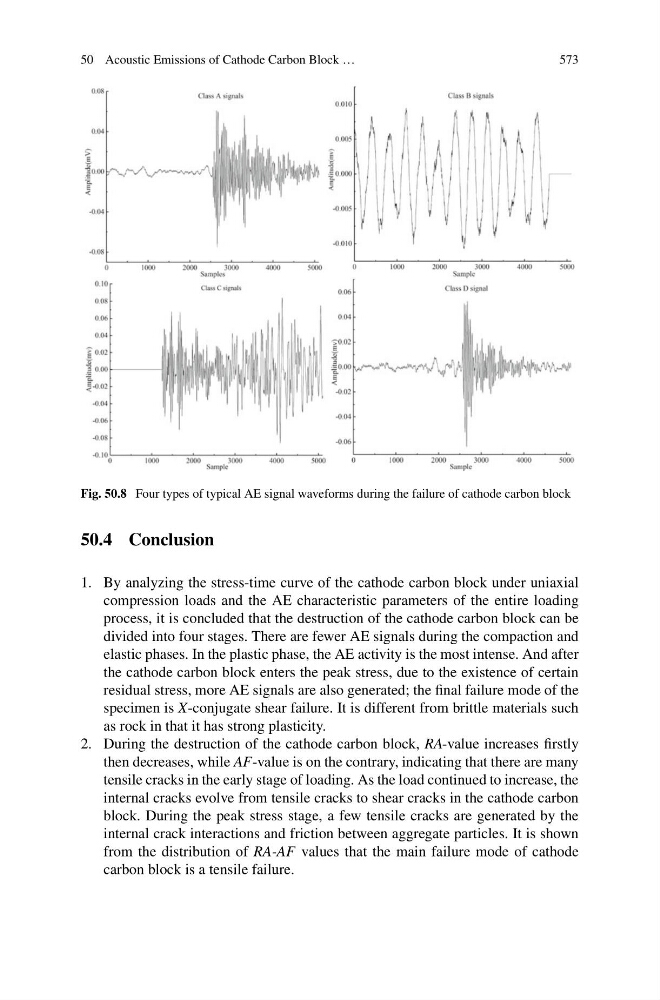
Fig. 50.8 Four types of typical AE signal waveforms during the failure of cathode carbon block
50.4 Conclusion
1. By analyzing the stress-time curve of the cathode carbon block under uniaxial
compression loads and the AE characteristic parameters of the entire loading
process, it is concluded that the destruction of the cathode carbon block can be
divided into four stages. There are fewer AE signals during the compaction and
elastic phases. In the plastic phase, the AE activity is the most intense. And after
the cathode carbon block enters the peak stress, due to the existence of certain
residual stress, more AE signals are also generated; the final failure mode of the
specimen is X-conjugate shear failure. It is different from brittle materials such
as rock in that it has strong plasticity.
2. During the destruction of the cathode carbon block, RA-value increases firstly
then decreases, while AF-value is on the contrary, indicating that there are many
tensile cracks in the early stage of loading. As the load continued to increase, the
internal cracks evolve from tensile cracks to shear cracks in the cathode carbon
block. During the peak stress stage, a few tensile cracks are generated by the
internal crack interactions and friction between aggregate particles. It is shown
from the distribution of RA-AF values that the main failure mode of cathode
carbon block is a tensile failure.
573
Fig. 50.8 Four types of typical AE signal waveforms during the failure of cathode carbon block
50.4 Conclusion
1. By analyzing the stress-time curve of the cathode carbon block under uniaxial
compression loads and the AE characteristic parameters of the entire loading
process, it is concluded that the destruction of the cathode carbon block can be
divided into four stages. There are fewer AE signals during the compaction and
elastic phases. In the plastic phase, the AE activity is the most intense. And after
the cathode carbon block enters the peak stress, due to the existence of certain
residual stress, more AE signals are also generated; the final failure mode of the
specimen is X-conjugate shear failure. It is different from brittle materials such
as rock in that it has strong plasticity.
2. During the destruction of the cathode carbon block, RA-value increases firstly
then decreases, while AF-value is on the contrary, indicating that there are many
tensile cracks in the early stage of loading. As the load continued to increase, the
internal cracks evolve from tensile cracks to shear cracks in the cathode carbon
block. During the peak stress stage, a few tensile cracks are generated by the
internal crack interactions and friction between aggregate particles. It is shown
from the distribution of RA-AF values that the main failure mode of cathode
carbon block is a tensile failure.