

572
Y. Luo et al.
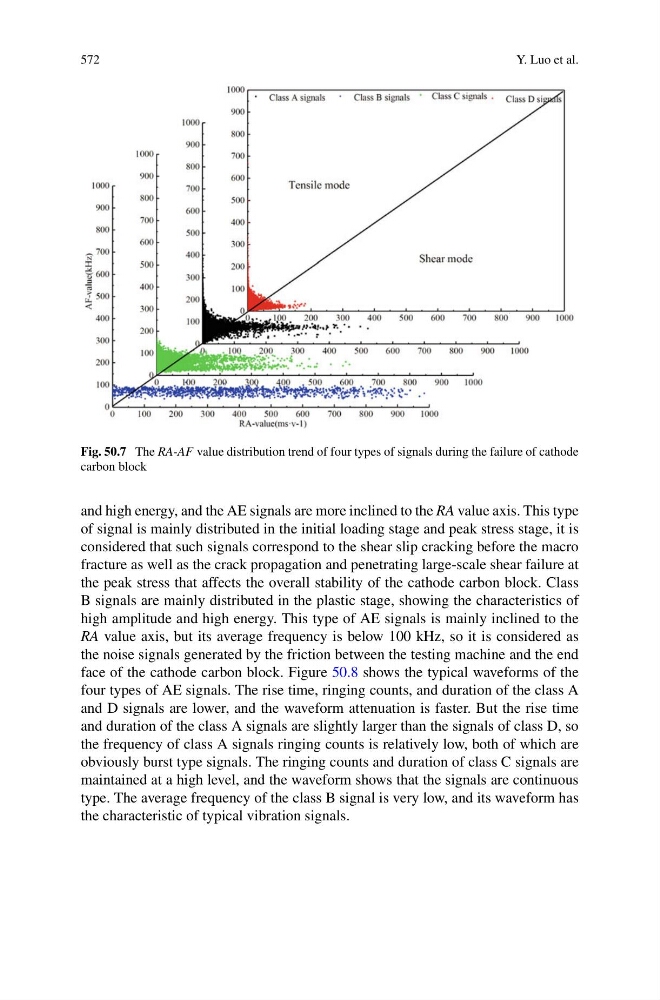
Fig. 50.7 The RA-AF value distribution trend of four types of signals during the failure of cathode
carbon block
and high energy, and the AE signals are more inclined to the RA value axis. This type
of signal is mainly distributed in the initial loading stage and peak stress stage, it is
considered that such signals correspond to the shear slip cracking before the macro
fracture as well as the crack propagation and penetrating large-scale shear failure at
the peak stress that affects the overall stability of the cathode carbon block. Class
B signals are mainly distributed in the plastic stage, showing the characteristics of
high amplitude and high energy. This type of AE signals is mainly inclined to the
RA value axis, but its average frequency is below 100 kHz, so it is considered as
the noise signals generated by the friction between the testing machine and the end
face of the cathode carbon block. Figure 50.8 shows the typical waveforms of the
four types of AE signals. The rise time, ringing counts, and duration of the class A
and D signals are lower, and the waveform attenuation is faster. But the rise time
and duration of the class A signals are slightly larger than the signals of class D, so
the frequency of class A signals ringing counts is relatively low, both of which are
obviously burst type signals. The ringing counts and duration of class C signals are
maintained at a high level, and the waveform shows that the signals are continuous
type. The average frequency of the class B signal is very low, and its waveform has
the characteristic of typical vibration signals.
Y. Luo et al.
Fig. 50.7 The RA-AF value distribution trend of four types of signals during the failure of cathode
carbon block
and high energy, and the AE signals are more inclined to the RA value axis. This type
of signal is mainly distributed in the initial loading stage and peak stress stage, it is
considered that such signals correspond to the shear slip cracking before the macro
fracture as well as the crack propagation and penetrating large-scale shear failure at
the peak stress that affects the overall stability of the cathode carbon block. Class
B signals are mainly distributed in the plastic stage, showing the characteristics of
high amplitude and high energy. This type of AE signals is mainly inclined to the
RA value axis, but its average frequency is below 100 kHz, so it is considered as
the noise signals generated by the friction between the testing machine and the end
face of the cathode carbon block. Figure 50.8 shows the typical waveforms of the
four types of AE signals. The rise time, ringing counts, and duration of the class A
and D signals are lower, and the waveform attenuation is faster. But the rise time
and duration of the class A signals are slightly larger than the signals of class D, so
the frequency of class A signals ringing counts is relatively low, both of which are
obviously burst type signals. The ringing counts and duration of class C signals are
maintained at a high level, and the waveform shows that the signals are continuous
type. The average frequency of the class B signal is very low, and its waveform has
the characteristic of typical vibration signals.