

564
Y. Luo et al.
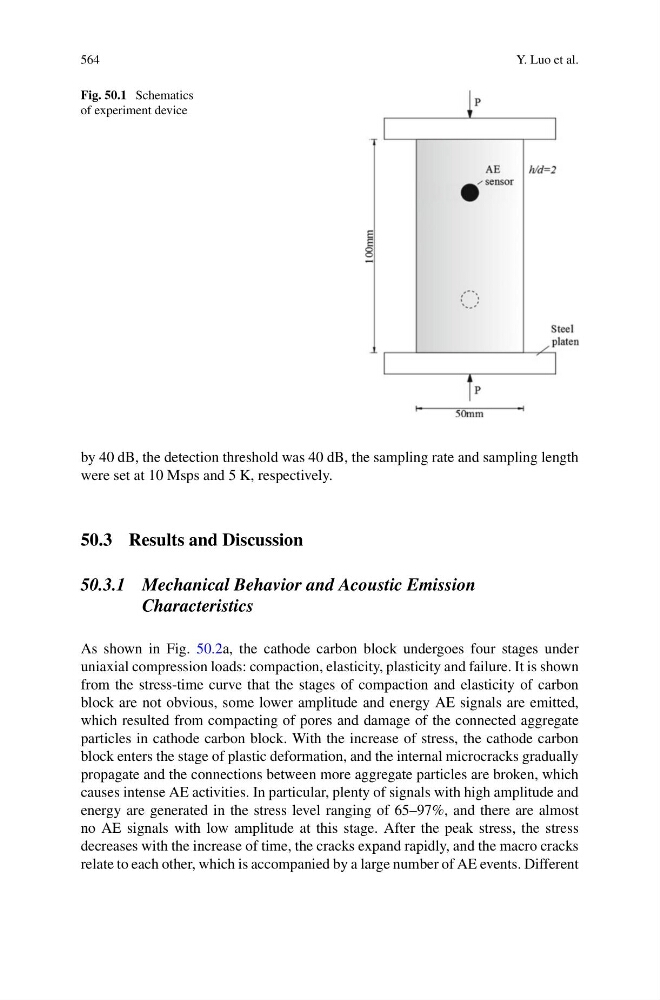
Fig. 50.1 Schematics
of experiment device
by 40 dB, the detection threshold was 40 dB, the sampling rate and sampling length
were set at 10 Msps and 5 K, respectively.
50.3 Results and Discussion
50.3.1 Mechanical Behavior and Acoustic Emission
Characteristics
As shown in Fig. 50.2a, the cathode carbon block undergoes four stages under
uniaxial compression loads: compaction, elasticity, plasticity and failure. It is shown
from the stress-time curve that the stages of compaction and elasticity of carbon
block are not obvious, some lower amplitude and energy AE signals are emitted,
which resulted from compacting of pores and damage of the connected aggregate
particles in cathode carbon block. With the increase of stress, the cathode carbon
block enters the stage of plastic deformation, and the internal microcracks gradually
propagate and the connections between more aggregate particles are broken, which
causes intense AE activities. In particular, plenty of signals with high amplitude and
energy are generated in the stress level ranging of 65–97%, and there are almost
no AE signals with low amplitude at this stage. After the peak stress, the stress
decreases with the increase of time, the cracks expand rapidly, and the macro cracks
relate to each other, which is accompanied by a large number of AE events. Different
Y. Luo et al.
Fig. 50.1 Schematics
of experiment device
by 40 dB, the detection threshold was 40 dB, the sampling rate and sampling length
were set at 10 Msps and 5 K, respectively.
50.3 Results and Discussion
50.3.1 Mechanical Behavior and Acoustic Emission
Characteristics
As shown in Fig. 50.2a, the cathode carbon block undergoes four stages under
uniaxial compression loads: compaction, elasticity, plasticity and failure. It is shown
from the stress-time curve that the stages of compaction and elasticity of carbon
block are not obvious, some lower amplitude and energy AE signals are emitted,
which resulted from compacting of pores and damage of the connected aggregate
particles in cathode carbon block. With the increase of stress, the cathode carbon
block enters the stage of plastic deformation, and the internal microcracks gradually
propagate and the connections between more aggregate particles are broken, which
causes intense AE activities. In particular, plenty of signals with high amplitude and
energy are generated in the stress level ranging of 65–97%, and there are almost
no AE signals with low amplitude at this stage. After the peak stress, the stress
decreases with the increase of time, the cracks expand rapidly, and the macro cracks
relate to each other, which is accompanied by a large number of AE events. Different