

50 Acoustic Emissions of Cathode Carbon Block …
565
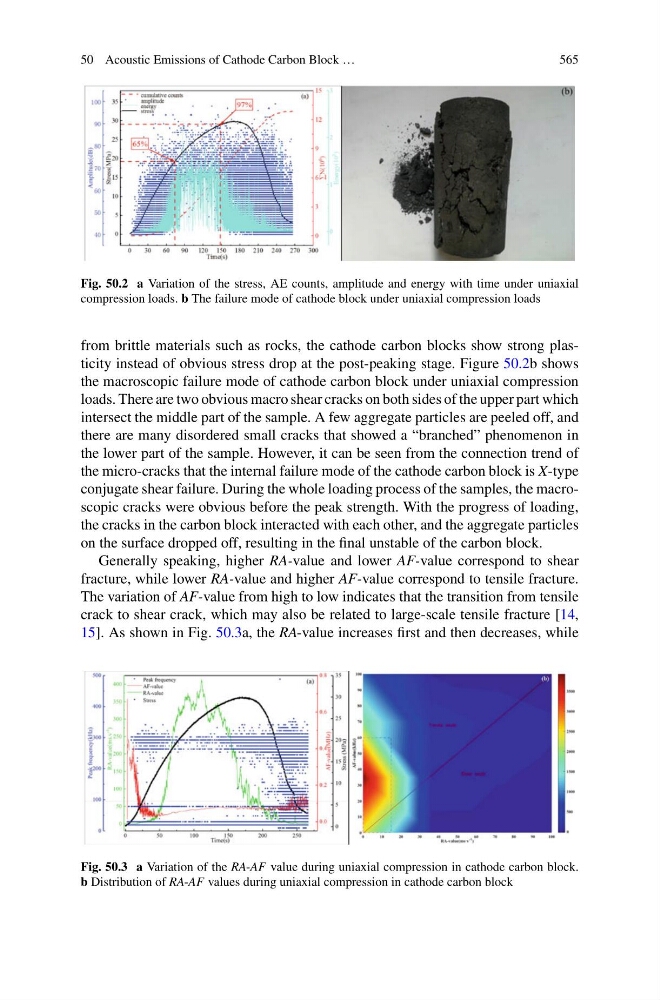
Fig. 50.2 a Variation of the stress, AE counts, amplitude and energy with time under uniaxial
compression loads. b The failure mode of cathode block under uniaxial compression loads
from brittle materials such as rocks, the cathode carbon blocks show strong plasticity instead of obvious stress drop at the post-peaking stage. Figure 50.2b shows
the macroscopic failure mode of cathode carbon block under uniaxial compression
loads. There are two obvious macro shear cracks on both sides of the upper part which
intersect the middle part of the sample. A few aggregate particles are peeled off, and
there are many disordered small cracks that showed a “branched” phenomenon in
the lower part of the sample. However, it can be seen from the connection trend of
the micro-cracks that the internal failure mode of the cathode carbon block is X-type
conjugate shear failure. During the whole loading process of the samples, the macroscopic cracks were obvious before the peak strength. With the progress of loading,
the cracks in the carbon block interacted with each other, and the aggregate particles
on the surface dropped off, resulting in the final unstable of the carbon block.
Generally speaking, higher RA-value and lower AF-value correspond to shear
fracture, while lower RA-value and higher AF-value correspond to tensile fracture.
The variation of AF-value from high to low indicates that the transition from tensile
crack to shear crack, which may also be related to large-scale tensile fracture [14,
15]. As shown in Fig. 50.3a, the RA-value increases first and then decreases, while
Fig. 50.3 a Variation of the RA-AF value during uniaxial compression in cathode carbon block.
b Distribution of RA-AF values during uniaxial compression in cathode carbon block
565
Fig. 50.2 a Variation of the stress, AE counts, amplitude and energy with time under uniaxial
compression loads. b The failure mode of cathode block under uniaxial compression loads
from brittle materials such as rocks, the cathode carbon blocks show strong plasticity instead of obvious stress drop at the post-peaking stage. Figure 50.2b shows
the macroscopic failure mode of cathode carbon block under uniaxial compression
loads. There are two obvious macro shear cracks on both sides of the upper part which
intersect the middle part of the sample. A few aggregate particles are peeled off, and
there are many disordered small cracks that showed a “branched” phenomenon in
the lower part of the sample. However, it can be seen from the connection trend of
the micro-cracks that the internal failure mode of the cathode carbon block is X-type
conjugate shear failure. During the whole loading process of the samples, the macroscopic cracks were obvious before the peak strength. With the progress of loading,
the cracks in the carbon block interacted with each other, and the aggregate particles
on the surface dropped off, resulting in the final unstable of the carbon block.
Generally speaking, higher RA-value and lower AF-value correspond to shear
fracture, while lower RA-value and higher AF-value correspond to tensile fracture.
The variation of AF-value from high to low indicates that the transition from tensile
crack to shear crack, which may also be related to large-scale tensile fracture [14,
15]. As shown in Fig. 50.3a, the RA-value increases first and then decreases, while
Fig. 50.3 a Variation of the RA-AF value during uniaxial compression in cathode carbon block.
b Distribution of RA-AF values during uniaxial compression in cathode carbon block