

49 A Comparison of Acoustic Emission in Cadaveric Specimens …
551
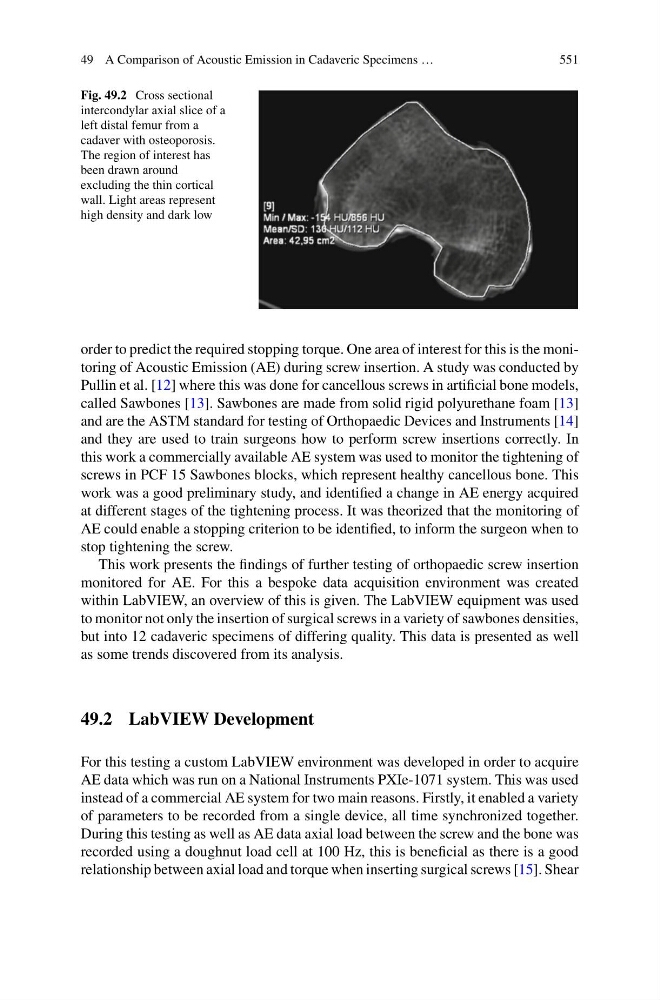
Fig. 49.2 Cross sectional
intercondylar axial slice of a
left distal femur from a
cadaver with osteoporosis.
The region of interest has
been drawn around
excluding the thin cortical
wall. Light areas represent
high density and dark low
order to predict the required stopping torque. One area of interest for this is the monitoring of Acoustic Emission (AE) during screw insertion. A study was conducted by
Pullin et al. [12] where this was done for cancellous screws in artificial bone models,
called Sawbones [13]. Sawbones are made from solid rigid polyurethane foam [13]
and are the ASTM standard for testing of Orthopaedic Devices and Instruments [14]
and they are used to train surgeons how to perform screw insertions correctly. In
this work a commercially available AE system was used to monitor the tightening of
screws in PCF 15 Sawbones blocks, which represent healthy cancellous bone. This
work was a good preliminary study, and identified a change in AE energy acquired
at different stages of the tightening process. It was theorized that the monitoring of
AE could enable a stopping criterion to be identified, to inform the surgeon when to
stop tightening the screw.
This work presents the findings of further testing of orthopaedic screw insertion
monitored for AE. For this a bespoke data acquisition environment was created
within LabVIEW, an overview of this is given. The LabVIEW equipment was used
to monitor not only the insertion of surgical screws in a variety of sawbones densities,
but into 12 cadaveric specimens of differing quality. This data is presented as well
as some trends discovered from its analysis.
49.2 LabVIEW Development
For this testing a custom LabVIEW environment was developed in order to acquire
AE data which was run on a National Instruments PXIe-1071 system. This was used
instead of a commercial AE system for two main reasons. Firstly, it enabled a variety
of parameters to be recorded from a single device, all time synchronized together.
During this testing as well as AE data axial load between the screw and the bone was
recorded using a doughnut load cell at 100 Hz, this is beneficial as there is a good
relationship between axial load and torque when inserting surgical screws [15]. Shear
551
Fig. 49.2 Cross sectional
intercondylar axial slice of a
left distal femur from a
cadaver with osteoporosis.
The region of interest has
been drawn around
excluding the thin cortical
wall. Light areas represent
high density and dark low
order to predict the required stopping torque. One area of interest for this is the monitoring of Acoustic Emission (AE) during screw insertion. A study was conducted by
Pullin et al. [12] where this was done for cancellous screws in artificial bone models,
called Sawbones [13]. Sawbones are made from solid rigid polyurethane foam [13]
and are the ASTM standard for testing of Orthopaedic Devices and Instruments [14]
and they are used to train surgeons how to perform screw insertions correctly. In
this work a commercially available AE system was used to monitor the tightening of
screws in PCF 15 Sawbones blocks, which represent healthy cancellous bone. This
work was a good preliminary study, and identified a change in AE energy acquired
at different stages of the tightening process. It was theorized that the monitoring of
AE could enable a stopping criterion to be identified, to inform the surgeon when to
stop tightening the screw.
This work presents the findings of further testing of orthopaedic screw insertion
monitored for AE. For this a bespoke data acquisition environment was created
within LabVIEW, an overview of this is given. The LabVIEW equipment was used
to monitor not only the insertion of surgical screws in a variety of sawbones densities,
but into 12 cadaveric specimens of differing quality. This data is presented as well
as some trends discovered from its analysis.
49.2 LabVIEW Development
For this testing a custom LabVIEW environment was developed in order to acquire
AE data which was run on a National Instruments PXIe-1071 system. This was used
instead of a commercial AE system for two main reasons. Firstly, it enabled a variety
of parameters to be recorded from a single device, all time synchronized together.
During this testing as well as AE data axial load between the screw and the bone was
recorded using a doughnut load cell at 100 Hz, this is beneficial as there is a good
relationship between axial load and torque when inserting surgical screws [15]. Shear