

550
S. Grigg et al.
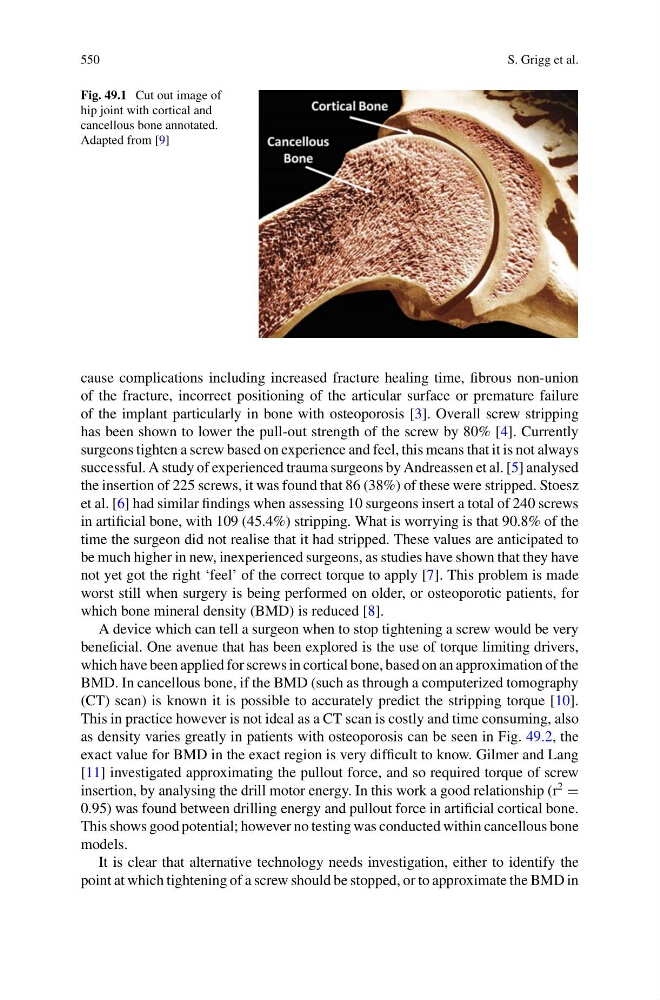
Fig. 49.1 Cut out image of
hip joint with cortical and
cancellous bone annotated.
Adapted from [9]
cause complications including increased fracture healing time, fibrous non-union
of the fracture, incorrect positioning of the articular surface or premature failure
of the implant particularly in bone with osteoporosis [3]. Overall screw stripping
has been shown to lower the pull-out strength of the screw by 80% [4]. Currently
surgeons tighten a screw based on experience and feel, this means that it is not always
successful. A study of experienced trauma surgeons by Andreassen et al. [5] analysed
the insertion of 225 screws, it was found that 86 (38%) of these were stripped. Stoesz
et al. [6] had similar findings when assessing 10 surgeons insert a total of 240 screws
in artificial bone, with 109 (45.4%) stripping. What is worrying is that 90.8% of the
time the surgeon did not realise that it had stripped. These values are anticipated to
be much higher in new, inexperienced surgeons, as studies have shown that they have
not yet got the right ‘feel’ of the correct torque to apply [7]. This problem is made
worst still when surgery is being performed on older, or osteoporotic patients, for
which bone mineral density (BMD) is reduced [8].
A device which can tell a surgeon when to stop tightening a screw would be very
beneficial. One avenue that has been explored is the use of torque limiting drivers,
which have been applied for screws in cortical bone, based on an approximation of the
BMD. In cancellous bone, if the BMD (such as through a computerized tomography
(CT) scan) is known it is possible to accurately predict the stripping torque [10].
This in practice however is not ideal as a CT scan is costly and time consuming, also
as density varies greatly in patients with osteoporosis can be seen in Fig. 49.2, the
exact value for BMD in the exact region is very difficult to know. Gilmer and Lang
[11] investigated approximating the pullout force, and so required torque of screw
insertion, by analysing the drill motor energy. In this work a good relationship (r
2
=
0.95) was found between drilling energy and pullout force in artificial cortical bone.
This shows good potential; however no testing was conducted within cancellous bone
models.
It is clear that alternative technology needs investigation, either to identify the
point at which tightening of a screw should be stopped, or to approximate the BMD in
S. Grigg et al.
Fig. 49.1 Cut out image of
hip joint with cortical and
cancellous bone annotated.
Adapted from [9]
cause complications including increased fracture healing time, fibrous non-union
of the fracture, incorrect positioning of the articular surface or premature failure
of the implant particularly in bone with osteoporosis [3]. Overall screw stripping
has been shown to lower the pull-out strength of the screw by 80% [4]. Currently
surgeons tighten a screw based on experience and feel, this means that it is not always
successful. A study of experienced trauma surgeons by Andreassen et al. [5] analysed
the insertion of 225 screws, it was found that 86 (38%) of these were stripped. Stoesz
et al. [6] had similar findings when assessing 10 surgeons insert a total of 240 screws
in artificial bone, with 109 (45.4%) stripping. What is worrying is that 90.8% of the
time the surgeon did not realise that it had stripped. These values are anticipated to
be much higher in new, inexperienced surgeons, as studies have shown that they have
not yet got the right ‘feel’ of the correct torque to apply [7]. This problem is made
worst still when surgery is being performed on older, or osteoporotic patients, for
which bone mineral density (BMD) is reduced [8].
A device which can tell a surgeon when to stop tightening a screw would be very
beneficial. One avenue that has been explored is the use of torque limiting drivers,
which have been applied for screws in cortical bone, based on an approximation of the
BMD. In cancellous bone, if the BMD (such as through a computerized tomography
(CT) scan) is known it is possible to accurately predict the stripping torque [10].
This in practice however is not ideal as a CT scan is costly and time consuming, also
as density varies greatly in patients with osteoporosis can be seen in Fig. 49.2, the
exact value for BMD in the exact region is very difficult to know. Gilmer and Lang
[11] investigated approximating the pullout force, and so required torque of screw
insertion, by analysing the drill motor energy. In this work a good relationship (r
2
=
0.95) was found between drilling energy and pullout force in artificial cortical bone.
This shows good potential; however no testing was conducted within cancellous bone
models.
It is clear that alternative technology needs investigation, either to identify the
point at which tightening of a screw should be stopped, or to approximate the BMD in