

538
J. Zhang et al.
Usually, a pooling layer is connected behind the convolution layer to reduce the
feature dimension and model training time. The common pooling methods include
maxi-pooling, average-pooling and weight-pooling. Among them, maxi-pooling is
widely used because it can extract the local maximum value and invariant features
from input features directly. The max-pooling can be described as in (47.4):
p
l(i, j)
=
max
( j−1)W +1≤t≤ j W
a
l(i,t)
(47.4)
where a
l(i,t) denotes the value of tth neuron in the i-th frame of layer l, t ∈
[( j − 1)W + 1, j W ], W is the width of the pooling region, and p
l(i, j) denotes the
corresponding value of the neuron in layer l of the pooling operation.
47.3 Proposed Method
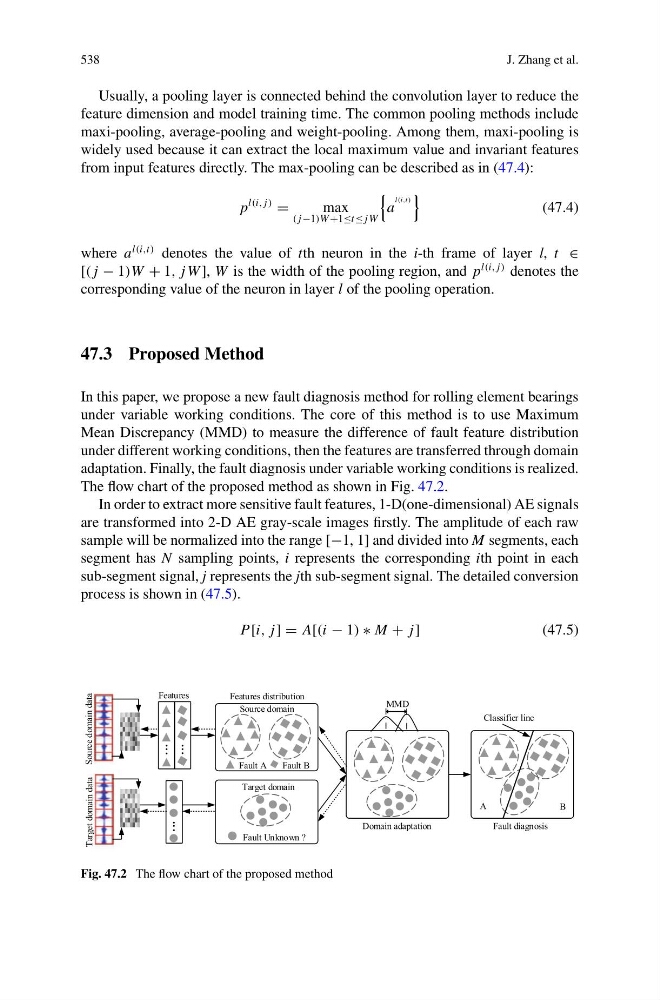
In this paper, we propose a new fault diagnosis method for rolling element bearings
under variable working conditions. The core of this method is to use Maximum
Mean Discrepancy (MMD) to measure the difference of fault feature distribution
under different working conditions, then the features are transferred through domain
adaptation. Finally, the fault diagnosis under variable working conditions is realized.
The flow chart of the proposed method as shown in Fig. 47.2.
In order to extract more sensitive fault features, 1-D(one-dimensional) AE signals
are transformed into 2-D AE gray-scale images firstly. The amplitude of each raw
sample will be normalized into the range [−1, 1] and divided into M segments, each
segment has N sampling points, i represents the corresponding ith point in each
sub-segment signal, j represents the jth sub-segment signal. The detailed conversion
process is shown in (47.5).
P[i, j] = A[(i − 1) ∗ M + j]
(47.5)
Source domain data
Fault A
Fault B
Target domain
Fault Unknown ?
MMD
Domain adaptation
A
B
Fault diagnosis
Target domain data
Source domain
...
...
...
Features
Features distribution
Classifier line
Fig. 47.2 The flow chart of the proposed method
J. Zhang et al.
Usually, a pooling layer is connected behind the convolution layer to reduce the
feature dimension and model training time. The common pooling methods include
maxi-pooling, average-pooling and weight-pooling. Among them, maxi-pooling is
widely used because it can extract the local maximum value and invariant features
from input features directly. The max-pooling can be described as in (47.4):
p
l(i, j)
=
max
( j−1)W +1≤t≤ j W
a
l(i,t)
(47.4)
where a
l(i,t) denotes the value of tth neuron in the i-th frame of layer l, t ∈
[( j − 1)W + 1, j W ], W is the width of the pooling region, and p
l(i, j) denotes the
corresponding value of the neuron in layer l of the pooling operation.
47.3 Proposed Method
In this paper, we propose a new fault diagnosis method for rolling element bearings
under variable working conditions. The core of this method is to use Maximum
Mean Discrepancy (MMD) to measure the difference of fault feature distribution
under different working conditions, then the features are transferred through domain
adaptation. Finally, the fault diagnosis under variable working conditions is realized.
The flow chart of the proposed method as shown in Fig. 47.2.
In order to extract more sensitive fault features, 1-D(one-dimensional) AE signals
are transformed into 2-D AE gray-scale images firstly. The amplitude of each raw
sample will be normalized into the range [−1, 1] and divided into M segments, each
segment has N sampling points, i represents the corresponding ith point in each
sub-segment signal, j represents the jth sub-segment signal. The detailed conversion
process is shown in (47.5).
P[i, j] = A[(i − 1) ∗ M + j]
(47.5)
Source domain data
Fault A
Fault B
Target domain
Fault Unknown ?
MMD
Domain adaptation
A
B
Fault diagnosis
Target domain data
Source domain
...
...
...
Features
Features distribution
Classifier line
Fig. 47.2 The flow chart of the proposed method