

47 Bearing Fault Transfer Diagnosis Based on Acoustic Emission …
537
D
s
= {(x
s
1 , y
s
1 ), . . . , (x
s
n , y
s
n s
)}D
t
= {x
t
1 , . . . , x
t
n t
}
(47.1)
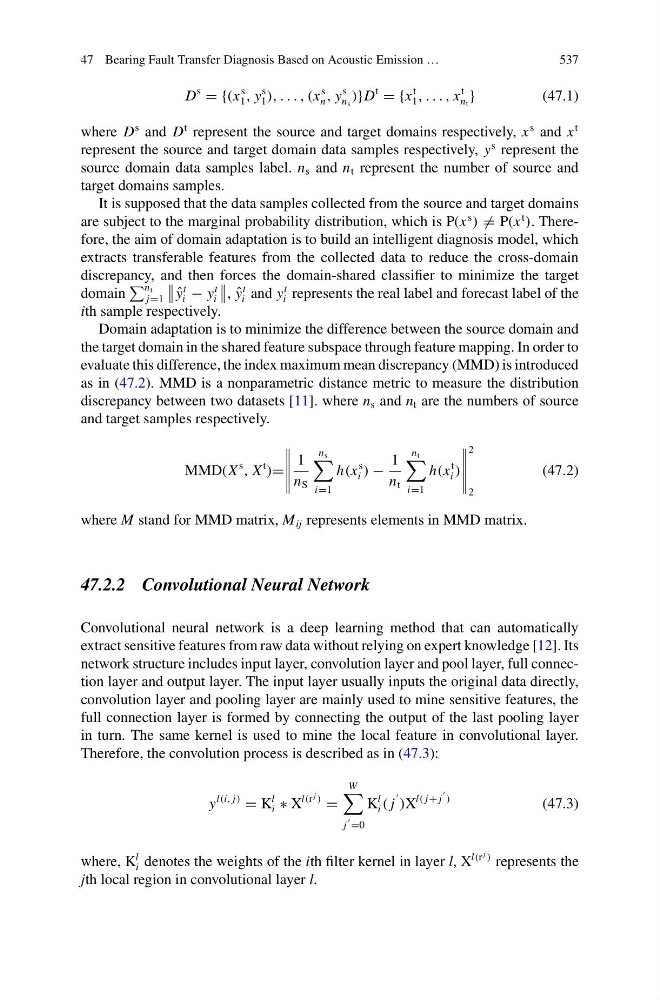
where D
s and D
t represent the source and target domains respectively, x
s and x
t
represent the source and target domain data samples respectively, y
s represent the
source domain data samples label. n s and n t represent the number of source and
target domains samples.
It is supposed that the data samples collected from the source and target domains
are subject to the marginal probability distribution, which is P(x
s
) = P(x
t
). Therefore, the aim of domain adaptation is to build an intelligent diagnosis model, which
extracts transferable features from the collected data to reduce the cross-domain
discrepancy, and then forces the domain-shared classifier to minimize the target
domain
n t
j=1
ˆ
y
t
i − y
t
i
, ˆ
y
t
i and y
t
i represents the real label and forecast label of the
ith sample respectively.
Domain adaptation is to minimize the difference between the source domain and
the target domain in the shared feature subspace through feature mapping. In order to
evaluate this difference, the index maximum mean discrepancy (MMD) is introduced
as in (47.2). MMD is a nonparametric distance metric to measure the distribution
discrepancy between two datasets [11]. where n s and n t are the numbers of source
and target samples respectively.
MMD(X
s
, X
t
)=
1
n S
n s
i=1
h(x
s
i ) −
1
n t
n t
i=1
h(x
t
i )
2
2
(47.2)
where M stand for MMD matrix, M ij represents elements in MMD matrix.
47.2.2 Convolutional Neural Network
Convolutional neural network is a deep learning method that can automatically
extract sensitive features from raw data without relying on expert knowledge [12]. Its
network structure includes input layer, convolution layer and pool layer, full connection layer and output layer. The input layer usually inputs the original data directly,
convolution layer and pooling layer are mainly used to mine sensitive features, the
full connection layer is formed by connecting the output of the last pooling layer
in turn. The same kernel is used to mine the local feature in convolutional layer.
Therefore, the convolution process is described as in (47.3):
y
l(i, j)
= K
l
i ∗ X
l(r
j )
=
W
j
=0
K
l
i ( j
)X
l( j+ j
)
(47.3)
where, K
l
i denotes the weights of the ith filter kernel in layer l, X
l(r
j ) represents the
jth local region in convolutional layer l.
537
D
s
= {(x
s
1 , y
s
1 ), . . . , (x
s
n , y
s
n s
)}D
t
= {x
t
1 , . . . , x
t
n t
}
(47.1)
where D
s and D
t represent the source and target domains respectively, x
s and x
t
represent the source and target domain data samples respectively, y
s represent the
source domain data samples label. n s and n t represent the number of source and
target domains samples.
It is supposed that the data samples collected from the source and target domains
are subject to the marginal probability distribution, which is P(x
s
) = P(x
t
). Therefore, the aim of domain adaptation is to build an intelligent diagnosis model, which
extracts transferable features from the collected data to reduce the cross-domain
discrepancy, and then forces the domain-shared classifier to minimize the target
domain
n t
j=1
ˆ
y
t
i − y
t
i
, ˆ
y
t
i and y
t
i represents the real label and forecast label of the
ith sample respectively.
Domain adaptation is to minimize the difference between the source domain and
the target domain in the shared feature subspace through feature mapping. In order to
evaluate this difference, the index maximum mean discrepancy (MMD) is introduced
as in (47.2). MMD is a nonparametric distance metric to measure the distribution
discrepancy between two datasets [11]. where n s and n t are the numbers of source
and target samples respectively.
MMD(X
s
, X
t
)=
1
n S
n s
i=1
h(x
s
i ) −
1
n t
n t
i=1
h(x
t
i )
2
2
(47.2)
where M stand for MMD matrix, M ij represents elements in MMD matrix.
47.2.2 Convolutional Neural Network
Convolutional neural network is a deep learning method that can automatically
extract sensitive features from raw data without relying on expert knowledge [12]. Its
network structure includes input layer, convolution layer and pool layer, full connection layer and output layer. The input layer usually inputs the original data directly,
convolution layer and pooling layer are mainly used to mine sensitive features, the
full connection layer is formed by connecting the output of the last pooling layer
in turn. The same kernel is used to mine the local feature in convolutional layer.
Therefore, the convolution process is described as in (47.3):
y
l(i, j)
= K
l
i ∗ X
l(r
j )
=
W
j
=0
K
l
i ( j
)X
l( j+ j
)
(47.3)
where, K
l
i denotes the weights of the ith filter kernel in layer l, X
l(r
j ) represents the
jth local region in convolutional layer l.