

536
J. Zhang et al.
variable working condition, (2) improving the universality of fault intelligent diagnosis methods based on machine learning. The remainder of this paper is organized
as follows. In Sect. 47.2, background of domain adaptation and convolutional neural
network is briefly introduced. Section 47.3 introduced the proposed method in detail.
In Sect. 47.4, experiments are carried out to demonstrate the effectiveness and the
superiority of the proposed improved method. Finally, some major conclusions are
drawn in Sect. 47.5.
47.2 Background
47.2.1 Domain Adaptation
Domain adaptation is a machine learning method to solve the problem that the accuracy of classification decreases when the source data and the target data come from
different feature distributions [10]. In transfer learning, domain adaptation is an effective technology that can transfer knowledge from a large number of source domain
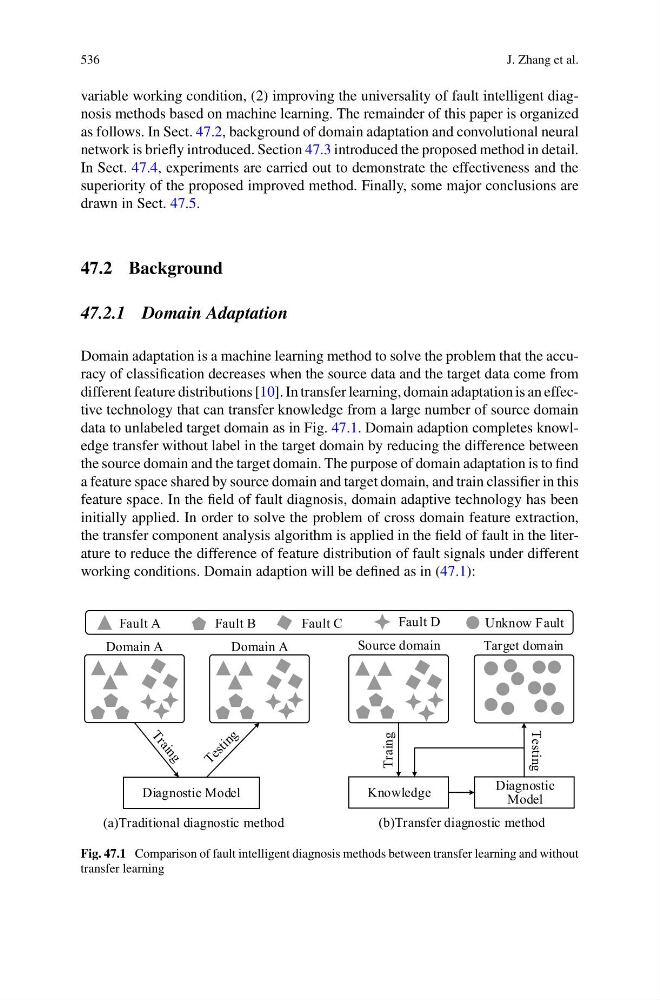
data to unlabeled target domain as in Fig. 47.1. Domain adaption completes knowledge transfer without label in the target domain by reducing the difference between
the source domain and the target domain. The purpose of domain adaptation is to find
a feature space shared by source domain and target domain, and train classifier in this
feature space. In the field of fault diagnosis, domain adaptive technology has been
initially applied. In order to solve the problem of cross domain feature extraction,
the transfer component analysis algorithm is applied in the field of fault in the literature to reduce the difference of feature distribution of fault signals under different
working conditions. Domain adaption will be defined as in (47.1):
Domain A
Source domain
Diagnostic Model
Domain A
Diagnostic
Model
Traing
Testing
Knowledge
Target domain
Fault A
Fault B
Fault C
Fault D
Unknow Fault
(a)Traditional diagnostic method
(b)Transfer diagnostic method
Fig. 47.1 Comparison of fault intelligent diagnosis methods between transfer learning and without
transfer learning
J. Zhang et al.
variable working condition, (2) improving the universality of fault intelligent diagnosis methods based on machine learning. The remainder of this paper is organized
as follows. In Sect. 47.2, background of domain adaptation and convolutional neural
network is briefly introduced. Section 47.3 introduced the proposed method in detail.
In Sect. 47.4, experiments are carried out to demonstrate the effectiveness and the
superiority of the proposed improved method. Finally, some major conclusions are
drawn in Sect. 47.5.
47.2 Background
47.2.1 Domain Adaptation
Domain adaptation is a machine learning method to solve the problem that the accuracy of classification decreases when the source data and the target data come from
different feature distributions [10]. In transfer learning, domain adaptation is an effective technology that can transfer knowledge from a large number of source domain
data to unlabeled target domain as in Fig. 47.1. Domain adaption completes knowledge transfer without label in the target domain by reducing the difference between
the source domain and the target domain. The purpose of domain adaptation is to find
a feature space shared by source domain and target domain, and train classifier in this
feature space. In the field of fault diagnosis, domain adaptive technology has been
initially applied. In order to solve the problem of cross domain feature extraction,
the transfer component analysis algorithm is applied in the field of fault in the literature to reduce the difference of feature distribution of fault signals under different
working conditions. Domain adaption will be defined as in (47.1):
Domain A
Source domain
Diagnostic Model
Domain A
Diagnostic
Model
Traing
Testing
Knowledge
Target domain
Fault A
Fault B
Fault C
Fault D
Unknow Fault
(a)Traditional diagnostic method
(b)Transfer diagnostic method
Fig. 47.1 Comparison of fault intelligent diagnosis methods between transfer learning and without
transfer learning