

41 Study of Acoustic Emission Response to Vortex …
467
on the pipe wall which can be recorded by an acoustic sensor. The extensive literature [3–5] on flow over a bluff body and the equations are helpful to estimate the lift
force and vortex shedding, while the numerical and experimental study is beneficial
to estimate the AE detectability.
41.2 Method
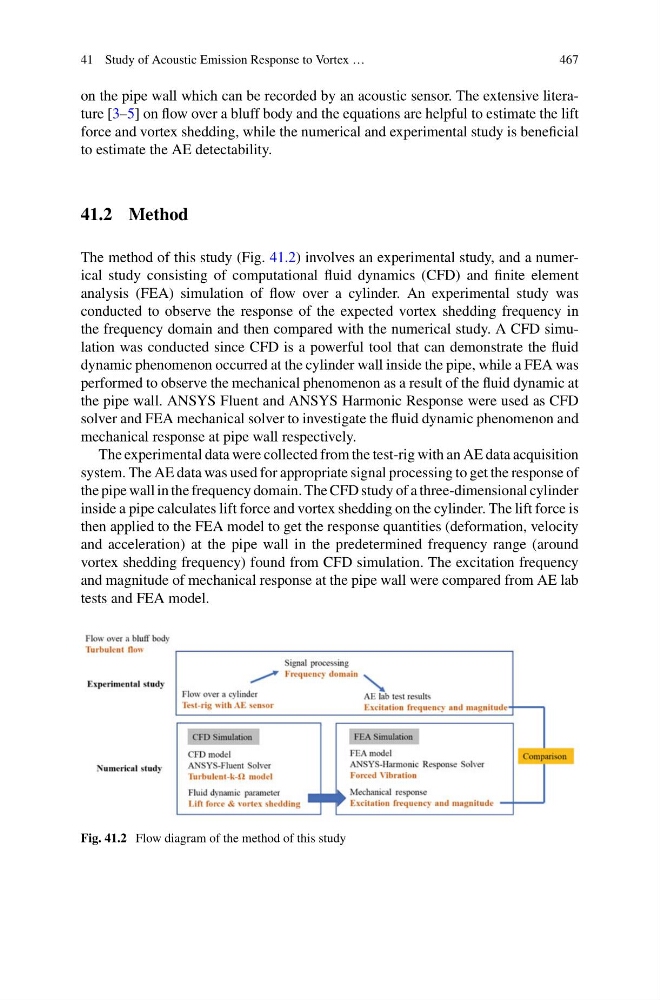
The method of this study (Fig. 41.2) involves an experimental study, and a numerical study consisting of computational fluid dynamics (CFD) and finite element
analysis (FEA) simulation of flow over a cylinder. An experimental study was
conducted to observe the response of the expected vortex shedding frequency in
the frequency domain and then compared with the numerical study. A CFD simulation was conducted since CFD is a powerful tool that can demonstrate the fluid
dynamic phenomenon occurred at the cylinder wall inside the pipe, while a FEA was
performed to observe the mechanical phenomenon as a result of the fluid dynamic at
the pipe wall. ANSYS Fluent and ANSYS Harmonic Response were used as CFD
solver and FEA mechanical solver to investigate the fluid dynamic phenomenon and
mechanical response at pipe wall respectively.
The experimental data were collected from the test-rig with an AE data acquisition
system. The AE data was used for appropriate signal processing to get the response of
the pipe wall in the frequency domain. The CFD study of a three-dimensional cylinder
inside a pipe calculates lift force and vortex shedding on the cylinder. The lift force is
then applied to the FEA model to get the response quantities (deformation, velocity
and acceleration) at the pipe wall in the predetermined frequency range (around
vortex shedding frequency) found from CFD simulation. The excitation frequency
and magnitude of mechanical response at the pipe wall were compared from AE lab
tests and FEA model.
Fig. 41.2 Flow diagram of the method of this study
467
on the pipe wall which can be recorded by an acoustic sensor. The extensive literature [3–5] on flow over a bluff body and the equations are helpful to estimate the lift
force and vortex shedding, while the numerical and experimental study is beneficial
to estimate the AE detectability.
41.2 Method
The method of this study (Fig. 41.2) involves an experimental study, and a numerical study consisting of computational fluid dynamics (CFD) and finite element
analysis (FEA) simulation of flow over a cylinder. An experimental study was
conducted to observe the response of the expected vortex shedding frequency in
the frequency domain and then compared with the numerical study. A CFD simulation was conducted since CFD is a powerful tool that can demonstrate the fluid
dynamic phenomenon occurred at the cylinder wall inside the pipe, while a FEA was
performed to observe the mechanical phenomenon as a result of the fluid dynamic at
the pipe wall. ANSYS Fluent and ANSYS Harmonic Response were used as CFD
solver and FEA mechanical solver to investigate the fluid dynamic phenomenon and
mechanical response at pipe wall respectively.
The experimental data were collected from the test-rig with an AE data acquisition
system. The AE data was used for appropriate signal processing to get the response of
the pipe wall in the frequency domain. The CFD study of a three-dimensional cylinder
inside a pipe calculates lift force and vortex shedding on the cylinder. The lift force is
then applied to the FEA model to get the response quantities (deformation, velocity
and acceleration) at the pipe wall in the predetermined frequency range (around
vortex shedding frequency) found from CFD simulation. The excitation frequency
and magnitude of mechanical response at the pipe wall were compared from AE lab
tests and FEA model.
Fig. 41.2 Flow diagram of the method of this study