

466
F. Zohora et al.
body. Flow over a bluff is a classical problem in the fluid dynamic research area
and has practical engineering applications. Flow over high-rise buildings, marine
risers, bridges, cooling towers, chimneys, airfoils, tube bankers in heat exchangers,
are a few of many practical engineering examples of flow over a bluff body. This
type of flow often includes many complex fluid phenomena such as vortex shedding,
wake flow, separation and high turbulence [2]. When the flow is obstructed by a
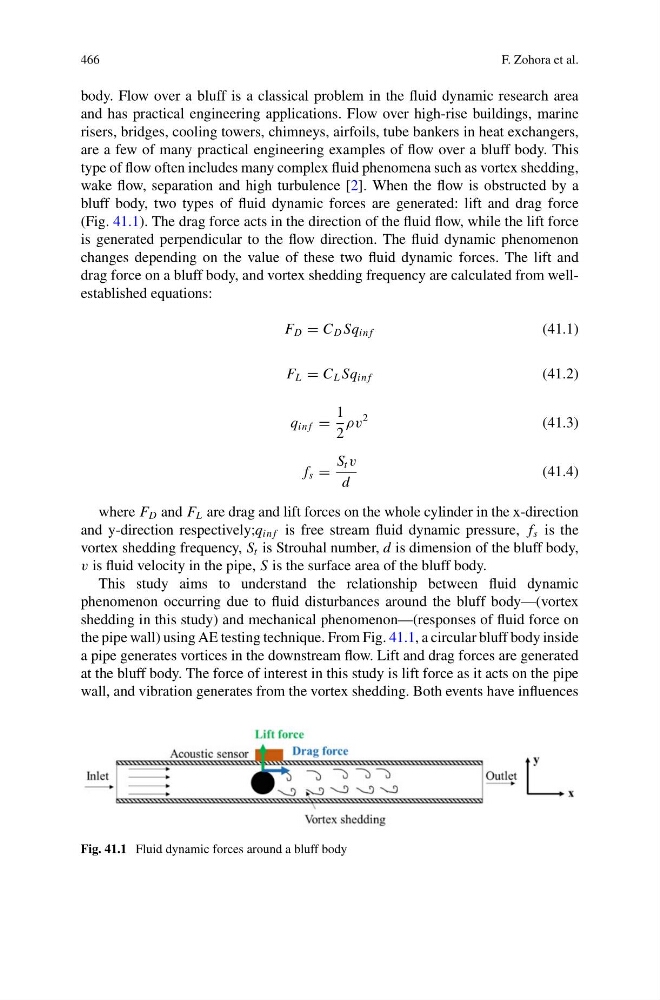
bluff body, two types of fluid dynamic forces are generated: lift and drag force
(Fig. 41.1). The drag force acts in the direction of the fluid flow, while the lift force
is generated perpendicular to the flow direction. The fluid dynamic phenomenon
changes depending on the value of these two fluid dynamic forces. The lift and
drag force on a bluff body, and vortex shedding frequency are calculated from wellestablished equations:
F D = C D Sq in f
(41.1)
F L = C L Sq in f
(41.2)
q in f =
1
2
ρv
2
(41.3)
f s =
S t v
d
(41.4)
where F D and F L are drag and lift forces on the whole cylinder in the x-direction
and y-direction respectively;q in f is free stream fluid dynamic pressure, f s is the
vortex shedding frequency, S t is Strouhal number, d is dimension of the bluff body,
v is fluid velocity in the pipe, S is the surface area of the bluff body.
This study aims to understand the relationship between fluid dynamic
phenomenon occurring due to fluid disturbances around the bluff body—(vortex
shedding in this study) and mechanical phenomenon—(responses of fluid force on
the pipe wall) using AE testing technique. From Fig. 41.1, a circular bluff body inside
a pipe generates vortices in the downstream flow. Lift and drag forces are generated
at the bluff body. The force of interest in this study is lift force as it acts on the pipe
wall, and vibration generates from the vortex shedding. Both events have influences
Fig. 41.1 Fluid dynamic forces around a bluff body
F. Zohora et al.
body. Flow over a bluff is a classical problem in the fluid dynamic research area
and has practical engineering applications. Flow over high-rise buildings, marine
risers, bridges, cooling towers, chimneys, airfoils, tube bankers in heat exchangers,
are a few of many practical engineering examples of flow over a bluff body. This
type of flow often includes many complex fluid phenomena such as vortex shedding,
wake flow, separation and high turbulence [2]. When the flow is obstructed by a
bluff body, two types of fluid dynamic forces are generated: lift and drag force
(Fig. 41.1). The drag force acts in the direction of the fluid flow, while the lift force
is generated perpendicular to the flow direction. The fluid dynamic phenomenon
changes depending on the value of these two fluid dynamic forces. The lift and
drag force on a bluff body, and vortex shedding frequency are calculated from wellestablished equations:
F D = C D Sq in f
(41.1)
F L = C L Sq in f
(41.2)
q in f =
1
2
ρv
2
(41.3)
f s =
S t v
d
(41.4)
where F D and F L are drag and lift forces on the whole cylinder in the x-direction
and y-direction respectively;q in f is free stream fluid dynamic pressure, f s is the
vortex shedding frequency, S t is Strouhal number, d is dimension of the bluff body,
v is fluid velocity in the pipe, S is the surface area of the bluff body.
This study aims to understand the relationship between fluid dynamic
phenomenon occurring due to fluid disturbances around the bluff body—(vortex
shedding in this study) and mechanical phenomenon—(responses of fluid force on
the pipe wall) using AE testing technique. From Fig. 41.1, a circular bluff body inside
a pipe generates vortices in the downstream flow. Lift and drag forces are generated
at the bluff body. The force of interest in this study is lift force as it acts on the pipe
wall, and vibration generates from the vortex shedding. Both events have influences
Fig. 41.1 Fluid dynamic forces around a bluff body